Guides
Learn to crochet: a step-by-step beginner's guide from first loop to first project
All you need is one 5 mm (US H-8) hook, one ball of smooth, light-coloured yarn and some patient practice. Work through the seven stages in order: supplies, first movements, the basic stitches, rows and edges, reading patterns, finishing, then your first project. Every lesson opens on its own page, and you can tick lessons off as you go.
- stages
- 7
- lessons
- 20
- guides
- 21
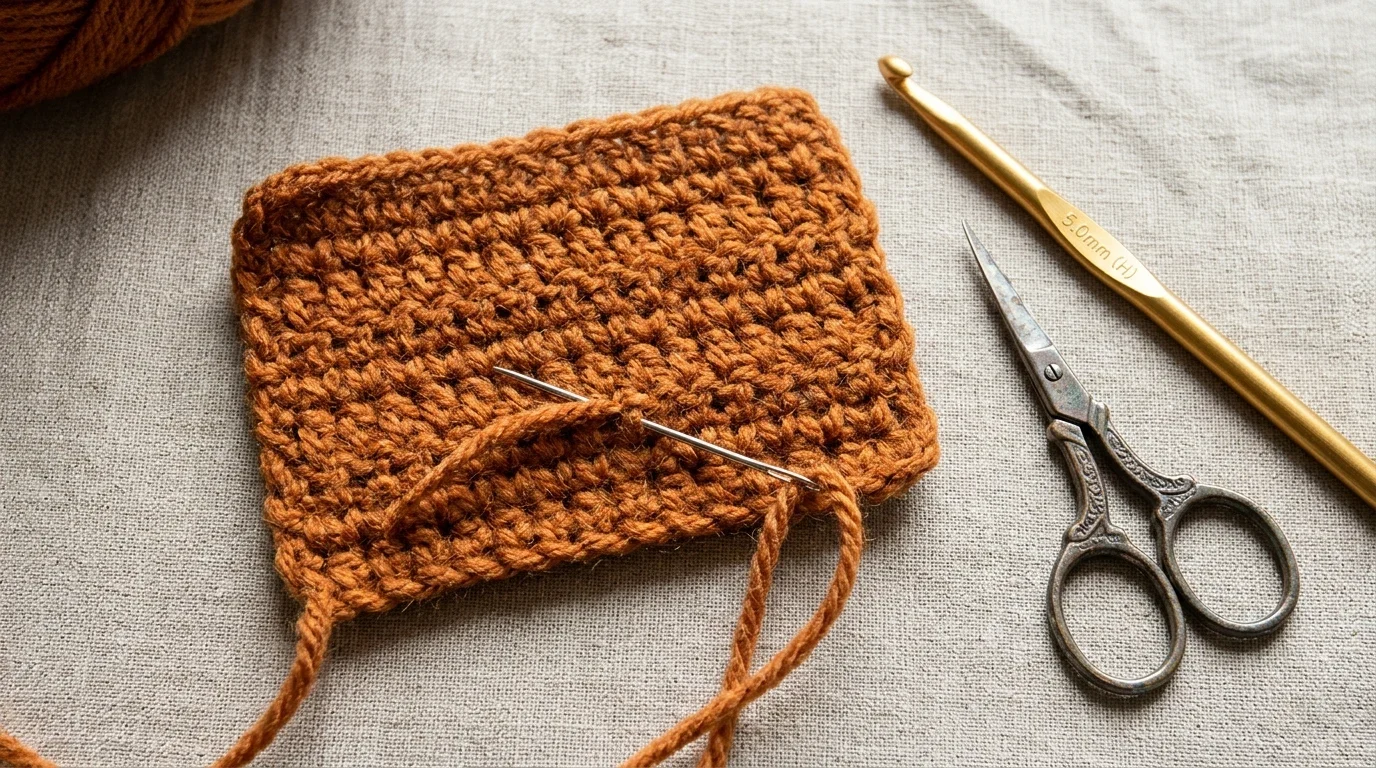
Stage 1 of 7
Stage 1: Getting started: what you need to begin crocheting
Four things and a little patience. Choosing easy yarn now saves hours of frustration later.
A 5 mm (US H-8) crochet hook
A comfortable middle size for worsted yarn. A cushioned handle helps if your hand tires.
One ball of smooth, light-coloured worsted (#4) yarn
Acrylic or cotton in a solid pale colour, so you can see every loop.
A blunt tapestry (yarn) needle
For weaving in the yarn ends when you finish.
Scissors, plus a few stitch markers
Markers in the first and last stitch of a row keep your edges straight. Safety pins or scraps of yarn work too.
Avoid on day one
Skip these until you can read your stitches: dark or black yarn, fluffy, fuzzy or novelty yarn such as chenille, yarn that splits easily, and yarn that changes colour along its length. They all hide the loops you need to see.
- Lesson 1.1
Beginner crochet supplies and choosing yarn
The four-item starter kit, how to read a yarn label, and which yarns to avoid at first.
- Lesson 1.2
Understanding yarn weights
What the numbers 0 to 7 on a yarn label mean and which weight to start with.
- Lesson 1.3
Crochet hook sizes and which hook to buy
Why a 5 mm (H-8) hook is the usual first hook, with the full size chart.
Stage 2 of 7
Stage 2: First movements: holding the hook, the slip knot and the foundation chain
Get comfortable holding the hook and yarn, then make your first chain. Do not worry about speed; even tension comes with practice.
The three counting rules
- Never count the slip knot as a stitch.
- Never count the loop that is on your hook.
- The foundation chain is not a row. Row 1 is the first row of stitches worked into it.
- Lesson 2.1
How to hold a crochet hook and yarn
Pencil grip, knife grip and a relaxed yarn hold that keeps your tension even.
- Lesson 2.2
How to make a slip knot
The adjustable starting loop, and why it never counts as a stitch.
- Lesson 2.3
How to make and count a foundation chain
The chain stitch, the front V and back bump, and how to count without mistakes.
Stage 3 of 7
Stage 3: The essential crochet stitches, in order of height
Each basic stitch is a little taller than the one before. Learn single crochet first, then half double and double crochet.
| Stitch (US) | UK name | First stitch of row 1 |
|---|---|---|
Slip stitch sl st | Slip stitch ss | Into the stitch |
Single crochet sc | Double crochet dc | 2nd chain from the hook |
Half double crochet hdc | Half treble crochet htr | 3rd chain from the hook |
Double crochet dc | Treble crochet tr | 4th chain from the hook |
Treble crochet tr | Double treble crochet dtr | 5th chain from the hook |
- Lesson 3.1
How to single crochet (sc, UK dc)
Your first real stitch: short, dense and worked into the 2nd chain from the hook.
- Lesson 3.2
How to half double crochet (hdc, UK htr)
One yarn over, then pull through all three loops at once.
- Lesson 3.3
How to double crochet (dc, UK tr)
The tall, quick stitch behind granny squares, blankets and scarves.
- Lesson 3.4
How to slip stitch (sl st)
The stitch with no height, used to join rounds and move across your work.
Stage 4 of 7
Stage 4: Working rows: turning chains, row 2 and straight edges
The end of the first row is where most beginners get stuck. Learn where the first and last stitch of each row go, and your edges stay straight.
| Stitch | Turning chain | Counts as a stitch? | First stitch goes into |
|---|---|---|---|
| single crochet (sc)UK double crochet (dc) | Chain 1 | Usually no | The very first stitch |
| half double crochet (hdc)UK half treble (htr) | Chain 2 | Usually no | The very first stitch |
| double crochet (dc)UK treble (tr) | Chain 3 | Usually yes | The second stitch (last stitch: top of the turning chain) |
| treble crochet (tr)UK double treble (dtr) | Chain 4 | Usually yes | The second stitch (last stitch: top of the turning chain) |
- Lesson 4.1
How to crochet the second row and use turning chains
Turning chain rules for each stitch, and where the first and last stitch of row 2 go.
- Lesson 4.2
How to count crochet stitches and rows
Count the tops and posts of your stitches so you never add or lose one.
- Lesson 4.3
How to get straight edges
Fix edges that slant in, pull out or leave gaps.
- Lesson 4.4
How to make a magic ring and crochet in the round
Start flat circles, coasters and hats without a hole in the middle.
Stage 5 of 7
Stage 5: Reading crochet patterns, abbreviations and US vs UK terms
Patterns are written in a short code. A dozen abbreviations and a few punctuation rules cover almost every beginner pattern.
Read a pattern row, piece by piece
Row 2: Ch 1, turn. *Sc in next 2 sts, 2 sc in next st; rep from * across. (16 sc)
Ch 1, turn- Make the turning chain, then turn your work over.
*- Start of the part to repeat.
Sc in next 2 sts, 2 sc in next st- The repeat: one single crochet in each of the next two stitches, then two in the following stitch (an increase).
rep from * across- Go back to the asterisk and keep repeating until the end of the row.
(16 sc)- The stitch count you should have at the end of the row. Count to check; do not work 16 more.
ch | chain |
|---|---|
sl st | slip stitch |
sc | single crochet (UK dc) |
hdc | half double crochet (UK htr) |
dc | double crochet (UK tr) |
tr | treble crochet (UK dtr) |
st(s) | stitch(es) |
sp | space, usually a chain space |
inc | increase: 2 stitches in one stitch |
dec | decrease: 2 stitches worked together into one |
rep | repeat |
FO | fasten off |
- Lesson 5.1
How to read a crochet pattern
Abbreviations, asterisks, brackets and stitch counts, line by line.
- Lesson 5.2
US vs UK crochet terms
Why a US double crochet is a UK treble, and how to tell which terms a pattern uses.
- Lesson 5.3
How to measure crochet gauge
Make and measure a swatch so a project comes out the right size.
Stage 6 of 7
Stage 6: Finishing your work and fixing beginner mistakes
Fasten off so nothing unravels, weave in the ends, and learn the quick fixes for the most common problems.
| Problem | Why it happens | Quick fix |
|---|---|---|
| Rows get wider and wider | An extra stitch at the start, often in the stitch under the turning chain | Check the turning chain rule for your stitch and put a marker in the first stitch of each row. |
| Rows get narrower and narrower | The last stitch of the row is missed | Put a marker in the last stitch and work into it every row. |
| The foundation chain is too tight to work into | Chains made on the narrow throat of the hook, or tight tension | Slide each loop up onto the shaft, or make the chain with a hook one size larger. |
| The fabric is stiff | Tension too tight, or a hook too small for the yarn | Relax your grip, or try a hook one size up. |
| Yarn keeps splitting | The hook catches between plies | Slow down, keep the hook pointing slightly down as it goes in, or try a smoother yarn or blunter hook. |
- Lesson 6.1
How to fasten off and weave in ends
Finish your last stitch securely and hide the yarn tails so they stay put.
- Lesson 6.2
Common beginner crochet mistakes and how to fix them
Growing or shrinking rows, tight chains, curling edges and more.
- Lesson 6.3
Why is my blanket turning into a triangle?
The two stitch-count mistakes that make work slant, and how to stop them.
Stage 7 of 7
Stage 7: Make your first crochet project
Pick the project that suits your patience: a quick coaster, a practical dishcloth, or a scarf or granny square.
- Path A
Quick win: a round or square coaster
A small piece you can finish in one sitting. Practise rounds with the double crochet coaster, or rows of single crochet for a square.
Stitches:
Open the patternch, sc or dc - Path B
Practical classic: a cotton dishcloth
Flat rows of one stitch. Even if the edges wobble, it still washes dishes.
Stitches:
Open the patternch, dc - Path C
Wearable or motif: a scarf or a granny square
A first scarf in rows of double crochet, or a classic granny square worked in rounds.
Stitches:
Open the patternch, dc, sl st
Tools
Helpful crochet calculators for beginners
Guide topics
US & UK Terms
1 guideHow US and UK crochet terms differ, and how to convert between them.
View all in US & UK TermsCrochet for Beginners
5 guidesWhere to start: first stitches, reading patterns and common mistakes.
- How to Crochet the Second Row (Turning Chain and First Stitch)
- How to Hold a Crochet Hook and Yarn (Pencil Grip, Knife Grip, and Tension)
- How to Read a Crochet Pattern: Step-by-Step Beginner's Guide
- How to Double Crochet Left-Handed: Step-by-Step Guide
Working in the Round
2 guidesMagic rings, circles and squares worked in rounds.
- How to Double Crochet in the Round: Flat Circle Math, Magic Ring & Seamless Joins
- How to Make a Magic Ring (Magic Circle) in Crochet
Troubleshooting
4 guidesFix common crochet problems: wonky edges, blankets that shrink or flare, and uneven tension.
- How to Fix Double Crochet Tension Problems & Row Height
- Common Beginner Crochet Mistakes (and How to Fix Each One)
- Why Is My Crochet Blanket Turning into a Triangle? How to Find and Fix Missing Stitches
- How to Get Straight Edges in Double Crochet: 3 Reliable Turning Methods Compared


All guides
All crochet guides, newest first








FAQ
Frequently asked questions about learning to crochet
How long does it take to learn to crochet?
Most people can make a chain and a few rows of single crochet in their first session. Even tension and confident counting take a few weeks of regular practice. Short daily sessions work better than one long one.
Is crochet easier than knitting?
Many beginners find crochet easier to start, because there is only one live loop on the hook, so mistakes are easy to undo. Knitting suits other people better. Try both if you are unsure.
How do I learn to crochet if I am left-handed?
Hold the hook in your left hand and the yarn in your right, and work from left to right. The steps are the same, mirrored. Holding a phone or mirror beside a right-handed photo or video can help you follow along.
How do I stop in the middle of a row without it unravelling?
Take the hook out, then pull the loop that was on it a few inches longer, or put a stitch marker or safety pin through it. The loop cannot pull back through, and you can carry on later.
Why is my first row shorter than my chain?
Stitches pull the chain in a little, and a tight chain makes it worse. Make the chain loosely, or with a hook one size larger, and the first row will match it more closely.
Which stitch should I learn first?
The chain, then single crochet. Single crochet is short and easy to count, so you learn where to put the hook before moving on to taller stitches.
What next