US vs. UK Crochet Terms: Complete Stitch Conversion Chart
Why US and UK patterns use the same words for different stitches, with full conversion charts and five clues to identify any pattern.

5 min read

The single biggest point of confusion in international crochet is that US and UK crochet patterns use the exact same stitch names to describe different stitches. Fortunately, the rule is simple: every UK stitch name is offset by one step higher than its US equivalent. What American crocheters call a single crochet (sc) is called a double crochet (dc) in the UK, and what Americans call a double crochet (dc) is called a treble crochet (tr) in the UK. The physical hand movements and universal chart symbols never change—only the regional label shifts by one rung on the stitch ladder.
Need to translate a full written pattern automatically? Paste your pattern lines into our interactive US to UK crochet terms converter to convert every stitch abbreviation in one click.
Master Conversion Chart: US vs. UK Crochet Stitches
Bookmark this table whenever you work from a British, Australian, or American pattern. Notice that chain (ch) and slip stitch (sl st / ss) are the only two basic stitches that share the same name worldwide—every taller stitch shifts by one step:

Universal Symbol | US Stitch Name | US Abbrev. | UK Stitch Name | UK Abbrev. | Initial Yarn Overs | Typical Turning Chain |
|---|---|---|---|---|---|---|
Oval ( |
| Chain |
| — | — | |
Dot ( |
| Slip Stitch |
|
| — | |
Cross ( |
| Double Crochet |
|
|
| |
Plain T ( |
| Half Treble Crochet |
|
|
| |
T with 1 Bar ( |
| Treble Crochet |
|
|
| |
T with 2 Bars |
| Double Treble Crochet |
|
|
| |
T with 3 Bars | Double Treble Crochet |
| Triple Treble Crochet |
|
|
|
Textured, Post, and Decrease Stitch Conversions (US vs. UK)
The one-step offset also applies to decreases, clusters, and post stitches:
US Specialty Term & Abbrev. | UK Specialty Term & Abbrev. | Tutorial Link |
|---|---|---|
Single Crochet 2 Together ( | Double Crochet 2 Together ( | — |
Treble 2 Together ( | ||
Raised Treble Front ( | ||
Raised Treble Back ( | ||
Extended Treble Crochet ( | ||
Linked Treble Crochet ( | ||
Foundation Treble Crochet ( | ||
Back Loop Only / Front Loop Only ( | Back Loop Only / Front Loop Only ( |
Pattern Vocabulary & Action Terms (US vs. UK)
Beyond stitch names, British and American patterns use different everyday words for pattern actions and measurements:
US Pattern Term | UK Pattern Term | What It Means |
|---|---|---|
Tension | Number of stitches and rows per | |
Skip ( | Miss ( | Pass over the next stitch(es) without working into them |
Yarn Over ( | Yarn Over Hook ( | Wrap the working yarn from back to front over the hook |
Cast Off or Fasten Off | Cut yarn and pull tail through final loop to lock the stitch | |
Skein / Hank | Ball / Hank | Put-up of yarn |
Color / Center / Inches | Colour / Centre / Centimetres ( | Regional spelling and measurement units |
Why Are US and UK Crochet Terms Different? (Loops vs. Yarn-Overs)
Why do two English-speaking traditions call the exact same stitch by two different names? As crochet patterns were standardized in print during the 19th century, British and American publishers counted two different parts of the stitch anatomy:

- UK Logic (Counts Loops on the Hook After Pulling Up a Loop):
- When you insert your hook into a stitch and pull up a loop without yarning over first, you have 2 loops on your hook—so British terminology named it double crochet (
dc). - When you yarn over first, insert your hook, and pull up a loop, you have 3 loops on your hook—so British terminology named it treble crochet (
tr).
- When you insert your hook into a stitch and pull up a loop without yarning over first, you have 2 loops on your hook—so British terminology named it double crochet (
- US Logic (Counts Main Pull-Through Completions / Yarn-Overs):
- Because the shortest stitch is finished with 1 single pull-through (
yo, pull through 2), American publishers named it single crochet (sc). - Because the next full stitch is finished with 2 pull-throughs of two loops (
[yo, pull through 2] twice), American publishers named it double crochet (dc).
- Because the shortest stitch is finished with 1 single pull-through (
What Happens If You Mix Up Double Crochet UK and US Double Crochet?

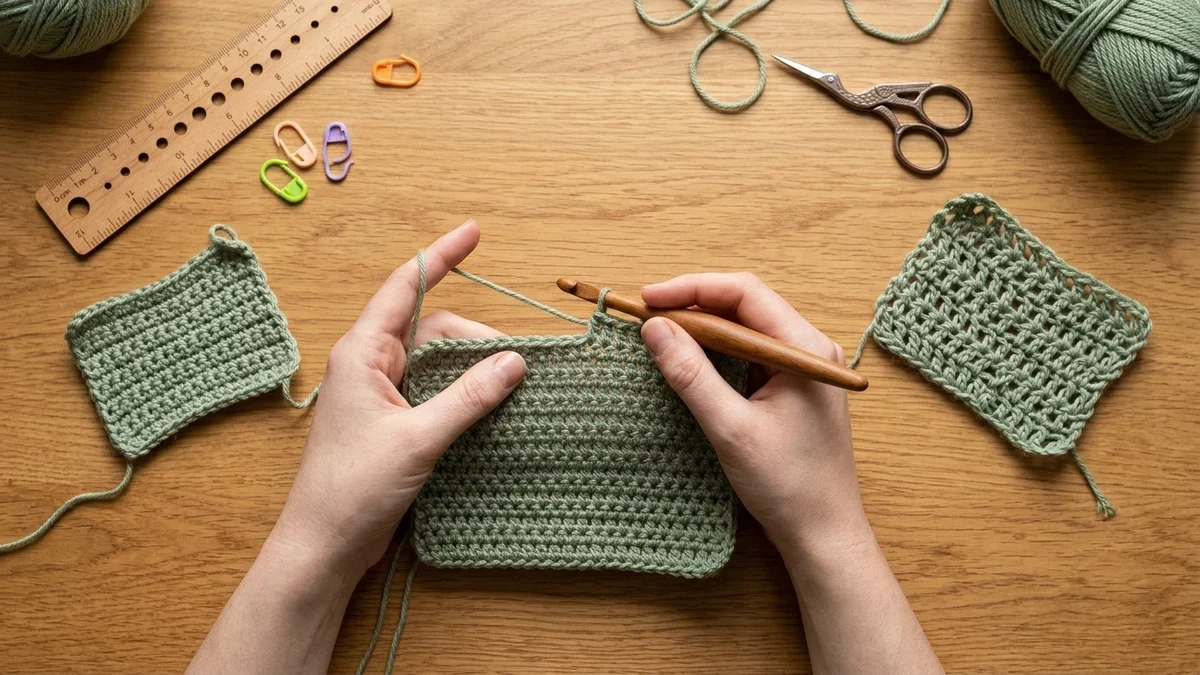
As shown in the comparison photo above, if you follow a US pattern that says "work 3 dc clusters" but you accidentally work UK double crochets (US sc), your granny square or blanket will turn out roughly half as tall, dense, and stiff. Conversely, if you follow a UK amigurumi pattern that says "work 6 dc in magic ring" and you work US double crochets (UK tr), your toy will have tall, gappy stitches where the stuffing pokes out!
5 Instant Clues: How to Tell If a Pattern Uses US or UK Terms
Most modern patterns state their terminology near the materials list, but if you find a vintage pattern or blog post that doesn't say, check these five instant clues:

- Look for
"sc"(Single Crochet): If the pattern uses single crochet (sc) or half double crochet (hdc) anywhere in the instructions, it is 100% in US terms. The term "single crochet" does not exist in modern UK crochet terminology. - Look for
"htr"(Half Treble) or"dtr"(Double Treble): If the pattern uses half treble (htr), double treble (dtr), or tells you to "miss 1 st" instead of"skip 1 st", it is 100% in UK terms. - Check Which Chain Row 1 Starts In:
- If Row 1 says
"dc in 2nd ch from hook", it is UK terms (because UKdcis a short single crochet). - If Row 1 says
"dc in 4th ch from hook", it is US terms (because 3 skipped chains equal the height of a tall USdc).
- If Row 1 says
- Check the Turning Chain Height: A row of
dcthat starts withch 1is UK double crochet; a row ofdcthat starts withch 3is US double crochet. - Check Yarn & Hook Naming Conventions: UK and Australian patterns typically list yarn weights as 4-Ply, DK (8-Ply), or Aran and list crochet hooks in metric millimeters (
4.0 mm,5.0 mm), whereas US patterns list Fingering (#1), Sport (#2), DK (#3), Worsted (#4) and include US letter codes (G-6,H-8,I-9).
Frequently Asked Questions (FAQ)
What is double crochet UK in US terms?
A UK double crochet (dc) is the exact same stitch as a US single crochet (sc): insert hook into stitch, yarn over, pull up a loop (2 loops on hook), yarn over, and pull through both loops.
What is a US double crochet called in the UK?
A US double crochet (dc) (yarn over, insert hook, pull up a loop, [yarn over, pull through 2] twice) is called a treble crochet (tr) in the UK, Australia, and New Zealand.
Do Canadian and Australian patterns use US or UK crochet terms?
- Canada: Uses US crochet terms (
sc,hdc,dc,tr). - United Kingdom, Ireland, Australia & New Zealand: Traditionally use UK crochet terms (
dc,htr,tr,dtr), though many independent Australian and European designers publish two PDF versions (one US, one UK) for international makers.


Questions & notes
No comments yet
Sign in or create a free account to comment under your profile and keep track of your replies.
Your email address is never published. Comments are moderated under our Community Guidelines; see our Privacy Policy for how we use your details.