Foundation Double Crochet (FDC) Tutorial: How to Crochet Without a Starting Chain
Build the chain and the first row of double crochet at the same time, for a stretchy bottom edge and no twisted chain.

13 min read

Stitch at a glance
- US terms
- Foundation double crochet
fdc - UK terms
- Foundation treble crochet
ftr
If you ask a room full of experienced crocheters to name their least favorite five minutes of any large blanket or sweater project, almost everyone will give the same answer: counting out a long, fragile starting chain of 200 stitches and then trying to work Row 1 back across it without twisting the chain or pinching the bottom edge tight.
Even when you switch to a larger hook for your starting chain, a row of simple chain stitches has very little horizontal elasticity compared to a row of finished double crochet stitches. That mismatch is why the bottom hem of a bottom-up cardigan often feels restrictive around the hips, and why the starting edge of a throw blanket bows inward like a crescent moon.
The Foundation Double Crochet (abbreviated fdc or FDC) solves both frustrations in a single stroke. Instead of making an entire chain and then working back across it, FDC builds the base chain link and the vertical double crochet post at the exact same time, stitch by stitch, from right to left (or left to right for left-handed crocheters).
In this tutorial, we will walk step by step through the anatomy of your first and second Foundation Double Crochet stitches, show you how to convert any standard pattern's starting-chain count into an exact FDC count, and point out the few project types where you should still stick with a traditional chain.
US vs. UK Terminology Note
In US crochet terminology, this technique is called Foundation Double Crochet (fdc). In UK crochet terminology, where a US double crochet is known as a treble crochet, this exact same technique is called Foundation Treble Crochet (ftr). If you are adapting a UK pattern, use our US vs. UK Crochet Terms Reference to confirm your stitch equivalents before starting.
Why Foundation Double Crochet Outperforms a Traditional Starting Chain
Learning Foundation Double Crochet feels slightly awkward for the first ten stitches because your fabric grows horizontally out of the side of your hook rather than stacking on top of an existing row. Once your fingers find the rhythm, however, FDC offers four major structural advantages:
- Identical Top-and-Bottom Elasticity: Because every FDC stitch contains its own generously sized base chain loop at the bottom and a normal double crochet V at the top, the bottom edge of your project stretches at the exact same rate as the rest of your fabric.
- Easy Width Checks Without Recounting 200 Chains: With a traditional chain, you cannot accurately measure the true width of your blanket until you have completed Row 1, because working stitches into a chain expands or contracts its length. With FDC, you are creating finished Row 1 height and width as you go—meaning you can simply hold your FDC strip up against a sofa cushion or your shoulders and stop when it is wide enough!
- Zero Risk of a Twisted Starting Chain: When joining a long starting chain in the round for a top-down sweater yoke or infinity cowl, a single 180-degree twist in the chain forces you to rip out the entire first round. An FDC ribbon is nearly an inch tall, making it effortless to lay flat and join in the round without twisting (and you easily close the tiny gap at the base using the starting yarn tail).
- No Hunting for Tiny Back Bumps: You never have to squint at tight chain loops or struggle to insert a large hook under a tiny back horizontal bar.
Anatomy of an FDC Stitch: The "Base Chain" vs. The "Stitch Post"
To understand why Foundation Double Crochet works, compare the yarn-over pull-through sequence of a standard double crochet with an FDC stitch:
- Standard Double Crochet (2 Pull-Throughs):
- Yarn over, insert hook into stitch, yarn over, and pull up a loop (
3 loops on hook). - Yarn over and pull through 2 loops (
2 loops on hook). - Yarn over and pull through 2 loops (
1 loop on hook).
- Yarn over, insert hook into stitch, yarn over, and pull up a loop (
- Foundation Double Crochet (3 Pull-Throughs):
- Yarn over, insert hook into the base of the previous stitch, yarn over, and pull up a loop (
3 loops on hook). - The Extra Step (Creating the Chain Base): Yarn over and pull through 1 loop only (
still 3 loops on hook). That single loop you just created is the "chain stitch" at the bottom of your new stitch! - Creating the Double Crochet Post: Yarn over and pull through 2 loops (
2 loops on hook), then yarn over and pull through the remaining 2 loops (1 loop on hook).
- Yarn over, insert hook into the base of the previous stitch, yarn over, and pull up a loop (
As explained in foundation stitch tutorials by Hooks, Books, & Wanderlust and OkieGirlBling'n'Things, the entire secret of FDC is remembering that "Pull through 1" builds the chain at the bottom, and "Pull through 2, pull through 2" builds the double crochet on top.
Step-by-Step Tutorial: How to Work Your First and Second FDC Stitches
Grab a smooth, light-colored worsted yarn (CYC Category 4), a 5.5 mm (US I-9) hook, and one locking stitch marker. Using a stitch marker on your first few attempts takes all the mystery out of where to insert your hook.
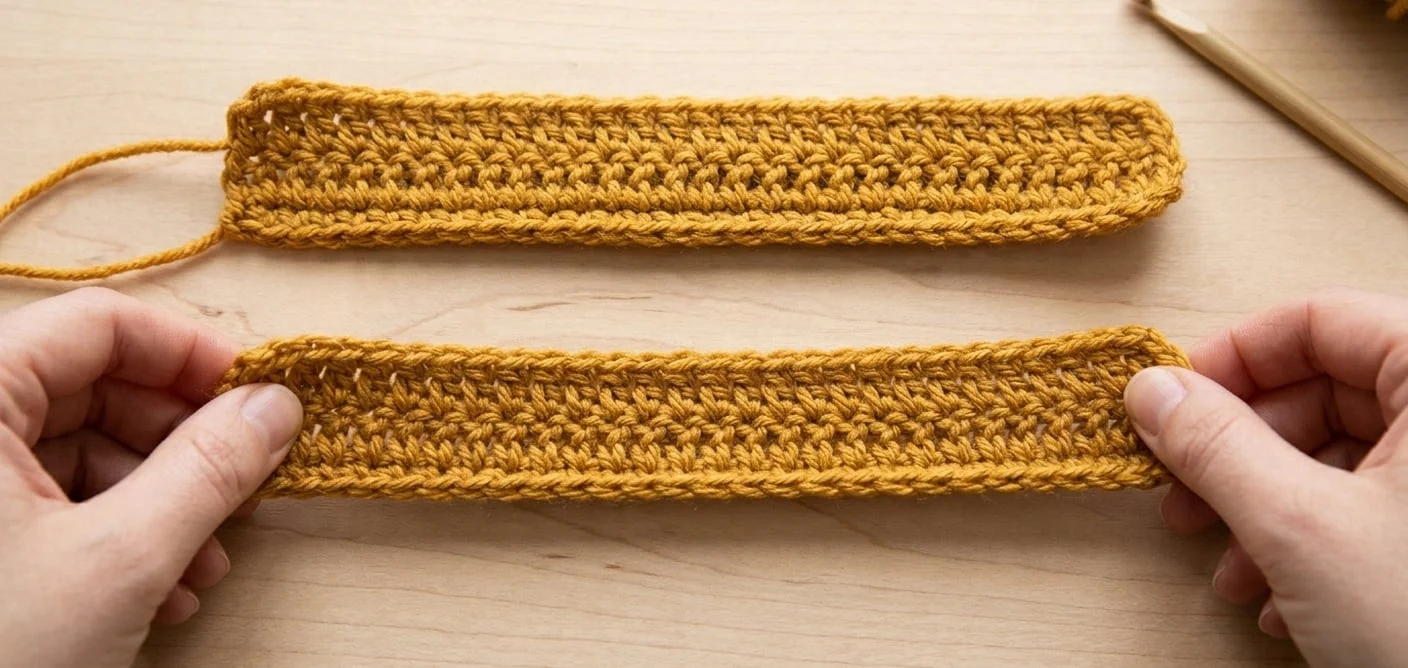
Part A: Making the Very First FDC Stitch
- Make a Slip Knot and Chain 3: Place a slip knot on your hook and make 3 chain stitches (
ch 3). (Note: Some crocheters prefer starting withch 2if they work shorter stitches, butch 3is standard as the first chain forms the base of Stitch #1 and the upper two chains form the side edge.) - Yarn Over and Insert into the First Chain: Yarn over, then insert your hook into the very first chain you made (the 3rd chain from the hook, right next to your slip knot). For the sturdiest edge, insert your hook under two strands of that chain (the top loop and the back bump).
- Pull Up a Loop: Yarn over and pull up a loop through the chain. You now have 3 loops on your hook.
- Make the Chain Base (Pull Through 1): Yarn over and pull through only the first loop on your hook. You still have 3 loops on your hook, and you have just created a little "V" link sitting underneath the first loop.
- Beginner Pro Tip: Pause right here and clip your locking stitch marker under the two strands of that newly formed bottom "V" link! That marked link is the exact spot where your hook will go for Stitch #2.
- Complete the Double Crochet Post: Yarn over and pull through 2 loops (
2 loops remain on hook). Yarn over and pull through the last 2 loops (1 working loop remains on hook). You have just completed your first Foundation Double Crochet!
Part B: Making the Second (and Every Subsequent) FDC Stitch
- Yarn Over: Wrap the working yarn over your hook.
- Insert Your Hook Under the Base "V" of the Previous Stitch: Look at the bottom edge of the stitch you just made (right where you clipped your stitch marker). Rotate the bottom of the stitch slightly toward you so you can see the neat "V" formed by the "pull-through-1" step. Insert your hook under both strands of that bottom "V".
- Pull Up a Loop: Yarn over and pull up a loop through that base "V" (
3 loops on hook). Let this loop relax slightly so it is not pinched tight. - Make the Next Chain Base (Pull Through 1): Yarn over and pull through only the first loop on your hook (
3 loops remain on hook). Move your stitch marker into this new bottom "V" if you are still practicing. - Complete the Double Crochet Post (Pull Through 2, Pull Through 2): Yarn over and pull through 2 loops, then yarn over and pull through the final 2 loops.
- Repeat Across: Repeat Steps 1 through 5 until you have the exact number of double crochet stitches required for Row 1 of your pattern. When you turn to start Row 2, use a Stacked Single Crochet or your pattern's turning chain and work normally across the top V loops!
Converting Standard Pattern Chain Counts to Foundation Double Crochet (Worked Math)
One of the most frequent questions crafters ask is: "My pattern says 'Chain 132, dc in 4th ch from hook and in each ch across.' How many Foundation Double Crochets do I make?"
Never make 132 Foundation Double Crochets when a pattern says "Chain 132"! Remember that a standard pattern's starting chain includes extra turning chains that get skipped when working into the 3rd or 4th chain from the hook.
The Universal Conversion Rule
Total FDC Stitches = Finished Stitch Count of Row 1
If the pattern tells you the stitch count in parentheses at the end of Row 1—for example, Row 1: Dc in 4th ch from hook and in each ch across (130 dc)—you simply work 130 FDC stitches.
What if the pattern does not state the stitch count at the end of Row 1? Use this simple subtraction table (or check your pattern repeat in our Foundation Chain Calculator):
Standard Pattern Row 1 Instruction | Do Skipped Chains Count as a Stitch? | Formula to Find Exact FDC Count (C = Starting Chain) | Worked Example (If Pattern Says Ch 102) |
|---|---|---|---|
"Dc in 4th ch from hook and each ch across" | Yes (3 skipped chs count as 1st dc) | FDC Count = C - 2 | 102 - 2 = 100 FDC |
"Dc in 3rd ch from hook (skipped chs do NOT count as st)" | No (2 skipped chs are ignored) | FDC Count = C - 2 | 102 - 2 = 100 FDC |
"Dc in 3rd ch from hook (skipped 2 chs count as 1st dc)" | Yes (2 skipped chs count as 1st dc) | FDC Count = C - 1 | 102 - 1 = 101 FDC |
Worked Example: Converting a Striped Throw Blanket to FDC
Suppose you are making a 45-inch-wide throw blanket where your gauge is 3.5 dc per inch (verified in the Crochet Gauge Calculator).
- Your target stitch count is: 45 in × 3.5 sts/in = 157.5 → 158 double crochet stitches
- A traditional pattern written with a
ch 3turning chain would tell you to Chain 160 (158 + 2) and work into the 4th chain from the hook. - To start with Foundation Double Crochet instead, you skip the 160-chain marathon entirely and work 158 FDC stitches. Your first row is already finished!
When NOT to Use Foundation Double Crochet
While Foundation Double Crochet is a game-changer for solid rows, post-stitch ribbing bases, and garment hems, there are three situations where you should NOT substitute FDC for a starting chain:
- Chevron, Ripple, and Wave Blankets: In a chevron or ripple pattern, Row 1 creates peaks and valleys by working
[3 dc in 1 ch]and[dc3tog across 3 chs]into the starting chain. Because FDC creates one uniform vertical stitch per base link, it leaves Row 1 completely flat while Row 2 suddenly tries to bend into zigzags, puckering the bottom edge. - Lacy Shell, V-Stitch, or Granny Stripe Setups on Row 1: If Row 1 of your pattern skips chains to form open lace arches (such as
*3 dc in next ch, skip 2 chs*), you cannot skip chains in an FDC row. (However, if the pattern starts with a solid row of plaindcon Row 1 and begins the shells or granny stripes on Row 2, FDC works beautifully!) - Projects Where You Explicitly Need a Non-Stretchy Cord: For bag straps or drawstring ties where you want the tight, inelastic spine of a chain to prevent stretching, stick with a standard chain or use Linked Double Crochet.
Common FDC Mistakes and Troubleshooting Fixes
1. The FDC Strip Curves Like a Rainbow (Banana Curling)
- Why It Happens: The bottom edge of your FDC strip is shorter than the top edge, causing the strip to arch upward. This happens when you pull the "pull-through-1" chain base loop too tight while making the upper double crochet post normal size.
- The Fix: After you yarn over and pull through 1 loop to form the chain base, pause for a fraction of a second and draw that single loop upward slightly so it is just as plump as the loops in your double crochet post.
2. Large Holes Along the Bottom Edge
- Why It Happens: You are inserting your hook under only one strand of the bottom "V" link instead of passing under both strands of the V.
- The Fix: Look at the bottom edge of the previous stitch before inserting your hook; you should clearly see two parallel strands sitting on top of your hook tip before you yarn over and pull up your loop.
3. Stair-Step Gap When Joining FDC in the Round
- Why It Happens: When joining a strip of FDC into a circle for a cowl or top-down sweater, slip-stitching the top of the last stitch to the top of the first stitch leaves the bottom edge disconnected in a V-shaped notch.
- The Fix: Leave a 6-inch starting tail when you make your initial slip knot. After joining the top of the round with a slip stitch, thread that starting tail onto a tapestry needle, pass it through the bottom base "V" of the final FDC stitch, and pull gently to close the bottom ring seamlessly.
Frequently Asked Questions
Does the initial ch 3 at the very start of an FDC row count as a stitch?
It depends on your preference, which is why you should always count the top "V" heads along your FDC strip. In the standard method taught by most US designers, the initial ch 3 sits tightly against the side of the first worked FDC stitch; some crafters count that ch 3 + the first worked stitch as 2 FDC, while others make a tighter ch 2 setup and do not count it at all. Whichever you prefer, count the finished vertical posts and top V loops so your Row 2 stitch count matches your pattern.
Can I work into the bottom of an FDC row later to add a border or collar?
Yes—and it is vastly easier than working into the underside of a traditional starting chain! Because the bottom edge of an FDC row consists of full, two-strand "V" links identical to the top of a row, you can insert your hook smoothly under both loops of each bottom V when adding a blanket border or ribbing.
Does Foundation Double Crochet use more yarn than a starting chain plus Row 1?
Only a little more on Row 1, because the base chain loops are slightly plumper than a tight starting chain. Across a full blanket or sweater, the difference in total yardage is negligible.
What if my pattern starts with single crochet or half double crochet instead?
The exact same foundation principle works for every basic stitch! For Foundation Single Crochet (fsc), you omit the initial yarn-over (insert hook into base V, yo pull up loop, yo pull through 1 for chain base, yo pull through 2 for sc). For Foundation Half Double Crochet (fhdc), you yarn over, pull up a loop, pull through 1 for the chain base, and then yarn over and pull through all 3 loops at once.
Conclusion and Next Steps
Once you work twenty or thirty Foundation Double Crochet stitches and feel how soft, stretchy, and even the bottom edge is, going back to a 200-stitch starting chain feels like a relic of the past. Keep a locking stitch marker clipped into the bottom "pull-through-1" link while you build your muscle memory, draw that base loop up generously so the strip stays flat, and enjoy watching Row 1 materialize on your hook in a single pass.
Ready to plan your next chainless project?
- Convert any pattern's starting chain and stitch repeat using our free Foundation Chain Calculator.
- Check how your FDC swatch measures up with the Crochet Gauge Calculator.
- Pair your stretchy FDC bottom edge with razor-straight side edges by reading our guide on How to Get Straight Edges in Double Crochet.


Questions & notes
No comments yet
Sign in or create a free account to comment under your profile and keep track of your replies.
Your email address is never published. Comments are moderated under our Community Guidelines; see our Privacy Policy for how we use your details.