Linked Double Crochet (LDC) Stitch: How to Crochet Without Gaps
A double crochet that links to its neighbor at mid-height, for solid, gap-free fabric at double crochet speed.

8 min read
Stitch at a glance
- US terms
- Linked double crochet
ldc - UK terms
- Linked treble crochet
ltr
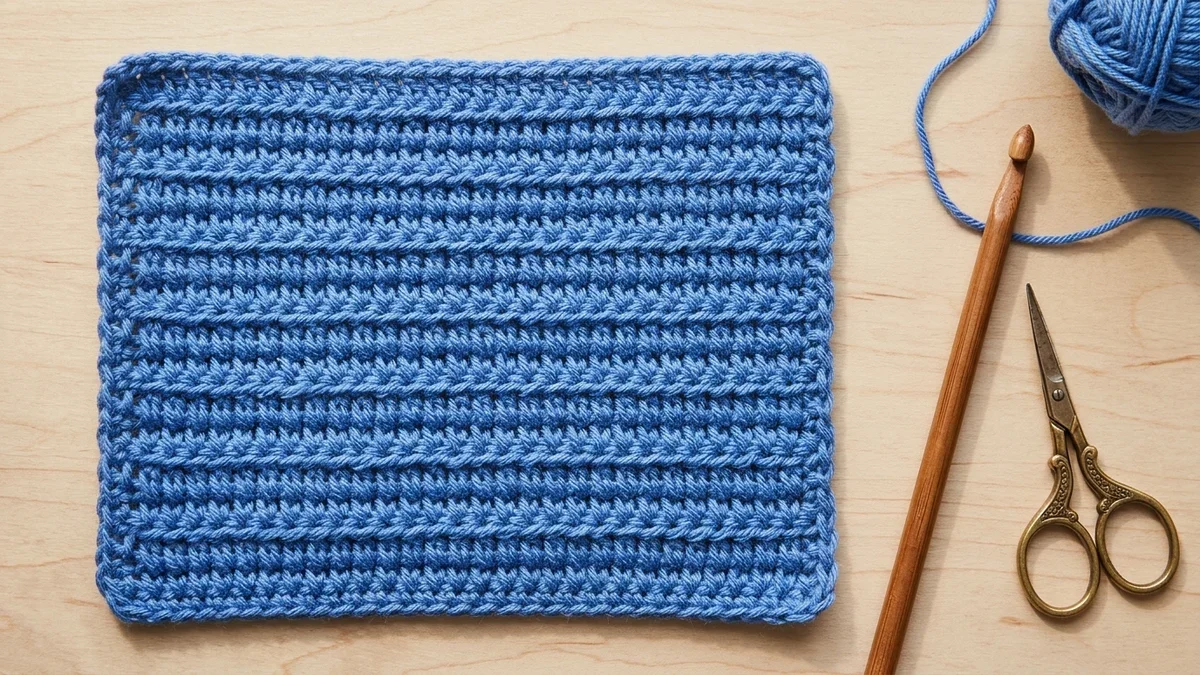
Linked Double Crochet (LDC or linked dc) is a simple structural modification of standard double crochet (dc) that eliminates the vertical gaps between tall stitch posts. Instead of starting the stitch with a free yarn over (yo) in the air, you insert your hook top-to-bottom under the horizontal middle bar of the stitch you just completed and pull up a loop, then pull up a second loop in the next stitch (3 loops on hook) and finish with [yo, pull through 2 loops] twice. That single horizontal link locks every post to its neighbor from side to side—giving you the full row height and speed of double crochet with the solid, opaque coverage of single crochet or Tunisian simple stitch.
US vs. UK Terminology Note: This tutorial uses standard US crochet terms. In UK crochet patterns, Linked Double Crochet (LDC) is called Linked Treble Crochet (LTRorlinked tr). For a full chart of regional equivalents, see our US vs. UK crochet terms guide.
Quick Reference: Linked Double Crochet (LDC)
Property | Specification |
|---|---|
US Name & Abbreviations | Linked Double Crochet ( |
UK Equivalent | Linked Treble Crochet ( |
Starting Stitch Abbreviation | Beginning Linked Double Crochet ( |
Stitch Multiple | Any number of stitches (or any chain count |
Turning Chain | 3 chains ( |
Fabric Texture | Solid, woven-look fabric with zero vertical gaps between posts; leaves a subtle horizontal ridge across the Wrong Side of each row |
Best Projects | Unlined crochet tote bags, heat-safe linked dc pot holders, baby blankets (no finger-snagging holes), and structured garment bodices |
Standard Double Crochet vs. Linked Double Crochet (DC vs. LDC)
Why do standard double crochet rows have gaps in the first place? When you begin a standard dc with a yarn over on your hook, that wrap forms a diagonal strand that only touches the previous stitch at the very top V-loop—leaving the middle of the tall posts completely unconnected.

By replacing that airborne yarn over with a loop drawn through the horizontal center bar of the adjacent post, LDC zips the middle of every stitch shut.
Comparison Metric | Standard Double Crochet ( | Linked Double Crochet ( |
|---|---|---|
How the 1st Loop Is Made | Yarn over ( | Insert hook under the horizontal middle bar of the previous stitch, |
Vertical Gaps Between Posts | Visible vertical slots that open wider when stretched | Virtually zero gaps; posts are locked together at mid-height |
Horizontal Width & Gauge | Standard baseline width (e.g., | Pulls in horizontally (typically roughly 10% to 15% narrower for the same stitch count, around |
Yarn Usage per Square Foot | Standard baseline yardage | Uses almost the exact same yarn per stitch, but because linked posts pack closer together horizontally, a finished square foot typically uses roughly 8% to 12% more yarn (estimate) |
Fabric Stretch & Drape | Fluid, flexible drape with generous horizontal stretch | Firmer, more structured fabric with minimal horizontal sag |
How to Crochet Linked Double Crochet (LDC) Step by Step
Because every LDC relies on the stitch to its right (or left, if crocheting left-handed) for its first loop, you use a slightly different setup on the very first stitch of a row (beg ldc) than on all remaining stitches across the row.
Part 1: Working the First Row into a Foundation Chain (beg ldc)

- Chain Your Desired Width + 2: For a 14-stitch practice swatch, chain 16 (
14 + 2). The last 3 chains act as your initialch-3turning height. - Pull Up Loop 1 (The Link): Insert your hook into the 2nd chain from the hook (working under the top loop or back bump), yarn over, and pull up a loop (
2 loops on hook). This replaces the yarn over of a standard double crochet. - Pull Up Loop 2 (The Base): Insert your hook into the 4th chain from the hook (skipping the 3rd chain), yarn over, and pull up a loop (
3 loops on hook). - Complete the First Stitch (
beg ldc): Yarn over and pull through the first 2 loops on your hook (2 loops remain). Yarn over and pull through the remaining 2 loops (1 loop remains). You have completed your Beginning Linked Double Crochet (beg ldc)—which counts as two linked stitches (the turning chain plus the first stitch).
Part 2: Working Linked Double Crochet (LDC) Across the Row
Once your first stitch is complete, look at the front of the post you just made. Halfway up the post, you will see a distinct horizontal bar running diagonally/horizontally across the stem.

- Insert Hook Under the Horizontal Middle Bar: Do not yarn over. Instead, insert your hook from top to bottom (or right to left) underneath that horizontal middle bar on the side of the stitch you just finished.
- Yarn Over and Pull Up a Loop: Yarn over and draw a loop through the horizontal bar (
2 loops on hook). - Insert Hook into the Next Stitch: Insert your hook under both top V-loops of the next stitch (or next foundation chain), yarn over, and pull up a loop (
3 loops on hook). - Yarn Over, Pull Through 2 Loops (
Twice):- Yarn over and pull through the first 2 loops on your hook (
2 loops remain). - Yarn over and pull through the remaining 2 loops (
1 loop remains).
- Yarn over and pull through the first 2 loops on your hook (
- Repeat Across the Row: Repeat Steps 1–4 in every stitch across the row.
Part 3: Starting Row 2 and Subsequent Turned Rows
- At the end of Row 1, turn your work and chain 3 (
ch 3). - Work a Beginning Linked Double Crochet (
beg ldc):- Insert your hook into the 2nd chain from the hook, yarn over, and pull up a loop (
2 loops on hook). - Insert your hook into the first stitch (or the second stitch if your pattern counts the
ch 3as a standalone stitch—just be consistent at the end of the row!), yarn over, and pull up a loop (3 loops on hook). [Yo, pull through 2 loops] twice.
- Insert your hook into the 2nd chain from the hook, yarn over, and pull up a loop (
- Continue working standard
ldcacross every stitch to the end of the row.
Pro Tip for Ultra-Clean Edges: Many crocheters prefer starting each row withch 2(does not count as a stitch), inserting the hook into the 2nd chain from the hook to pull up a loop, and then inserting into the very first stitch at the base of the chain to complete thebeg ldc. That way, yourbeg ldcsits directly on top of Stitch #1, and you never have to wrestle with working into the tight top of a turning chain at the end of the next row.
How to Increase and Decrease in Linked Double Crochet
Shaping garment armholes, bag gussets, or amigurumi panels in LDC is effortless once you know where to pick up the linking bar:
How to Increase (ldc inc — 2 LDC in the Same Stitch)
- Work 1 regular
ldcinto the target stitch. - To work the second
ldcof the increase, insert your hook under the horizontal middle bar of theldcyou just made, yarn over, and pull up a loop (2 loops on hook). - Insert your hook into the exact same base stitch, yarn over, and pull up a loop (
3 loops on hook). [Yo, pull through 2 loops] twice. Both stitches in the increase are now linked to each other with zero pinhole at the base!
How to Decrease (ldc2tog — Linked Double Crochet 2 Together)
Unlike a standard dc2tog decrease, an ldc2tog links both legs together so the decrease stays completely solid:
- Insert hook under the horizontal middle bar of the previous stitch,
yo, and pull up a loop (2 loops on hook). - Insert hook into the next stitch,
yo, and pull up a loop (3 loops on hook). Yoand pull through 2 loops (2 loops remain— first leg half-closed).- Instead of yarning over for the second leg, insert your hook under the horizontal middle bar of the first leg you just partially made,
yo, and pull up a loop (3 loops on hook). - Insert hook into the following stitch,
yo, and pull up a loop (4 loops on hook). Yoand pull through 2 loops (3 loops remain).Yoand pull through all 3 loops on the hook to close the gap-free decrease.
The Linked Stitch Family: LHDC, LDC, and LTR
Once you understand how the horizontal bar replaces a yarn over, you can apply the exact same linking principle to shorter or taller stitches:

- Linked Half Double Crochet (
LHDC): Pull up a loop in the diagonal/horizontal bar of the previous half double crochet, pull up a loop in the next stitch (3 loops on hook), andyo, pull through all 3 loops. Creates a super-dense canvas ideal for rug borders and structured brims. - Linked Double Crochet (
LDC): Uses 1 horizontal bar at mid-height (3 loops on hook,[yo, pull through 2] twice). The sweet spot for speed, height, and opacity. - Linked Treble Crochet (
LTR): Because a treble crochet (tr) starts with 2 yarn overs, a Linked Treble picks up 2 horizontal bars down the side of the previous post (4 loops on hookafter pulling up a loop in the base stitch, then[yo, pull through 2] 3 times).
Frequently Asked Questions (FAQ)
Is Linked Double Crochet reversible?
When worked back and forth in turned rows, LDC looks nearly identical on both sides because the horizontal ridge on the back of each stitch alternates every row. When worked in continuous or joined rounds without turning, all the smooth vertical V-columns face the outside (Right Side) and all the horizontal linking ridges sit on the inside (Wrong Side).
Why is my Linked Double Crochet fabric curling?
When worked in the round or with tight tension, pulling up a stingy loop through the horizontal middle bar squeezes the center of each row tighter than the top V-loops, causing the edges to curl toward the front. Loosen your tension slightly when drawing up that first horizontal-bar loop, or step up 0.5 mm in crochet hook size.
Can I substitute Linked Double Crochet (LDC) in a standard DC pattern?
Yes—especially for blankets, bags, and tops where you want zero see-through holes—provided you swatch first. Because LDC pulls adjacent posts closer together horizontally (~10%–15% narrower per stitch, estimate), you will usually need either a 0.5 mm to 1.0 mm larger hook or extra stitches per row to match a standard dc pattern's width. Check your adjusted stitch count with our crochet gauge calculator.




Questions & notes
No comments yet
Sign in or create a free account to comment under your profile and keep track of your replies.
Your email address is never published. Comments are moderated under our Community Guidelines; see our Privacy Policy for how we use your details.