Half Double Crochet (hdc): How to Do the Stitch
The half double crochet sits between a single and a double crochet in height. It makes a dense, warm fabric and works up quickly.

12 min read
Stitch at a glance
- US terms
- Half double crochet
hdc - UK terms
- Half treble crochet
htr
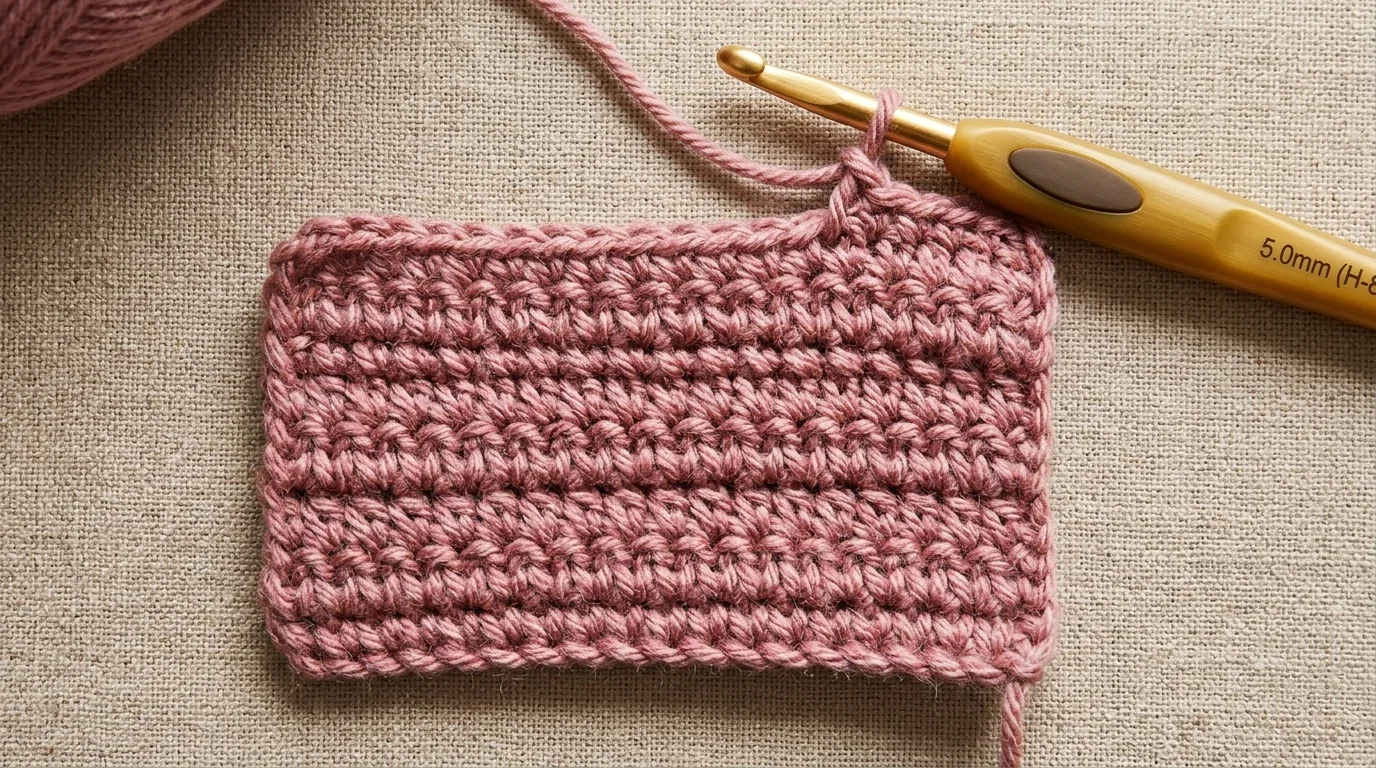
To make a half double crochet (hdc), yarn over, insert your hook into the stitch, yarn over and pull up a loop (3 loops on hook), then yarn over and pull through all 3 loops on your hook at once. Sitting right between a single crochet (sc) and a double crochet (dc) in height, the half double crochet builds a warm, cohesive fabric with soft drape and a unique third loop that makes knit-look ribbing effortless.
US vs. UK terminology note: In US crochet patterns, this stitch is called half double crochet (hdc). In UK crochet patterns, the exact same stitch is called half treble crochet (htr).
Half Double Crochet Quick Reference
Property | Detail |
|---|---|
US Name & Abbreviation | Half double crochet — |
UK Name & Abbreviation | Half treble crochet — |
Initial Yarn-Overs | 1 wrap before inserting the hook ( |
Maximum Loops on Hook | 3 loops (immediately before the final pull-through) |
Pull-Through Sequence | Yarn over, pull through all 3 loops at once |
Starting Chain on Foundation | 3rd chain from the hook |
Standard Turning Chain |
|
Unique Stitch Anatomy | Has a horizontal 3rd loop on the back/front below the top |
Crochet Chart Symbol | Vertical |
How to Work a Half Double Crochet Step by Step
Compared to single crochet, a half double crochet adds just one extra step: a yarn-over before you insert your hook, which leaves 3 loops on your hook instead of 2.
- Yarn over (
yo): Wrap the working yarn from back to front over your crochet hook. Including your active loop, you now have 2 loops (strands) on your hook. - Insert the hook into the stitch: Push the tip of your hook under both top loops (
V) of the target stitch (or into the 3rd chain from the hook if you are starting on a bare foundation chain). - Yarn over and pull up a loop: Wrap the working yarn over your hook and draw it through the stitch. You now have 3 loops on your hook.

- Yarn over and pull through all 3 loops: Wrap the yarn over your hook one more time and draw it smoothly through all 3 loops on your hook in a single motion. One active loop remains on your hook, and your half double crochet (
hdc) is complete.
Pro Tip: How to Stop Your Hook from Catching on the Middle Loop
The most common beginner struggle in half double crochet is getting the hook tip snagged on the middle loop of the 3 loops on the hook. That middle strand is the initial yarn-over you made in Step 1, which runs diagonally across the stitch and sits slightly tighter than the loop you pulled up in Step 3. To glide through all 3 loops without snagging:
- Keep your initial yarn-over relaxed on the full width of the hook shaft before inserting the hook.
- Rotate the hook beak downward to the 6 o'clock position (pointing straight toward the base of the stitch rather than sideways at 9 o'clock) and wiggle the hook tip slightly upward as it passes under the middle loop.
Worked Example: A 3-Row Half Double Crochet Swatch
To practice even edges and stitch counting, let's work a 10-stitch swatch across 3 rows using the most beginner-friendly convention: the ch 2 turning chain is for height only and does NOT count as a stitch.
Foundation Chain (Ch 12 for 10 hdc)
- Make a slip knot and chain 12 (
ch 12). - Why 12 chains produce 10 stitches: You will skip the first 2 chains from the hook and work your first
hdcinto the 3rd chain from the hook. When those 2 skipped chains do not count as a stitch, you work into12 − 2 = 10chains (10 hdc total).

Row 1 (10 hdc)
- Yarn over and insert your hook into the 3rd chain from the hook (do not count the active loop on your hook).
- Yarn over, pull up a loop (3 loops on hook), then yarn over and pull through all 3 loops. That is your first
hdc(place a stitch marker under its topVif you like). - Work
1 hdcinto each of the remaining 9 chains across the foundation cord. - Count your top
Vs: You have 10 completedhdcstitches (1 + 9 = 10).
Row 2 (10 hdc)
- Chain 2 and turn (
ch 2, turn): Because ourch 2does not count as a stitch, it simply lifts the hook to row height. - Work into the very first stitch: Yarn over and insert your hook under both top loops of the first stitch right at the base of the
ch 2. Complete1 hdc.

- Work across all 9 remaining stitches: Work
1 hdcinto each stitch across the row, ending in the topVof the 10th stitch (do not work into thech 2turning chain from the previous row). - Count your stitches:
10 hdc.
Row 3 (10 hdc)
- Repeat Row 2:
Ch 2, turn(does not count as a stitch), work1 hdcinto the very first stitch and into each stitch across (10 hdctotal).
The Half Double Crochet Turning Chain (Does Ch 2 Count?)
Unlike single crochet (where ch 1 almost never counts as a stitch) and double crochet (where ch 3 almost always counts as a stitch), half double crochet sits right on the borderline. Designers use three different turning-chain rules for hdc, so always check the "Pattern Notes" section before starting:
Turning Chain Rule | Counts as a Stitch? | Foundation Chain for | Where to Work 1st | Where to Work Last | Edge Look |
|---|---|---|---|---|---|
1. Non-Counting | No |
| 1st stitch (right at the base of the | Top | Solid, gap-free edge; can create a tiny bump if your chains are loose |
2. Non-Counting | No |
| 1st stitch (at the base of the | Top | Ultra-straight, flat vertical edge with zero bulging |
3. Counting | Yes (counts as 1st |
| 2nd stitch (skip the base of the | Into the 2nd (top) chain of the previous row's | Leaves a small space between the |
The hdc Third Loop (How to Work the Knit-Look Camel Stitch)
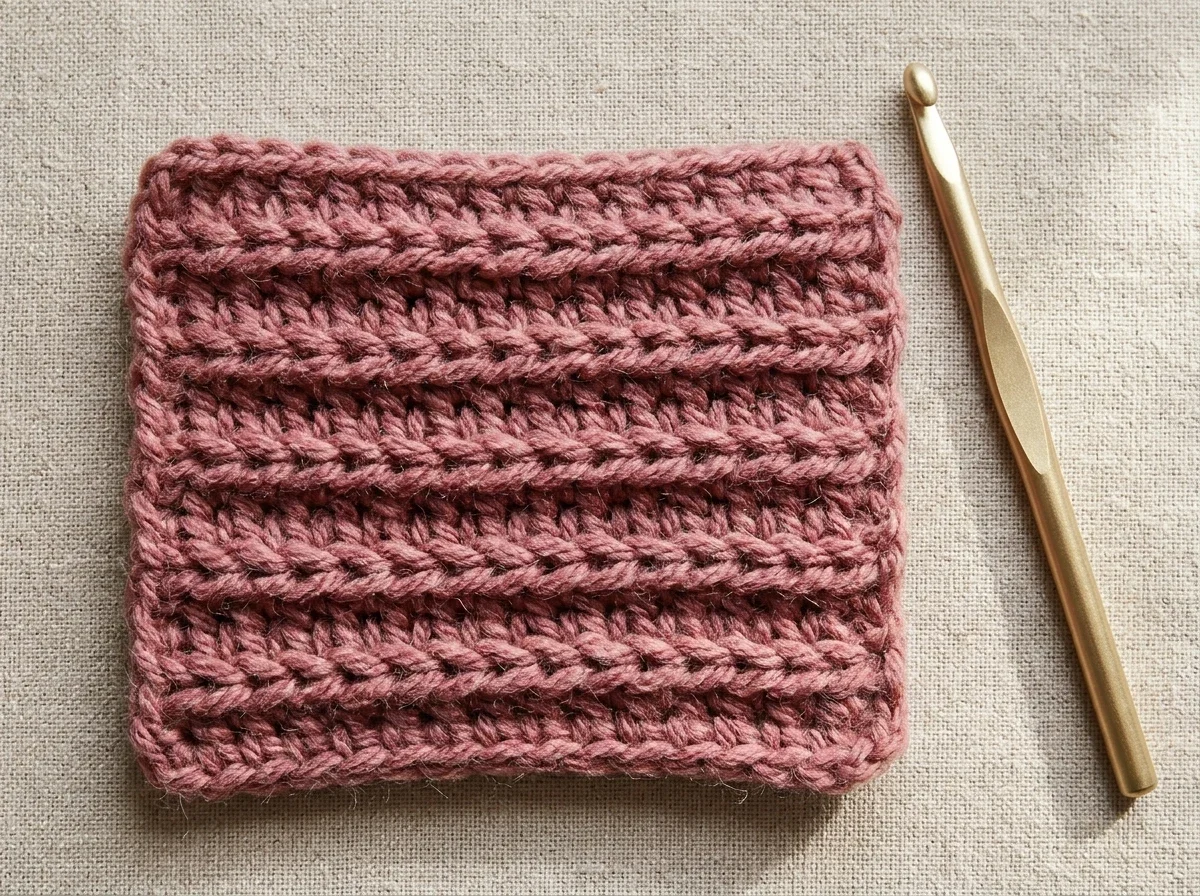
Because you yarn over before inserting your hook and pull through all 3 loops at once, that initial yarn-over forms an extra horizontal bar across the stitch called the third loop (3rd loop). Every standard hdc has three loops:
- Front loop (
FLO): The front strand of the topVclosest to you. - Back loop (
BLO): The back strand of the topVfarthest from you. - Third loop (
3rd loop): The horizontal diagonal bar sitting just below the topV.
When you work your stitches into the third loop only instead of under the top V, the entire top V gets pushed forward onto the surface of the fabric—creating a gorgeous braided ridge that looks just like knitted stockinette or ribbing (often called the camel stitch).
Where to Find the 3rd Loop in Rows vs. Joined Rounds
- When working in flat turned rows: After you turn your work at the end of a row, the back of the previous row is facing you. Look on the front side of the fabric facing you, directly below the front loop of the top
V. Inserting your hook upward under that horizontal bar pushes the topVtoward the other side of the fabric. - When working in the round (without turning): Because the right side is always facing you, tilt the top of your work slightly toward you and look behind and just below the back loop. Working into that back third loop pushes the braided
Vs outward onto the front of hats, cowls, and baskets.
Increasing and Decreasing in Half Double Crochet (hdc2tog)
Whether you are shaping a sweater sleeve or the crown of a beanie, you can add or subtract stitches cleanly in half double crochet.

How to Increase in Half Double Crochet (hdc inc)
To add 1 stitch, work 2 complete hdc stitches into the same stitch:
- Work
1 hdcinto the target stitch as usual. - Yarn over, insert your hook into the exact same stitch, yarn over and pull up a loop (3 loops on hook), and yarn over and pull through all 3 loops.
How to Decrease: 3 Ways to Work hdc2tog
Because a standard hdc starts with a yarn-over, pulling two full half double crochets together puts 5 loops on your hook, which can feel thick in dense garments or amigurumi. Here are all three ways to work a half double crochet decrease (hdc2tog) so you can pick the best finish for your project:
- Standard
hdc2tog(5 loops on hook — matches pattern stitch texture):- Yarn over, insert hook into the first stitch, yarn over and pull up a loop (3 loops on hook).
- Yarn over, insert hook into the next stitch, yarn over and pull up a loop (5 loops on hook).
- Yarn over and pull through all 5 loops at once.
- Less-Bulky
hdc2tog(4 loops on hook — skips the second yarn-over):- Yarn over, insert hook into the first stitch, yarn over and pull up a loop (3 loops on hook).
- Without yarning over, insert your hook directly into the next stitch, yarn over and pull up a loop (4 loops on hook).
- Yarn over and pull through all 4 loops at once.
- Invisible
hdcDecrease (Front loops only — best for hats & amigurumi):- Yarn over, insert your hook under the front loop only (
FLO) of the first stitch, then immediately swing your hook under the front loop only (FLO) of the next stitch (4 strands on hook). - Yarn over and pull through the first 2 loops (the two front loops—3 loops remain on hook).
- Yarn over and pull through all 3 remaining loops.
- Yarn over, insert your hook under the front loop only (
Must-Know Half Double Crochet Variations
Once you know the basic hdc, changing where you insert your hook or how you pull through loops unlocks an entire family of hdc variations:
- Half Double Crochet in the Back Loop Only (
hdc blo): Insert your hook under only the back strand of the topVon every row. This creates deep, stretchy accordion ribbing ideal for sweater cuffs, hat brims, and our ribbed ear warmer pattern. - Herringbone Half Double Crochet (
hhdc): Yarn over, insert hook into the stitch, yarn over and pull up a loop and continue pulling that loop straight through the first loop already on your hook (2 loops remain on hook); then yarn over and pull through the remaining 2 loops. This tilts the stitches into a woven chevron texture. - Extended Half Double Crochet (
ehdc): Yarn over, insert hook, yarn over and pull up a loop (3 loops on hook); yarn over and pull through 1 loop only (making a tiny chain at the base—still 3 loops on hook); then yarn over and pull through all 3 loops. Gives you the height of a double crochet with the dense, hole-free look ofhdc. - Foundation Half Double Crochet (
fhdc): A chainless starting technique that works the foundation chain and the first row ofhdcsimultaneously for a stretchy bottom edge.
What Half Double Crochet Is Best Used For
Half double crochet is often called the "Goldilocks stitch" of crochet: it builds height much faster than single crochet while avoiding the open gaps between posts that double crochet can leave. To see exactly how hdc compares with sc and dc in fabric density and yarn consumption, check our stitch comparison guide.
Here is where hdc shines:
- Cozy baby blankets and throws (
half double crochet blanket): Creates a warm, squishy blanket where little fingers and toes won't poke through holes. - Winter hats, beanies, and ear warmers: Worked in the back loop (
hdc blo) or third loop, it produces knit-like stretch and warmth—try it right away on our beginner-friendly ribbed ear warmer. - Quick everyday gifts and home accessories: A 15-minute project like our hdc mug cozy lets you practice even
hdcrows and buttonhole loops on a small scale. - Sweaters and cardigans: Provides enough drape to hang comfortably on the body without requiring a lining underneath.
Frequently Asked Questions
What is the difference between single crochet, half double crochet, and double crochet?
All three stitches differ by how you yarn over and pull through loops:
- Single crochet (
sc): Insert hook without yarning over first, pull up a loop (2 loops on hook), yarn over and pull through 2 loops. - Half double crochet (
hdc): Yarn over first, insert hook, pull up a loop (3 loops on hook), yarn over and pull through all 3 loops at once. - Double crochet (
dc): Yarn over first, insert hook, pull up a loop (3 loops on hook), yarn over and pull through 2 loops twice.
What is a half double crochet called in the UK?
In UK crochet terminology, a US half double crochet (hdc) is called a half treble crochet (htr). Both stitches are worked the exact same way.
Which chain from the hook do you start a half double crochet in?
When working into a foundation chain, work your first half double crochet into the 3rd chain from the hook (never count the loop on your hook).
Does the chain-2 turning chain count as a stitch in half double crochet?
In most modern crochet patterns, the ch 2 turning chain in half double crochet does not count as a stitch—you work your first hdc into the very first stitch at the base of the ch 2 and ignore the turning chain at the end of the row. However, some traditional patterns do count the ch 2 as the first stitch (in which case you skip the first stitch and work into the top of the ch 2 at the end of the next row). Always check your pattern's notes.
Why are the edges of my half double crochet rows bumpy?
If your ch 2 turning chain does not count as a stitch, those two extra chains can push outward on the side of the row like a small bump. To make your edges completely flat without changing your stitch count, chain 1 (ch 1) instead of ch 2 when turning, pulling that single chain loop slightly taller to match row height.
How do I stop my hook from getting stuck on the middle loop of an hdc?
Keep your first yarn-over relaxed on the full shaft of the hook (not pulled tight into the narrow throat), and rotate the hook tip downward toward 6 o'clock as you pull through all 3 loops. Pointing the hook beak straight down lets it slip cleanly under the diagonal middle loop without catching.


Questions & notes
No comments yet
Sign in or create a free account to comment under your profile and keep track of your replies.
Your email address is never published. Comments are moderated under our Community Guidelines; see our Privacy Policy for how we use your details.