Calculators · Yarn and hooks
Yarn yardage calculator
Estimate how much yarn and how many balls a project needs from a weighed swatch, a pattern's yardage or yarn per stitch.

Running out of yarn halfway, or finding the next ball is a different dye lot, is a familiar crochet problem. This calculator estimates the yarn length, weight and number of balls for a project in three ways, from most to least accurate, and shows a likely range for the first two.
How to use the calculator
- Choose how to estimate: a weighed swatch (best), a pattern's yardage, or yarn per stitch.
- Enter the project's width and length.
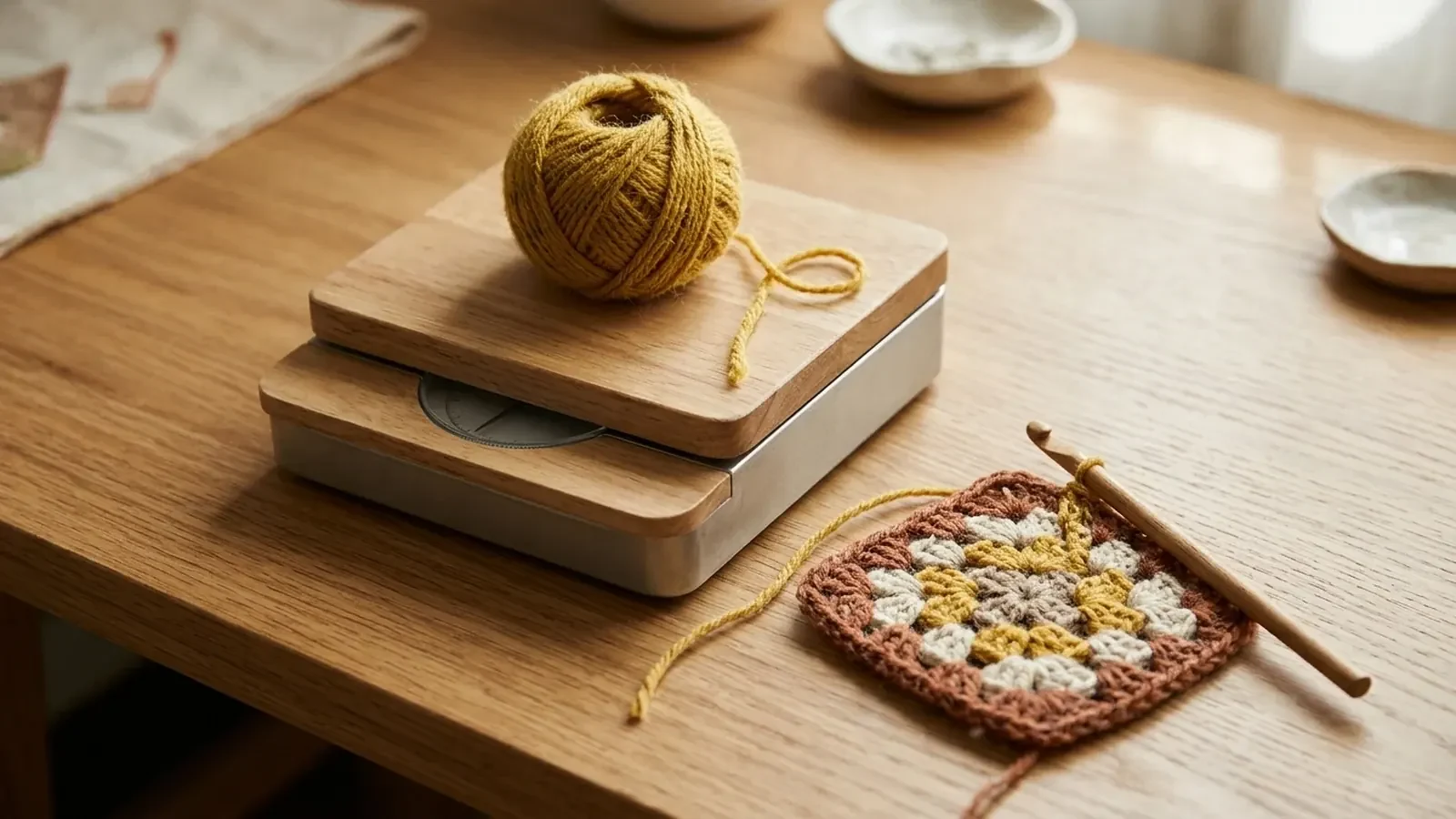
- Weighed swatch: crochet a swatch at least 6 in (15 cm) square in the project's stitch, yarn and hook, cut the tails, and weigh it on a kitchen scale.
- Pattern's yardage: enter the pattern's size and the yarn it uses, and both stitch gauges if yours differs.
- Yarn per stitch: unravel 10 stitches from your swatch, measure the yarn without stretching it, and enter your stitch and row gauge.
- Enter the length and weight on your yarn label, and the extra to allow for tails and safety (10% is usual).
How the calculator works
All three methods give a base amount of yarn; the extra is added on top.
- Weighed swatch: the project is a number of swatches in area, so
weight = project area ÷ swatch area × swatch weight. The label's length per gram (ball length ÷ ball weight) turns the weight into length. - Pattern's yardage:
yarn = pattern yarn × your area ÷ pattern area × your stitch gauge ÷ pattern stitch gauge. The gauge part is 1 unless you enter both gauges. - Yarn per stitch:
yarn = stitches in the project × yarn per stitch, where the stitches are width × stitch gauge × length × row gauge.
Yarn to buy = base yarn × (1 + extra)
Balls = yarn to buy ÷ length per ball, always rounded up
The swatch method is shown with a range of ±6% and the pattern method with ±12%, the uncertainty bands used in the research behind these calculators. The per-stitch method has no range.
Reading your results
- Yarn to buy: in both yards and metres, including your extra.
- Balls: rounded up, with the exact figure underneath. When the exact figure is only just over a whole number, the calculator points it out.
- Weight: in grams and ounces.
- Likely range: how far the real amount might reasonably fall either side.
Worked example
A 6 × 6 in swatch in waffle stitch weighs 18 g. The yarn comes in 100 g balls of 220 yd, so 2.2 yd per gram. The blanket will be 45 × 60 in.
- Area: 45 × 60 = 2,700 sq in, which is 2,700 ÷ 36 = 75 swatches.
- Weight: 75 × 18 = 1,350 g, or 1,350 × 2.2 = 2,970 yd.
- With 10% extra: 3,267 yd (2,987 m) and 1,485 g.
- Balls: 3,267 ÷ 220 = 14.85, so buy 15. The likely range is 3,071 to 3,463 yd.
Accuracy and limits
- The arithmetic is exact and covered by our automated tests. The estimate is only as good as the swatch: same stitch, yarn and hook, weighed accurately.
- The stitch matters as much as the yarn: dense, textured stitches such as waffle, puff and post stitches use much more yarn per square inch than plain rows; the guide linked below compares them.
- The pattern method scales by stitch gauge only, not row gauge, so it is the rougher estimate.
- The size you enter is the main fabric. Work out a border or fringe separately with the border yarn calculator or the fringe and tassel calculator.
Common mistakes
- Weighing a damp swatch. Water adds weight. Weigh it dry; measure its size after blocking.
- Weighing the tails. Long tails add grams to a small swatch. Cut them, or keep them off the scale.
- Using a scale in ounces. Most kitchen scales are far more precise in grams.
Tips for more accurate results
- Raise the extra to 15 to 20% for many colour changes, hand-dyed yarn you cannot match later, or a border you have not swatched.
- Buy every ball from one dye lot.
- Planning stripes? Split the total between colours with the stripe calculator.
Frequently asked questions
Which method is the most accurate?
A weighed swatch, because it uses your yarn, hook, stitch and tension. Scaling a pattern's yardage is useful before you have bought the yarn, but it is rougher.
How do I use the yarn per stitch method without a scale?
Measure your gauge, then pull out 10 stitches from the swatch and measure that length of yarn without stretching it. Enter both, and the calculator multiplies by the stitches in the project.
How much extra should I allow?
10% suits a single-colour project. Allow 15 to 20% for lots of colour changes, novelty or hand-dyed yarn, or heavy textured stitches.
My exact figure is 14.08 balls. Do I need a 15th?
The total already includes your extra, so 14 balls will probably be enough if you can stop a row early. For a garment, or a yarn you could not match later, buy the 15th.
Which stitches use the most yarn?
In general, dense and textured stitches, such as single crochet, waffle, post stitches and puffs, use more yarn per square inch than taller, more open stitches such as double crochet, V-stitch and mesh.
Related guides and tools
More yarn and hooks calculators
All calculatorsCrochet hook size converter
Convert crochet hook sizes between millimetres, US letters, old UK numbers, Japanese sizes and steel thread hooks, with brand differences flagged.Open the calculatorRemaining yarn calculator
Weigh a partly used ball to find how many yards or metres are left, and whether it is enough to finish your next rows or motifs.Open the calculatorScrap yarn blanket size calculator
Find the biggest blanket or scarf you can make from the yarn you already have, from a weighed swatch, with checkpoints for corner-to-corner.Open the calculator

Questions about this calculator
No comments yet
Sign in or create a free account to comment under your profile and keep track of your replies.
Your email address is never published. Comments are moderated under our Community Guidelines; see our Privacy Policy for how we use your details.