Which Crochet Stitch Uses the Most Yarn? SC, HDC & DC Compared
Single crochet uses less yarn per stitch but more per square foot. Here is why, with estimates and a swatch-weighing method.

5 min read

Among the three basic crochet stitches—single crochet (sc), half double crochet (hdc), and double crochet (dc)—single crochet (sc) uses the most yarn for a project of the same finished size, while double crochet (dc) uses the least. Although a single unraveled dc stitch contains a longer strand of yarn than a single sc stitch, each row of double crochet is more than twice as tall—meaning you work fewer than half as many horizontal row knots to fill a 4" × 4" swatch or a full blanket. Across all crochet stitches, 3D "yarn eaters" like bobble, popcorn, and puff stitches and waffle or basketweave post stitches consume the most yarn overall because they stack multiple loops or overlap vertical posts inside every square inch.
US vs. UK Terminology Note: This guide uses standard US crochet terms. In UK patterns, single crochet (sc) is called double crochet (dc), half double crochet (hdc) is called half treble (htr), and double crochet (dc) is called treble crochet (tr). See our US vs. UK crochet terms guide for full conversions.
The Yarn Usage Paradox: Per Individual Stitch vs. Per Square Foot
Why do so many crocheters get conflicting answers when they ask whether single crochet or double crochet uses more yarn? Because "per stitch" and "per square foot of fabric" give opposite rankings!
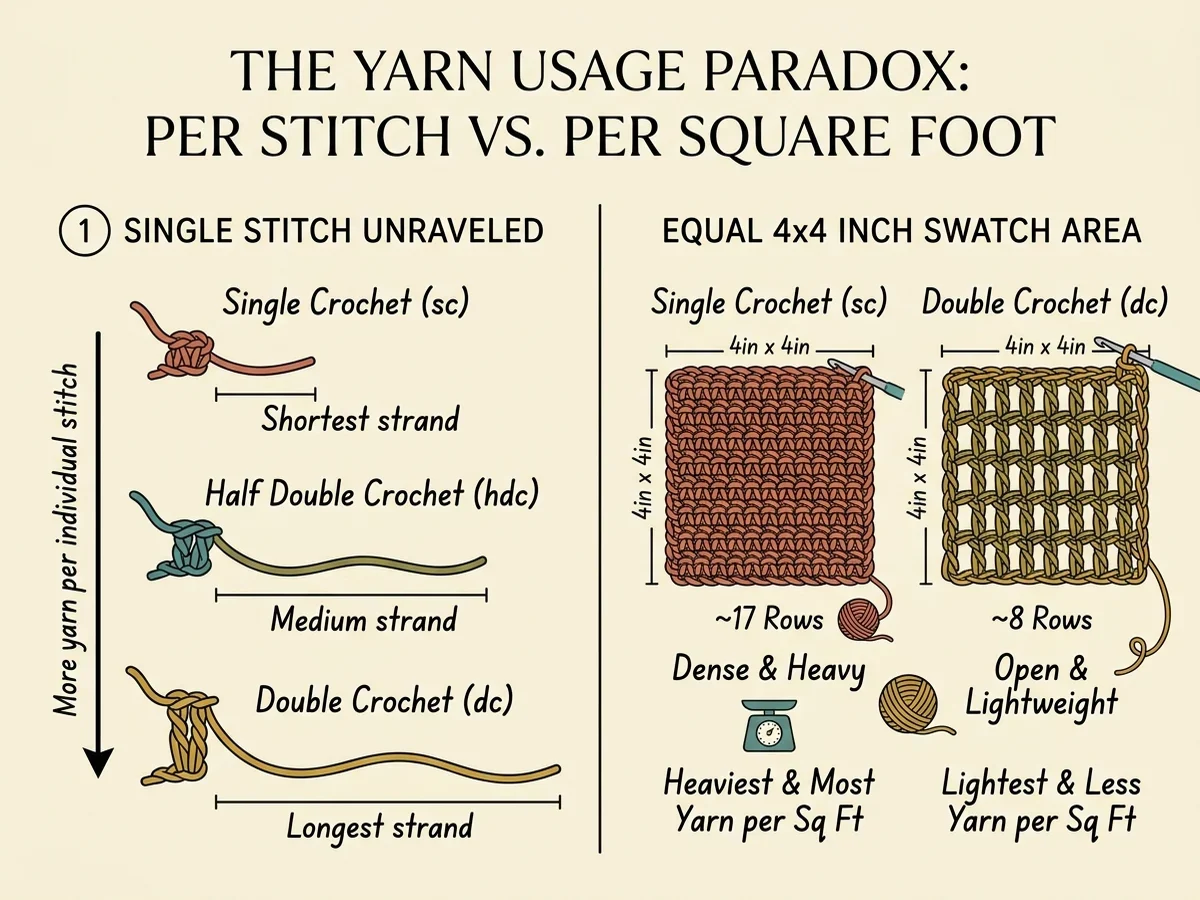
- Per Individual Stitch (
1 Stitch Unraveled):- Single Crochet (
sc): Shortest strand (no initial yarn over; 1 pull-through). - Half Double Crochet (
hdc): Medium strand (1 initial yarn over; 1 pull-through of 3 loops). - Double Crochet (
dc): Longest strand of the three (1 initial yarn over; 2 pull-throughs of 2 loops).
- Single Crochet (
- Per Equal Area of Fabric (
4" × 4"Swatch or50" × 60"Blanket):- Because each row of single crochet is short and dense, it takes roughly 17 rows of
scin #4 worsted yarn to reach4 inchestall, compared to only 11 rows ofhdcand 8 rows ofdc. - All those extra horizontal top V-loops packed into 17 rows make a single crochet blanket significantly heavier—and more yarn-hungry—than a double crochet blanket of the exact same dimensions.
- Because each row of single crochet is short and dense, it takes roughly 17 rows of
Mathematical Model: Comparing SC, HDC, and DC Over Equal Area
The table below shows a theoretical mathematical model comparing sc, hdc, and dc worked in #4 medium/worsted yarn with a 5.5 mm (I-9) hook over a 4" × 4" (16 sq in) swatch and a 12" × 12" (1 sq ft) area (estimate).
Metric (Theoretical Worsted #4 Model, estimate) | |||
|---|---|---|---|
Approx. Yarn per Single Stitch ( |
|
|
|
Typical Gauge per |
|
|
|
Total Stitches in a |
|
|
|
Estimated Yarn in a |
|
|
|
Estimated Yarn per Square Foot ( |
|
|
|
Relative Area Yarn Usage vs. |
|
|
|
Want to calculate exact skeins for your next blanket, scarf, or sweater? Enter your swatch dimensions and stitch type into our yarn yardage calculator.
All Major Crochet Stitches Ranked from Most Yarn to Least Yarn
When we expand the comparison beyond basic stitches to include textured 3D stitches and openwork mesh, crochet stitches fall into six clear tiers of yarn consumption per square foot:
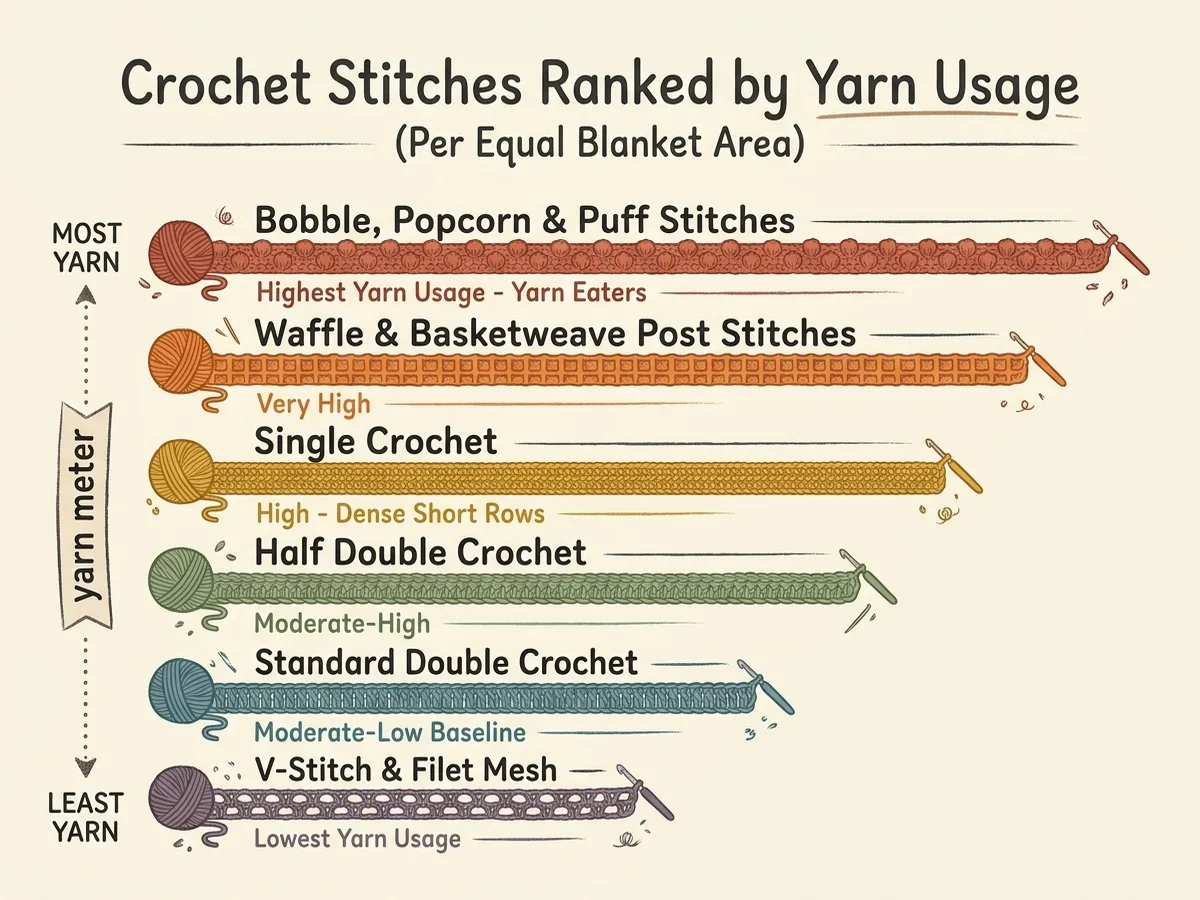
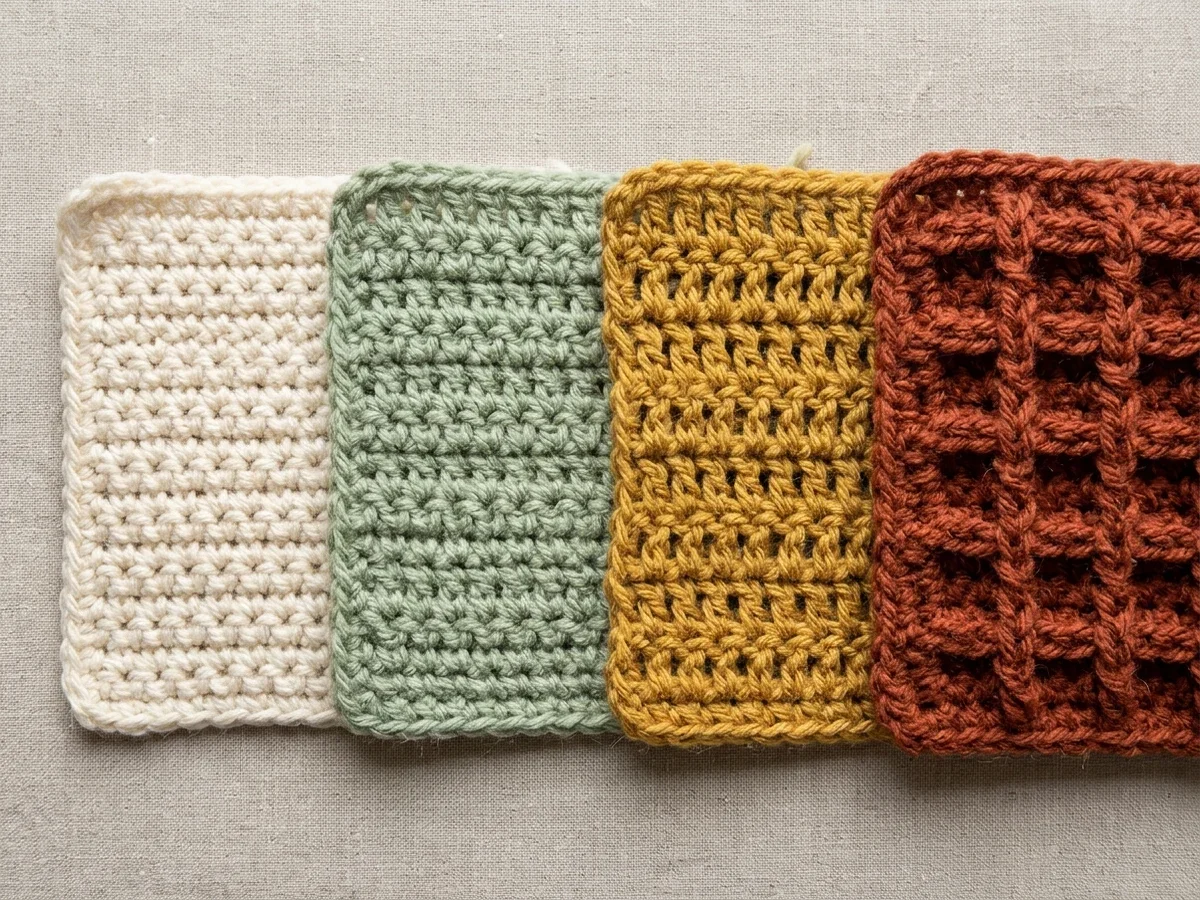
Rank (Most to Least Yarn) | Stitch Family | Typical Multiplier vs. Flat | Why It Uses This Much Yarn |
|---|---|---|---|
#1. Highest ("Yarn Eaters") |
| Packs 4 to 5 full | |
#2. Very High |
| Wrapping around the vertical post overlaps rows vertically, requiring more rows per inch. | |
#3. High | Single Crochet ( |
| Short row height requires more than twice as many horizontal row tops per vertical foot as |
#4. Moderate–High |
| Medium row height ( | |
#5. Moderate–Low (Baseline) |
| Tall 2-pull-through post covers maximum vertical height per stitch while maintaining solid coverage. | |
#6. Lowest (Yarn Savers) | DC V-Stitch, Treble ( |
| Open chain spaces ( |
How to Measure Your Exact Yarn Usage with a Kitchen Gram Scale
Because individual hand tension, fiber loft, and hook size can shift yarn usage by 15% to 25% (estimate), the most accurate way to know how much yarn your hands use is the 3-Step Gram Scale Swatch Method:
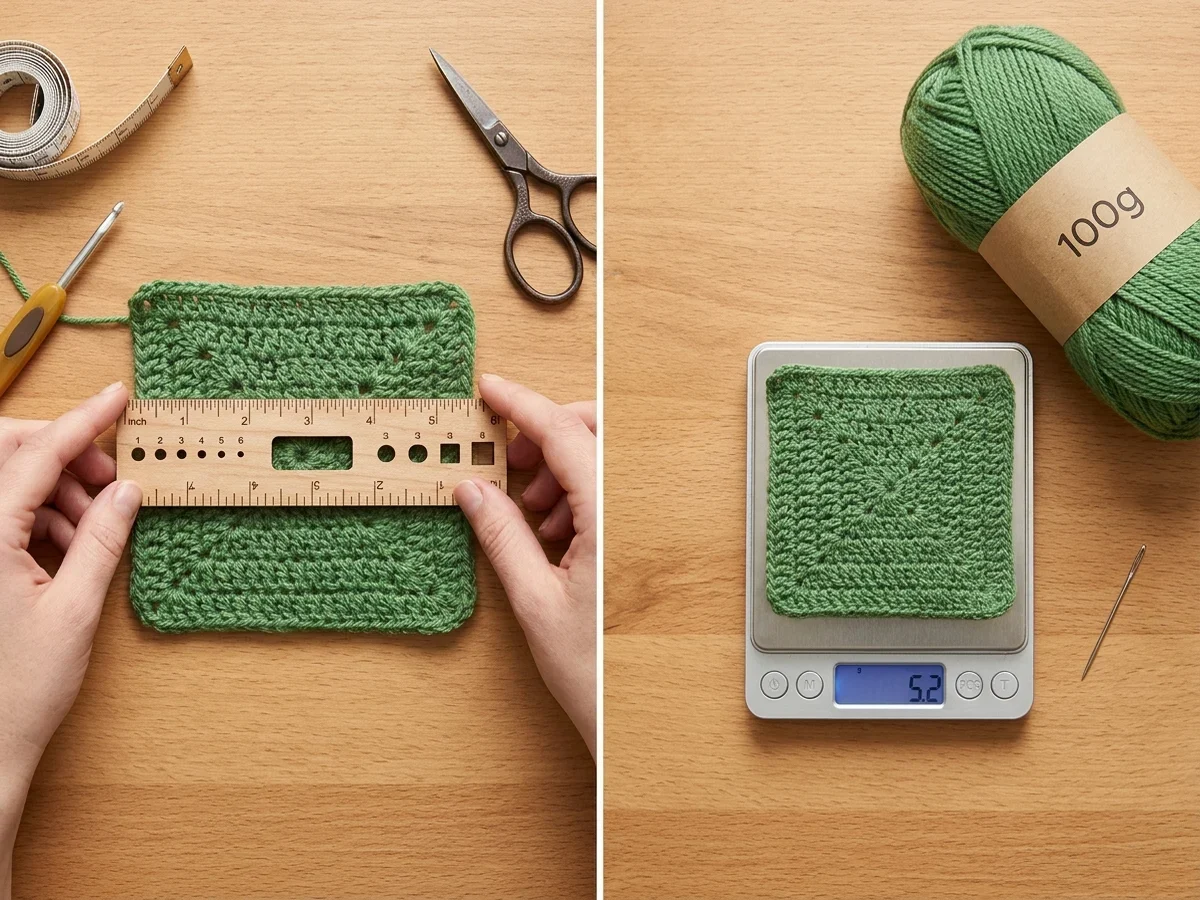
- Crochet and Measure a
4" × 4"(16 sq in) Swatch: Work a swatch in your chosen stitch and hook size, then measure its exact width and height (Width × Height = Swatch Area in sq in). - Weigh the Swatch in Grams: Place the swatch on a digital kitchen scale (for example,
9 gramsfor a4" × 4"swatch). - Multiply by Your Project's Total Area:
- Divide your target project area by your swatch area, then multiply by your swatch weight.
- Worked Example: A
50" × 60"throw blanket has an area of3,000 sq in. Divided by a16 sq inswatch (3,000 ÷ 16 = 187.5 swatches), a9-gramswatch means the blanket will require roughly1,688 grams(17 skeins of 100g yarn) before adding a 10% safety buffer. Running low on a specific colorway? Check our remaining yarn calculator to see how many rows you can finish with what's left on the ball.
Frequently Asked Questions (FAQ)
Does single crochet or double crochet use more yarn for a blanket?
Single crochet (sc) uses more yarn than double crochet (dc) for a blanket of the exact same width and length. Even though each individual sc is smaller, you have to crochet more than twice as many rows of sc to reach the same blanket length—consuming roughly 20% to 28% more yarn overall (estimate).
What crochet stitch uses the least amount of yarn for a solid-looking blanket?
Standard double crochet (dc), Extended Double Crochet (edc), and Classic Granny Stripe (3-dc clusters) stretch your yarn the furthest while still producing a cozy blanket without wide mesh holes. If you don't mind an airy lacy texture, Double Crochet V-Stitch uses even less yarn.
Does going up a hook size use more or less yarn?
For a fixed stitch and row count (like an amigurumi toy), a larger hook makes bigger loops and uses more yarn. However, for a fixed finished measurement (like a 50" × 60" throw blanket), going up a hook size creates a looser, airier gauge with fewer stitches and rows per square inch—so the finished blanket actually uses less total yarn.


Questions & notes
No comments yet
Sign in or create a free account to comment under your profile and keep track of your replies.
Your email address is never published. Comments are moderated under our Community Guidelines; see our Privacy Policy for how we use your details.