Treble Crochet (tr): How to Do the Treble or Triple Stitch
The treble, or triple, crochet is one step taller than the double crochet. It creates an open, drapey fabric that grows fast.

12 min read

Stitch at a glance
- US terms
- Treble crochet (triple crochet)
tr - UK terms
- Double treble crochet
dtr
To make a treble crochet (tr), yarn over twice, insert your hook into the stitch, yarn over and pull up a loop (4 loops on hook), then yarn over and pull through 2 loops three times until 1 loop remains on your hook. Also called the triple crochet, the treble stitch is one step taller than a double crochet and creates a tall, airy fabric with generous drape that works up quickly.
US vs. UK terminology note: In US crochet patterns, tr stands for treble crochet (worked with two initial yarn-overs) and corresponds to a double treble (dtr) in UK patterns. If you are following a UK pattern that calls for a "treble crochet (tr)", that stitch uses only one initial yarn-over—see our double crochet tutorial or our complete UK treble vs US treble conversion guide.
Treble Crochet Quick Reference
Property | Detail |
|---|---|
US Name & Abbreviation | Treble crochet — |
UK Name & Abbreviation | Double treble crochet — |
Initial Yarn-Overs | 2 wraps before inserting the hook ( |
Maximum Loops on Hook | 4 loops (immediately after pulling up a loop through the stitch) |
Pull-Through Sequence |
|
Starting Chain on Foundation | 5th chain from the hook (skipped 4 chains count as the first |
Standard Turning Chain |
|
Relative Height | ~3× the height of single crochet ( |
Crochet Chart Symbol | Tall |
How to Work a Treble Crochet Stitch Step by Step
Whether you are working into a foundation chain or across a row of stitches, every US treble crochet follows the same three-stage pull-through rhythm:
- Yarn over twice (
yo × 2): Wrap the working yarn from back to front over your hook two times. Including the active loop already on your hook, you now have 3 loops (wraps) on your hook. - Insert the hook: Push the tip of your hook into the target chain or under both top loops (
V) of the target stitch. (If you are starting Row 1 on a bare foundation chain, insert your hook into the 5th chain from the hook.) - Yarn over and pull up a loop: Wrap the yarn over your hook and draw it through the stitch. You now have 4 loops on your hook.

- First pull-through (
4 → 3 loops): Yarn over and pull through the first 2 loops on your hook. You have 3 loops remaining on the hook. - Second pull-through (
3 → 2 loops): Yarn over and pull through the next 2 loops on your hook. You have 2 loops remaining on the hook. - Third pull-through (
2 → 1 loop): Yarn over a final time and pull through the last 2 loops on your hook. One active loop remains on your hook, and your first tall treble crochet post is complete.
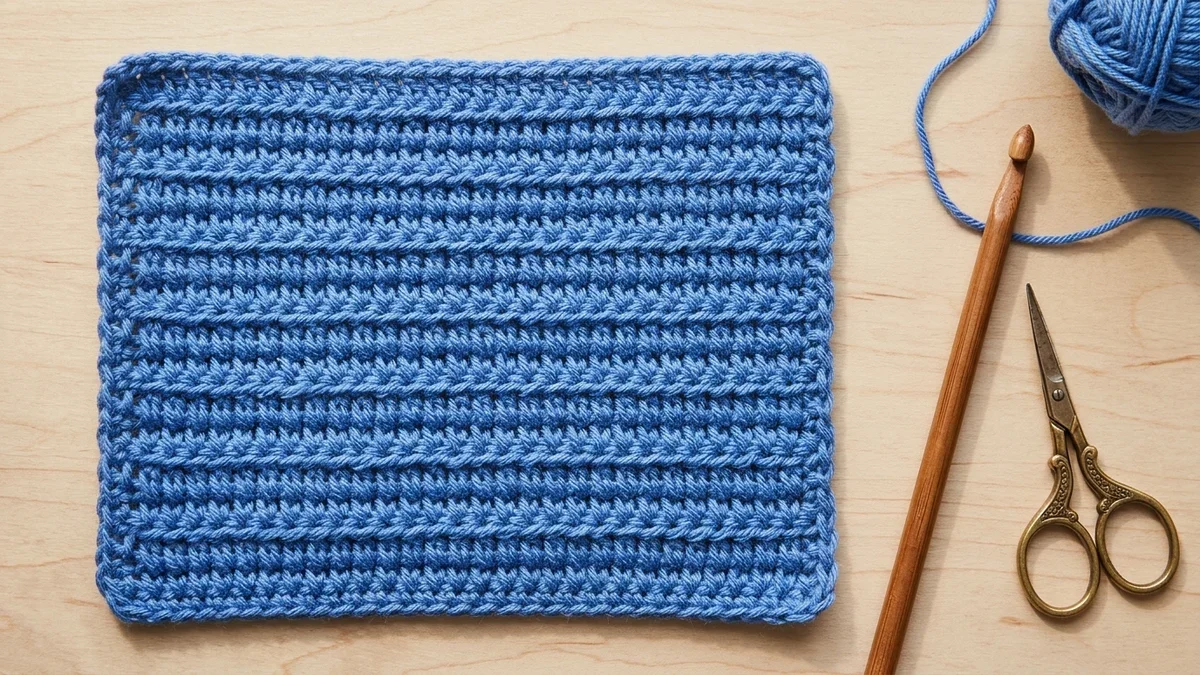
Worked Example: A 3-Row Treble Crochet Swatch
Practicing a small 11-stitch swatch is the fastest way to master the 5th-chain start and verify that your edges stay straight. In standard treble crochet patterns, the 4 skipped chains at the start of Row 1 and the ch 4 turning chain on subsequent rows count as the first treble crochet stitch of the row.
Foundation Chain (Ch 14 for 11 tr)
- Make a slip knot and work 14 chains (
ch 14). - Why 14 chains produce 11 stitches: You will work your first treble into the 5th chain from the hook. That leaves
14 − 4 = 10chains to work into, plus the 4 skipped chains that stand in as your first stitch:1 (skipped 4-ch post) + 10 worked tr = 11 tr total.

Row 1 (11 tr)
- Yarn over twice and insert your hook into the 5th chain from the hook (never count the loop on your hook).
- Complete 1
trin that 5th chain ([yo, pull through 2] × 3). Because the 4 skipped chains count as stitch #1, you now have 2 stitches standing side by side. - Work
1 trinto each of the remaining 9 chains across the foundation cord. - Count your stitches:
1 (skipped 4-ch post at the right edge) + 1 (tr in 5th ch) + 9 (tr across remaining chains) = 11 tr.
Row 2 (11 tr)
- Chain 4 and turn (
ch 4, turn): Thisch 4turning chain counts as the firsttrof Row 2, sitting directly above the first stitch of the row. - Skip the first stitch: Because the
ch 4already occupies the first stitch position, do not work into the base of thech 4. Instead, yarn over twice and insert your hook under both top loops of the second stitch of the row. - Work across: Work
1 trinto the second stitch and into each stitch across (9 trworked into full stitches, bringing your count to1 + 9 = 10stitches). - Work the 11th stitch into the turning chain: Work your final (
11th)trinto the 4th chain (the top chain) of the previous row's turning chain. Tip: place a locking stitch marker into the 4th chain of everych 4turning chain as soon as you make it so you never miss the final edge stitch.
Row 3 (11 tr)
- Repeat Row 2:
Ch 4, turn(counts as firsttr), skip the first stitch, work1 trinto each of the next 9 stitches, and work1 trinto the top of thech-4turning chain (11 trtotal).
The Turning Chain in Treble Crochet (And How to Stop Edge Gaps)
Because a treble crochet is roughly three times as tall as a single crochet, it needs a 4-chain turning chain (ch 4) to reach the height of the new row. However, a 4-chain cord is skinnier than a full treble post, which often leaves a visible gap between the turning chain and the second stitch of the row.
Here are the three ways patterns and experienced crocheters handle the treble turning chain:
Turning Chain Method | Counts as a Stitch? | Where to Work First | Where to Work Last | Best For |
|---|---|---|---|---|
Standard | Yes (counts as 1st | 2nd stitch of the row (skip base of | Into the 4th chain of the previous row's | Openwork, lace shawls, and patterns where an airy edge matches the fabric |
Tighter | Yes (counts as 1st | 2nd stitch of the row | Into the 3rd chain of the previous row's | Crocheters with loose chain tension whose |
Non-Counting | No (for height only) | 1st stitch of the row (right into the base of the | Into the top | Solid treble rows or garment panels where you want a firmer, gap-free border |
US Treble vs. UK Treble: Complete Tall-Stitch Comparison
Because the word "treble" exists in both US and UK crochet terminology with different meanings, it is one of the most common sources of pattern mistakes. In the UK system, stitch names count the total number of loops on the hook (or total pull-throughs), whereas the US system counts the number of initial yarn-overs (double = 1 wrap + active loop; treble = 2 wraps; double treble = 3 wraps).

Use this ladder to compare US treble crochet against shorter and taller stitches:
US Stitch Name (Abbr.) | UK Stitch Name (Abbr.) | Initial Yarn-Overs | Pull-Throughs of 2 Loops | Starting Chain from Hook | Standard Turning Chain | Chart Symbol |
|---|---|---|---|---|---|---|
Single crochet ( | Double crochet ( | 0 (insert first) | 1 | 2nd ch |
|
|
Half double crochet ( | Half treble ( | 1 | 1 (pulls through all 3) | 3rd ch |
|
|
Double crochet ( | Treble crochet ( | 1 | 2 | 4th ch |
|
|
Extended double crochet ( | Extended treble ( | 1 | 1 through 1 loop, then 2 through 2 | 4th ch |
|
|
Treble / Triple crochet ( | Double treble ( | 2 | 3 | 5th ch |
|
|
Double treble crochet ( | Triple treble ( | 3 | 4 | 6th ch |
|
|
Triple treble crochet ( | Quadruple treble ( | 4 | 5 | 7th ch |
|
|
If you want a stitch that is slightly taller and more flexible than a double crochet without the open gaps of a full treble crochet, try the extended double crochet (edc), which uses one initial yarn-over and adds a single extra chain pull-through at the base of the stitch. For a full printable chart covering every stitch term, visit our guide on UK treble vs US treble.
Double Treble (dtr) and Taller Stitches
Once you understand the rhythm of the treble crochet (yo × 2, then [yo, pull through 2] × 3), you already know how to work every taller crochet stitch. Each step up the height ladder simply adds one more initial yarn-over before you insert your hook and one more yo, pull through 2 to finish the post:
How to Work a Double Treble Crochet (dtr, UK ttr)
- Yarn over 3 times (
yo × 3): You have 4 loops (wraps) on your hook before inserting. - Insert hook into the stitch (or into the 6th chain from the hook on a foundation chain), yarn over, and pull up a loop (5 loops on hook).
[Yarn over, pull through 2 loops] × 4: Your loop count drops5 → 4 → 3 → 2 → 1. Use ach 5turning chain.
How to Work a Triple Treble Crochet (ttr, UK quad tr)
- Yarn over 4 times (
yo × 4): You have 5 loops (wraps) on your hook before inserting. - Insert hook into the stitch (or into the 7th chain from the hook on a foundation chain), yarn over, and pull up a loop (6 loops on hook).
[Yarn over, pull through 2 loops] × 5: Your loop count drops6 → 5 → 4 → 3 → 2 → 1. Use ach 6turning chain.
Increasing and Decreasing in Treble Crochet
Shaping shawls, sleeves, and openwork ripples requires increasing (tr inc) and decreasing (tr2tog) in treble crochet without distorting the tall posts.

How to Increase in Treble Crochet (tr inc)
To add 1 stitch, work 2 complete treble crochet stitches into the same base stitch:
- Work 1 normal
trinto the target stitch ([yo, pull through 2] × 3). - Yarn over twice, insert your hook into the exact same base stitch, and work a second complete
tr. The two tall posts fan out in aVfrom a single base stitch (1 stitch → 2 stitches).
How to Decrease: Treble Crochet Two Together (tr2tog)
To merge 2 adjacent stitches into 1 top stitch, work each treble post until one pull-through remains, then close them together:
- Work the first partial treble: Yarn over twice, insert your hook into the first stitch, yarn over and pull up a loop (4 loops on hook).
[Yarn over, pull through 2 loops] × 2. Stop here—you have 2 loops on your hook (the active loop plus the unfinished first post). - Work the second partial treble: Leaving those 2 loops on your hook, yarn over twice, insert your hook into the next stitch, yarn over and pull up a loop (5 loops on hook).
[Yarn over, pull through 2 loops] × 2. You now have 3 loops on your hook (the initial loop plus two unfinished treble posts). - Close the decrease: Yarn over once and pull through all 3 loops on your hook. Two tall treble posts now converge into a single top
V(2 stitches → 1 stitch).
Troubleshooting Loose Loops and Leaning Posts
The #1 frustration crocheters report with treble crochet is a loose, saggy loop sticking out of the back or top of the stitch. Here is why it happens and how to fix it immediately:
- Hold the two wraps with your index finger as you insert the hook: When you yarn over twice and tip the hook downward to enter the stitch below, the second wrap naturally slides toward the wider handle or loosens. Rest your right (hook-hand) index finger gently over both wraps on the hook shaft as you insert the hook into the stitch so the wraps cannot uncoil.
- Snug the second wrap before the third pull-through: The loose loop on the back of a treble stitch is almost always the first yarn-over you placed on the hook (which becomes the upper crossbar of the post). After your second
yo, pull through 2(when 2 loops remain on the hook), pause for a fraction of a second and keep mild tension on your working yarn before pulling through the final 2 loops. - Keep your pull-throughs vertical, not stretched sideways: Pulling the active loop horizontally toward the left (for right-handed crocheters) elongates the top
Vand makes the post lean. Draw eachyo, pull through 2straight upward to the natural height of the previous stitch.
Where to Use Treble Crochet
Because treble crochet posts are tall and separated by open spaces, a solid treble fabric is much less dense than single or half double crochet. It excels in projects that need height, movement, or dramatic texture:
- Lacy shawls, summer wraps, and market bags: Tall posts create breathable openwork that drapes softly without feeling heavy or stiff.
- Cables and front/back post stitches (
fptr/bptr): When you reach across two rows to cross stitches for crochet cables or waffle/basketweave textures, a regular double crochet is often too short and pulls the fabric tight; the extra height of a front post treble crochet (fptr) allows cables to cross smoothly without puckering. - Granny square corners and flower petals: Many motifs use treble stitches in the corners to turn a circular center into a sharp square, or combine
sc,hdc,dc, andtrin the same space to form rounded flower petals and shells. - Fast-growing blankets andstriped throws: Combined in alternating rows with shorter stitches, treble stitches add height and visual rhythm while covering vertical inches quickly.
Frequently Asked Questions
Is treble crochet the same as triple crochet?
Yes. In US crochet terminology, treble crochet and triple crochet are two names for the exact same stitch, abbreviated tr. Both names refer to the stitch worked by yarning over twice before inserting your hook and pulling through two loops three times ([yo, pull through 2] × 3).
How many yarn-overs do you do for a treble crochet?
You start a US treble crochet with 2 yarn-overs before inserting your hook into the stitch, and you perform 4 more yarn-overs after inserting the hook (1 to pull up a loop, plus 3 to pull through pairs of loops), for 6 yarn-overs in total per stitch.
Which chain from the hook do you start a treble crochet in?
When working into a foundation chain, work your first treble crochet into the 5th chain from the hook (do not count the loop on your hook). The 4 skipped chains fold up beside your first worked stitch and count as the first treble crochet of the row.
How many turning chains do you need for treble crochet?
The standard turning chain for treble crochet is 4 chains (ch 4), which matches the height of the stitch and usually counts as the first tr of the new row. If your chains tend to be loose and leave a gap at the edge of the row, try chaining 3 (ch 3) instead.
What is a UK treble crochet in US terms?
A UK treble crochet (tr) is a US double crochet (dc)—worked with only one initial yarn-over before inserting the hook. Conversely, a US treble crochet (tr) is called a double treble (dtr) in UK patterns. Always check our UK treble vs US treble chart before starting a pattern.
Why are my treble crochet stitches loose on the back?
A loose loop on the back of a treble stitch happens when the two initial yarn-overs slide apart or loosen on the hook shaft while you dip the hook into the stitch below. Hold both wraps snug against the hook shaft with your index finger as you insert the hook, and keep steady tension on your working yarn before pulling through the final 2 loops.
How do I make a stitch slightly shorter than treble crochet but taller than double crochet?
Use the extended double crochet (edc). It starts with a single yarn-over like a standard double crochet, pulls through 1 loop first to create a chain-like base, and then finishes with two pull-throughs of 2 loops—giving you extra height and drape without the open gaps of a full treble crochet.


Questions & notes
No comments yet
Sign in or create a free account to comment under your profile and keep track of your replies.
Your email address is never published. Comments are moderated under our Community Guidelines; see our Privacy Policy for how we use your details.