Extended Double Crochet (EDC) Stitch: Step-by-Step Tutorial
One extra pull-through at the base of a double crochet adds height and drape without the gaps of a treble.

8 min read

Stitch at a glance
- US terms
- Extended double crochet
edc - UK terms
- Extended treble crochet
etr
By the DoubleCrochet Team | Last Updated: November 2026 | Skill Level: Easy / Confident Beginner
An extended double crochet (edc, exdc, or xdc) is worked just like a regular double crochet with one extra yarn over, pull through 1 loop step at the very bottom of the stitch (pull through 1, pull through 2, pull through 2 instead of pull through 2, pull through 2). That single extra chain built into the foot of the post makes the stitch slightly taller and more flexible than a standard double crochet—bridging the height gap between double crochet (dc) and treble crochet (tr) without leaving wide lacy gaps between posts.
(Terminology note: This tutorial uses US crochet terms; in UK patterns, an extended double crochet is called an extended treble crochet (etr or extr).)
Pulling through just 1 loop on the first pass builds a tiny chain-1 pedestal at the base of every double crochet post, adding height and fluid drape.
Quick Reference: Extended Double Crochet (edc)
Stitch Property | Details |
|---|---|
US Abbreviations |
|
UK Equivalent | Extended Treble Crochet ( |
Pull-Through Rhythm |
|
Loop Count Sequence |
|
Chart Symbol | Standard |
Turning Chain |
|
Stitch Multiple | Any number of stitches |
What Is Extended Double Crochet (edc)? (The Anatomy of the Base Chain)
In a standard double crochet, you yarn over, pull up a loop (3 loops on hook), and immediately pull through 2 loops twice. In an extended double crochet (edc), you pause with those 3 loops on your hook and work a single chain stitch into the first loop only before completing the rest of the double crochet.
Because that extra chain sits vertically at the bottom of the post:
- It adds a half-step of height: An
edcstands taller than a standarddcbut shorter than a treble crochet (tr), which requires two initial yarn-overs. - It keeps the post solid: A treble crochet's double yarn-over creates a tall, spindly post that easily separates into wide holes. Because
edcstarts with only one initial yarn-over, the upper body of the stitch stays as compact and coverage-friendly as regular double crochet while the base chain acts like a flexible hinge.
Step-by-Step Tutorial: How to Work the Extended Double Crochet Stitch

Step-by-Step Instructions for One edc Stitch
- Yarn Over & Insert Hook: Yarn over (
yo) once from back to front and insert your hook under both topVloops of the target stitch (or into the 4th chain from the hook on Row 1). - Pull Up a Loop (
3 loops on hook): Yarn over and draw a loop up through the stitch. You have 3 loops on your hook. - Pull Through ONE Loop (
Base Extension Chain): Yarn over and pull through only the first loop on your hook (the loop closest to the hook tip). Because you replaced 1 loop with 1 new loop, you still have 3 loops on your hook, and a small chain link now sits at the foot of your stitch. - Pull Through TWO Loops (
2 loops remain): Yarn over and pull through the first 2 loops on your hook. You now have 2 loops remaining. - Pull Through Final TWO Loops (
1 loop remains): Yarn over and pull through the remaining 2 loops on your hook. One extended double crochet (edc) is complete!
Working a 14-Stitch Practice Swatch (With Arithmetic)
Grab worsted-weight (#4) yarn and a 5.0 mm (H-8) hook to practice the 1 → 2 → 2 rhythm across flat rows:
- Foundation Chain:
Ch 16(14 target stitches + 2 extra chainsfor the startingch-3turning height). - Row 1: Work
1 edcinto the 4th chain from the hook (the 3 skipped chains count as your first stitch), then work1 edcinto each of the remaining 12 chains across. Turn.- Row 1 Arithmetic:
1 starting ch-3 + 1 edc in 4th ch + 12 edc across = 14 sts total.
- Row 1 Arithmetic:
- Row 2:
Ch 3(counts as first stitch; or usech 4if youredcposts are very tall), skip the first stitch at the base of the turning chain, work1 edcinto the topVof each of the next 12 stitches across, and work1 edcinto the top (3rd chain) of the previous row's turning chain. Turn. (14 sts total) - Rows 3–6: Repeat Row 2 four more times (
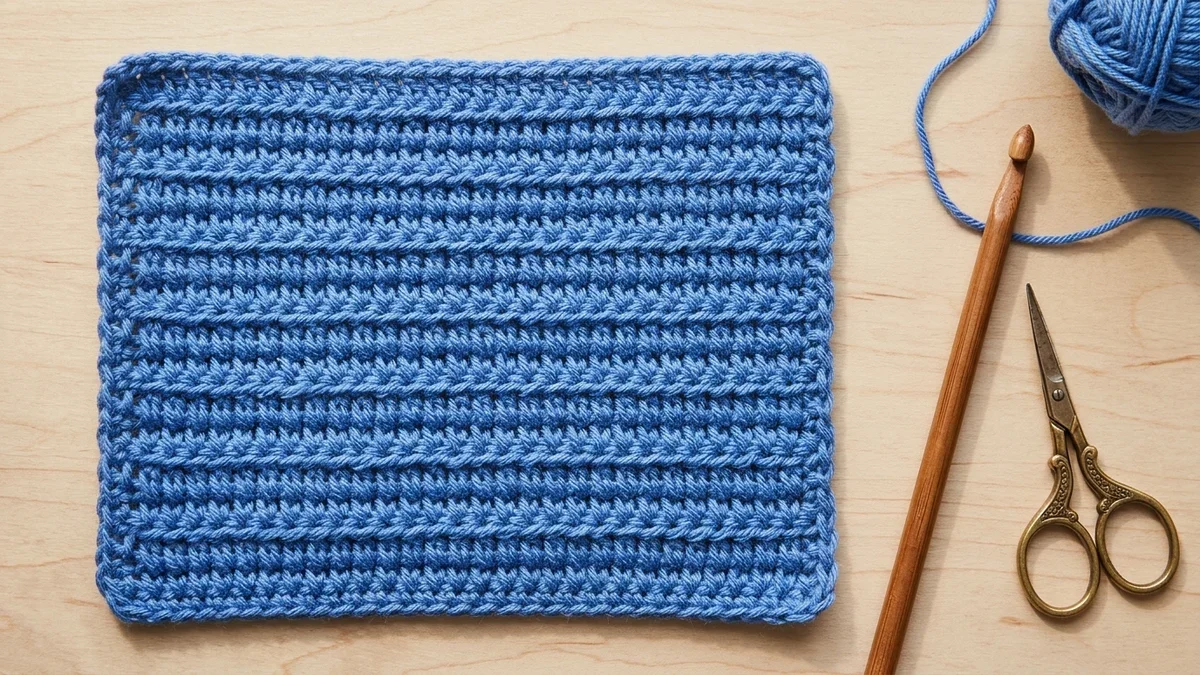
approx. 4" wide × 3.75" tall, estimate).
Structural Comparison: Standard DC vs. Extended DC (edc) vs. Treble Crochet (tr)

Feature | Standard Double Crochet ( | Extended Double Crochet ( | Treble Crochet ( |
|---|---|---|---|
Initial Yarn-Overs | 1 yarn-over before inserting hook | 1 yarn-over before inserting hook | 2 yarn-overs before inserting hook |
Pull-Through Sequence |
|
|
|
Relative Post Height | Standard | Intermediate height ( | Tallest ( |
Fabric Opacity | Solid, balanced everyday fabric | Supple, braided posts with minimal gapping | Open, airy columns that separate easily |
Filet Crochet Grid Shape | 3-dc blocks are slightly wider than tall | 3-edc blocks form true 1:1 squares | 3-tr blocks are taller than wide |
Practical Use Cases: Fixing Short Row Gauge & True-Square Filet Grids
Use Case 1: Fixing Short Row Gauge Without Changing Hook Size
Have you ever swatched for a sweater pattern where your stitch width gauge matches the designer's (e.g., 14 sts = 4 inches), but your row height gauge is too short (e.g., 8 rows = 3.4 inches instead of 4 inches)?
- If you go up a hook size to make your rows taller, your stitches will also get wider, ruining your sweater width.
- The
edcRescue: Keep your exact same hook size (preserving your 14-stitch width gauge) and substituteedcfordc! That extrapull through 1base chain adds the missing vertical lift to every row—a favorite trick when troubleshooting short rows caused by tight "yanker" tension.
Use Case 2: Making Filet Crochet Meshes Truly Square
In traditional filet crochet (3 dc solid blocks alternating with dc, ch 2, skip 2 open windows), standard double crochet stitches are slightly shorter than the width of 3 stitches, which squashes graphed hearts, letters, or motifs horizontally. Substituting edc for dc stretches each row vertically just enough to make every 3-stitch pixel a true square.
How Does edc Differ from Foundation Double Crochet (fdc)?
Because both techniques start with a yarn over, pull through 1 loop base chain, crocheters frequently mix up Extended Double Crochet (edc) and foundation dc (fdc). Here is the exact difference:

- Extended Double Crochet (
edc— Used on Any Row): You insert your hook into the stitch of the row below, pull up a loop, and work thepull through 1chain vertically into the foot of the post. On the next stitch, you insert into the next stitch of the row below. - Foundation Double Crochet (
fdc— Used Only on Row 1): You usefdcto replace the starting chain and Row 1 at the same time. To make the nextfdc, you insert your hook into the base chain of the stitch you just made, building the row sideways in mid-air.
Common Mistakes and Troubleshooting Fixes
1. Inserting Your Hook Into the Extension Chain Instead of the Top V

- The Problem: Because the
pull through 1step creates a visible chain link at the bottom of every post, beginners sometimes insert their hook into that lower chain link on the next row, which shortens the fabric and leaves a horizontal ridge. - The Fix: Always insert your hook under the two top
Vloops at the very top crown of theedcstitch—just as you do on a regular double crochet.
2. Using a Short Turning Chain (Ch 2) That Pinches the Side Edges
- The Problem: Because an
edcis taller than a regulardc, starting a row with a shortch 2forces the first stitch of the row to crouch down, pulling the side edges inward. - The Fix: Use a
ch 3turning chain (or ach 4turning chain if you crochet loosely), or work a chainless startingedcby pulling your starting loop up to fulledcheight before yarning over.
Frequently Asked Questions (FAQ)
How do I work an Extended Double Crochet decrease (edc2tog)?
To decrease two extended double crochets into one (edc2tog):
- First Leg: Yarn over, insert hook into first stitch, yarn over, pull up a loop (
3 loops on hook). Yarn over, pull through 1 loop (3 loops remain), then yarn over and pull through 2 loops (2 loops remain on hook). - Second Leg: Yarn over, insert hook into the next stitch, yarn over, pull up a loop (
4 loops on hook). Yarn over, pull through 1 loop (4 loops remain), then yarn over and pull through 2 loops (3 loops remain on hook). - Close Decrease: Yarn over and pull through all 3 loops on your hook (
1 loop remains).
Does Extended Double Crochet use more or less yarn per square foot than standard double crochet?
Each individual edc stitch uses slightly more yarn than a single dc because of the extra pull through 1 base chain. However, because edc rows are taller, you need fewer rows to reach your target blanket or garment length—so total yarn consumption per square foot is very close to standard double crochet (estimate).
What does the crochet chart symbol for Extended Double Crochet look like?
On international crochet symbol charts, an edc is drawn as a standard double crochet T-bar with a single diagonal crossbar plus a small open oval (0 chain symbol) attached directly to the bottom foot of the vertical stem.




Questions & notes
No comments yet
Sign in or create a free account to comment under your profile and keep track of your replies.
Your email address is never published. Comments are moderated under our Community Guidelines; see our Privacy Policy for how we use your details.