V-Stitch Baby Blanket Crochet Pattern
An airy one-row repeat of V-stitches that you can make any width. Size it with the blanket calculator, then repeat the same row until it is long enough.

10 min read

Pattern at a glance
- Hook
- 5.5 mm (US I-9)
- Yarn
- Soft worsted-weight yarn; work out the amount with the yarn yardage calculator
- Terms
- US terms
Materials
- Soft worsted-weight (#4) yarnWashable acrylic, cotton or a blend for a baby blanket
- 5.5 mm (US I-9) crochet hookA size up from the label keeps the fabric soft
- Tapestry needleFor weaving in ends
Abbreviations
- ch
- chain
- dc
- double crochet
- sk
- skip
- sp
- space
- V-st
- (dc, ch 1, dc) in the same stitch or space
This V-stitch baby blanket crochet pattern uses an airy, rhythmic one-row repeat of classic V-stitch clusters (dc, ch 1, dc) framed by straight double crochet side edges. After working the foundation setup row (Multiple of 3 + 4), you never have to squint at individual stitch loops again—every new V-stitch lands right inside the center ch-1 space of the V-stitch below, making this one of the fastest, most relaxing baby blankets you can crochet. Below you'll find the complete pattern for a standard ~30" × 35" stroller/nursery blanket, a 5-size starting chain chart, baby-safety guidelines, and a two-round border.
This pattern is written in US crochet terms (where US double crochet dc is called treble crochet tr in UK terms, and US single crochet sc is called double crochet dc in UK terms).
Pattern At a Glance & Skill Notes
Specification | Details |
|---|---|
Skill Level | Easy / Confident Beginner (uses only |
Stitch Multiple | Multiple of 3 + 4 (e.g., Ch 94 for 30 V-stitches + 2 edge |
Standard Stroller Size | Approx. |
Recommended Yarn | Worsted-Weight (#4 Medium) or DK (#3 Light) Machine-Washable Baby Yarn |
Estimated Yardage (Stroller) | Approx. 850–950 yds ( |
Recommended Hook |
|
Materials, Gauge, and Baby-Safety Guidelines
Materials Needed
- Yarn: Worsted-Weight (#4 Medium) Machine-Washable Yarn (~850–950 yds / 777–869 m total for the
30" × 35"Stroller Blanket, estimate).- For a 3-Color Striped Blanket: Approx. 350 yds Color A (Natural Cream), 300 yds Color B (Soft Sage), and 300 yds Color C (Buttercream Yellow) (estimate). To check yardage for a different yarn weight or custom size, use our yarn yardage calculator.
- Crochet Hook:
5.0 mm (US H-8)ergonomic crochet hook (plus an optional5.5 mm / US I-9hook for making a loose foundation chain). - Notions: Blunt tapestry needle for weaving in ends, locking stitch markers, and scissors.
Gauge
- Target Gauge:
3.5 V-stitches (10.5 sts) × 8 rows = 4" × 4" (10 cm × 10 cm)in V-stitch pattern with a 5.0 mm hook (estimate).
Essential Baby Blanket Safety Notes (Yarn, Holes, and Borders)

When crocheting a blanket for a newborn, infant, or toddler, keep these three safety practices in mind:
- Never Add Loose Fringe, Tassels, or Tied Pom-Poms: Babies explore textures with their mouths and hands. Loose fringe strands can be pulled out and swallowed (choking hazard) or wrap tightly around tiny fingers and toes (tourniquet hazard). Always finish baby blankets with a secure, stitched-down border such as single crochet, crab stitch, or low-profile shells.
- Keep Stitch Spaces Compact: Because each V-stitch
(dc, ch 1, dc)is worked directly into thech-1space below it, the V-posts pinch thatch-1gap closed so little fingers cannot get trapped. If you want a completely zero-space fabric for a newborn, use our Solid2-dcV-Stitch Variation in the Variations section below. - Choose Machine-Washable, Hypoallergenic, OEKO-TEX Certified Yarn: Babies spit up and spill daily. Choose soft, anti-pilling acrylic, 100% cotton, cotton-bamboo blends, or superwash merino wool carrying an OEKO-TEX Standard 100 label (tested free of harmful dyes and chemicals), and avoid fuzzy mohair or shedding novelty yarns that can irritate an infant's airways.
Sizing Chart: 5 Baby Blanket Sizes (Multiple of 3 + 4)
You can make this blanket in any width by chaining a Multiple of 3 + 4. For additional crib, receiving, or throw dimensions, check our interactive blanket sizes calculator:
Blanket Size | Target Dimensions (With Border) (estimate) | Starting Chain ( | V-Stitches Per Row | Approx. Rows ( | Est. Worsted (#4) Yardage (estimate) |
|---|---|---|---|---|---|
Lovey / Security Blanket |
| Ch 40 ( | 12 V-sts + 2 edge | 24 rows | ~180 yds (165 m) |
Car Seat / Stroller (Pattern Size) |
| Ch 94 ( | 30 V-sts + 2 edge | 66 rows | ~850–950 yds (777–869 m) |
Square Receiving Blanket |
| Ch 106 ( | 34 V-sts + 2 edge | 64 rows | ~1,000 yds (914 m) |
Crib / Nursery Blanket |
| Ch 112 ( | 36 V-sts + 2 edge | 92 rows | ~1,450 yds (1,326 m) |
Toddler Nap Blanket |
| Ch 130 ( | 42 V-sts + 2 edge | 100 rows | ~1,850 yds (1,692 m) |
Stitches and Abbreviations (US Terms)
ch/ch-1 sp— chain / chain-1 spacedc— double crochet (UK: treble crochettr)rep— repeatsc— single crochet (UK: double crochetdc)sk— skipsl st— slip stitchst(s)— stitch(es)V-st(V-Stitch) — work(dc, ch 1, dc)all into the same chain orch-1space
Pattern Notes
- Why We Start in the 5th Chain from the Hook (
Multiple of 3 + 4):- On Row 1, working your first
V-stinto the 5th chain from the hook leaves 4 skipped chains at the beginning of the row: 3 chains stand as your first edgedcpost, and 1 chain acts as a 1-chain horizontal buffer between the edge post and the first V-stitch. - At the end of Row 1, you skip 1 chain and work 1
dcinto the final chain—giving both the left and right edges identical symmetry!
- On Row 1, working your first
- One-Row Repeat (
Row 2): From Row 2 onward, you only work into the centerch-1space of each V-stitch across the row, and place your final edgedcinto the top (3rd chain) of the previous row's turningch 3. - Color Changes (If Striping): Change colors on the final yarn-over pull-through of the last edge
dcof the row (when 2 loops remain on your hook) so the new color forms thech 3turning chain of the next row cleanly.
Step-by-Step Instructions (Stroller Size: 30" × 35")
Part 1: V-Stitch Blanket Body (Ch 94 → 30 V-Stitches × 66 Rows)
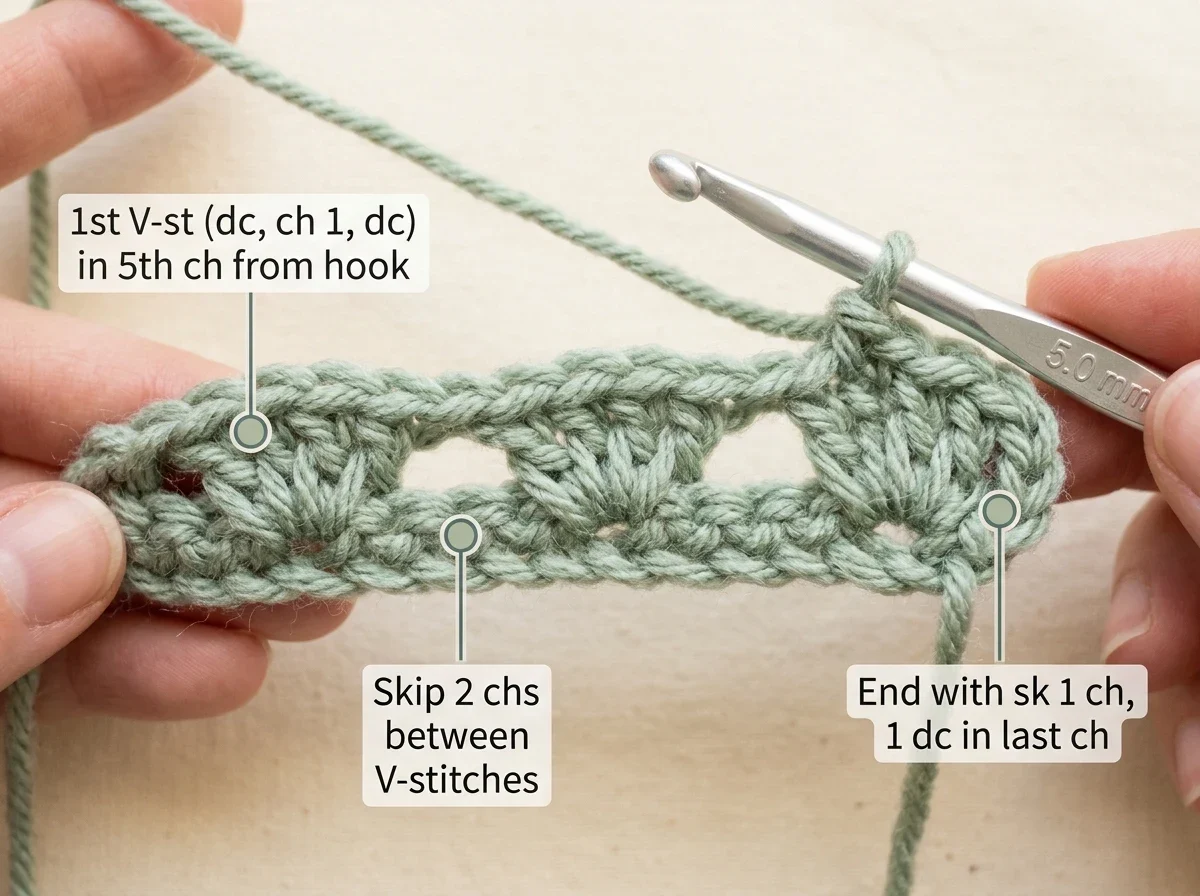
Foundation Chain: With worsted-weight (#4) yarn and a 5.0 mm (H-8) hook (or a 5.5 mm hook for the chain only), ch 94 (or any Multiple of 3 + 4 from the Sizing Chart above).
- Row 1 (Setup Row — RS): Work 1
V-st(dc, ch 1, dc)into the 5th ch from hook (the 4 skipped chains count as 1 starting edgedc+ 1 skipped base ch). *`Sk next 2 chs, work 1V-stin next ch; rep from` across until 2 chains remain (29 more V-stitches made). Sk next ch, work 1dcin the last ch. Turn. — 30 V-sts + 2 edgedc(Math check: 5 chs for 1st V-st + [29 repeats × 3 chs = 87 chs] + 2 chs for ending[sk 1, dc in last ch]=5 + 87 + 2 = 94 chainsaccounted for; 92 total stitches including ch-1 spaces).*

- Row 2 (One-Row Repeat — WS): Ch 3 (counts as first edge
dchere and throughout). Work 1V-st(dc, ch 1, dc)into the centerch-1 spof the firstV-stbelow, and work 1V-stinto thech-1 spof eachV-stacross (30 V-sts total). Work 1dcinto the top (3rd chain) of the previous row's turning chain. Turn. — 30 V-sts + 2 edgedc - Rows 3–66: Repeat Row 2 sixty-four more times until your blanket has 66 completed rows and measures approximately
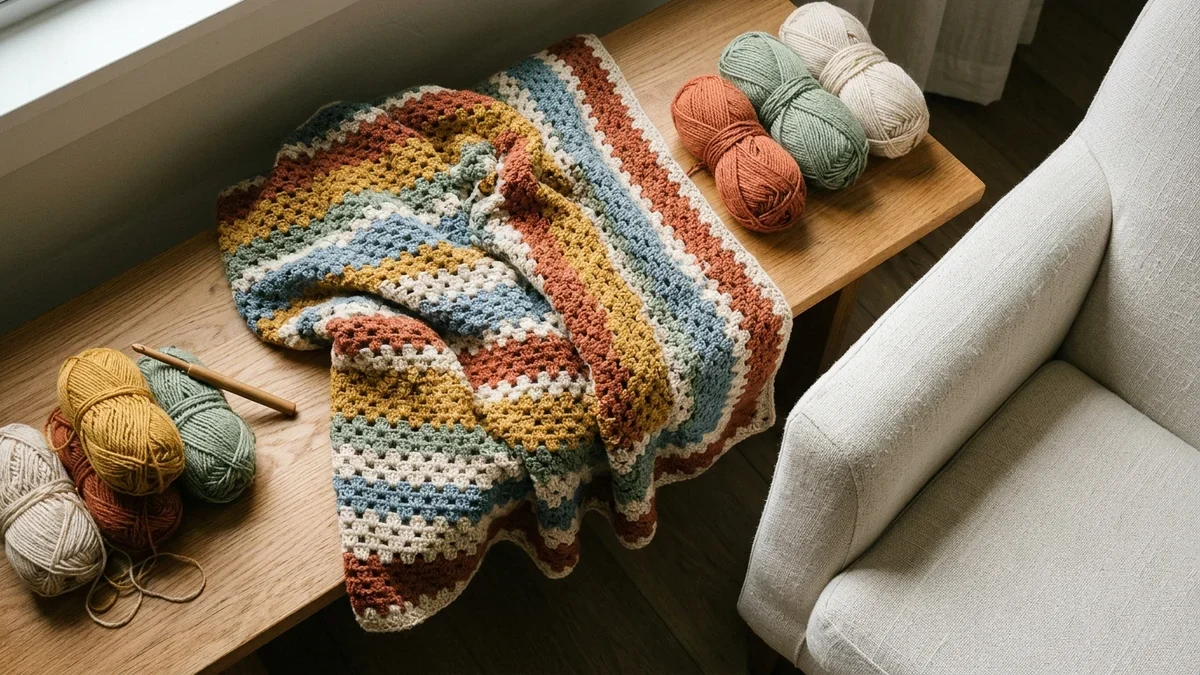
33.5"–34" (85–86 cm)long before the border (estimate).- (Optional 6-Row Nursery Stripe Sequence): Work 6 rows Natural Cream, 6 rows Soft Sage, 6 rows Buttercream Yellow; repeat that 18-row sequence 3 times (
54 rows), then finish with 6 rows Natural Cream and 6 rows Soft Sage (66 rows total).
- (Optional 6-Row Nursery Stripe Sequence): Work 6 rows Natural Cream, 6 rows Soft Sage, 6 rows Buttercream Yellow; repeat that 18-row sequence 3 times (
- Do not fasten off after Row 66 (or join your border color at the top-right corner with
RSfacing); proceed to Finishing.
Finishing: Baby-Safe 2-Round Border

A two-round border stabilizes the stretchy V-stitch edges and gives the blanket a polished, heirloom frame:
Round 1: Single Crochet Framing Round
- With Right Side (
RS) facing, ch 1 (does not count as a st). - Top Edge: Work 1
scin the first edgedc, then work 2scinto each V-stitch across (1scin the firstdcand 1scin thech-1 sp, skipping the seconddcof each V so the top edge doesn't flare—or work 3scper V-stitch if your single crochet tension is tight), and work 3scinto the corner edge stitch to turn 90 degrees. - Left Side Edge (Row Ends): Work 2
scevenly into the side of eachdcrow end down the vertical side (66 rows × 2 sc = 132 side sc). - Bottom Corner: Work 3
scinto the bottom corner. - Bottom Foundation Edge: Work 2
scat the base of each V-stitch across the bottom foundation chain so the stitch count matches your top edge, and work 3scinto the second bottom corner. - Right Side Edge (Row Ends): Work 2
scinto the side of eachdcrow end up to the starting corner, work 2 morescinto the starting corner space (completing the 3-sccorner), and join with asl stto the firstsc.
Round 2: Choose Simple sc OR Baby-Safe Scalloped Shells
- Option A — Clean Modern Single Crochet Frame: Ch 1, work 1
scin eachscaround, placing 3scin the centerscof each corner, and join with an invisible needle join. - Option B — Low-Profile Scalloped Shell Edging: Ch 1,
scin first st, *`sk next 2 sts, work 5dc(shell) in next st, sk next 2 sts,scin next st; rep from` around*, adjusting the final repeat before each corner by 1–2 stitches so a 5-dcshell lands neatly at each corner point. Join with asl stto the firstsc, fasten off, and weave all ends securely into the blanket in 3 alternating directions.
Variations (Solid Zero-Gap V-Stitch & Colorwork)
1. Solid "No-Chain" V-Stitch Variation (2 dc Cluster — Zero Finger Gaps)
If you want an ultra-cozy newborn blanket with no ch-1 holes at all:
- Chain any even number (such as Ch 96 for a Stroller Blanket).
- Row 1: Work
2 dcin the 4th ch from hook, *`sk next ch, work2 dcin next ch; rep from across to last 2 chs, sk 1 ch, work 1dc` in last ch*. Turn. - Row 2: Ch 3, work
2 dcdirectly into the tight V-split between the twodcposts of each pair across, ending with 1dcin the top of the turning chain.
2. Double-Stranded Bulky Speed Blanket
Hold 2 strands of DK (#3) yarn together (one solid cream strand + one pastel variegated strand) with a 6.5 mm (US K-10.5) hook and chain 70 (3 × 22 + 4 = 22 V-stitches) for a marled, plush baby blanket that works up in a single weekend (estimate).
Troubleshooting Common V-Stitch Baby Blanket Issues
Problem / Symptom | Cause | How to Fix It |
|---|---|---|
Foundation edge pulls tighter than the rest of the blanket | Starting chain was worked too tightly compared to the open V-stitch rows. | Always make your foundation chain ( |
Blanket gets wider or narrower after several rows | Accidentally working a V-stitch into the gap next to the | Count your V-stitches every 5 rows ( |
Border waves or ruffles along the top and bottom edges | Working 3 | Work 2 |
Frequently Asked Questions
What is the stitch multiple for a V-stitch baby blanket?
For a classic symmetrical V-stitch (dc, ch 1, dc) where you skip 2 chains between V-stitches and frame both side edges with a standalone dc post, the foundation chain multiple is a Multiple of 3 + 4 (for example, Ch 40, Ch 94, Ch 106, Ch 112, or Ch 130).
Is a V-stitch crochet blanket safe for a newborn baby?
Yes, provided you use a standard 5.0 mm hook (or smaller) so the ch-1 spaces stay compact, use a machine-washable non-shedding yarn, and finish the blanket with a flat or low-profile stitched border rather than loose fringe or tassels. For a completely hole-free surface, use the Solid 2-dc V-Stitch Variation (without the ch 1).
How many skeins of yarn do I need for a V-stitch baby blanket?
A standard 30" × 35" stroller/nursery V-stitch blanket uses approximately 850 to 950 yards (300–340 g) of worsted-weight (#4) yarn (estimate), which equals 3 standard 100 g (~300–315 yd) skeins (or 4 skeins if you want extra yardage for a multi-round border).
Why does the V-stitch work up so much faster than single or solid double crochet?
Because every row after Row 1 is worked directly into the large, easy-to-see ch-1 center space of the V-stitch below rather than under tiny individual top loops, your hook glides into the center of each V by feel—making it an effortless no-look project once Row 1 is complete.
Do I need to block a V-stitch baby blanket?
Lightly steam-blocking (for acrylic) or wet-blocking (for cotton or superwash wool) helps open up the V-chevron texture and relaxes the starting and ending edges so the blanket drapes evenly.
About the Author
Claire Vance is a crochet pattern designer, technical editor, and fiber educator at DoubleCrochet.io. She designs heirloom baby blankets and teaches stitch multiples and sizing math according to Craft Yarn Council standards.




Questions & notes
No comments yet
Sign in or create a free account to comment under your profile and keep track of your replies.
Your email address is never published. Comments are moderated under our Community Guidelines; see our Privacy Policy for how we use your details.