Free Modern Granny Stripe Blanket Pattern (7 Sizes)
Rows of 3-dc clusters with straight edges, a size chart from lovey to queen, and four modern ways to plan the stripes.

10 min read
Pattern at a glance
- Hook
- 5.5 mm (US I-9) plus 6.0 mm for the chain (worsted); 4.5 mm (US 7) plus 5.0 mm (DK)
- Yarn
- CYC #4 worsted/aran or CYC #3 DK; see the size chart for yardage
- Finished size
- Seven sizes, from 18 × 18 in (46 × 46 cm) to 90 × 100 in (229 × 254 cm)
- Gauge
- 4.5 clusters (13.5 dc) × 8 rows = 4 in (10 cm), blocked, in worsted
- Terms
- US terms
Materials
- YarnCYC #4 worsted/aran or CYC #3 DK
- Crochet hooksMain hook plus one 0.5 mm larger for the chain
Abbreviations
- ch
- chain
- dc
- double crochet
- sc
- single crochet
- sp(s)
- space(s) between clusters
- Cl
- cluster (3 dc in the same space)
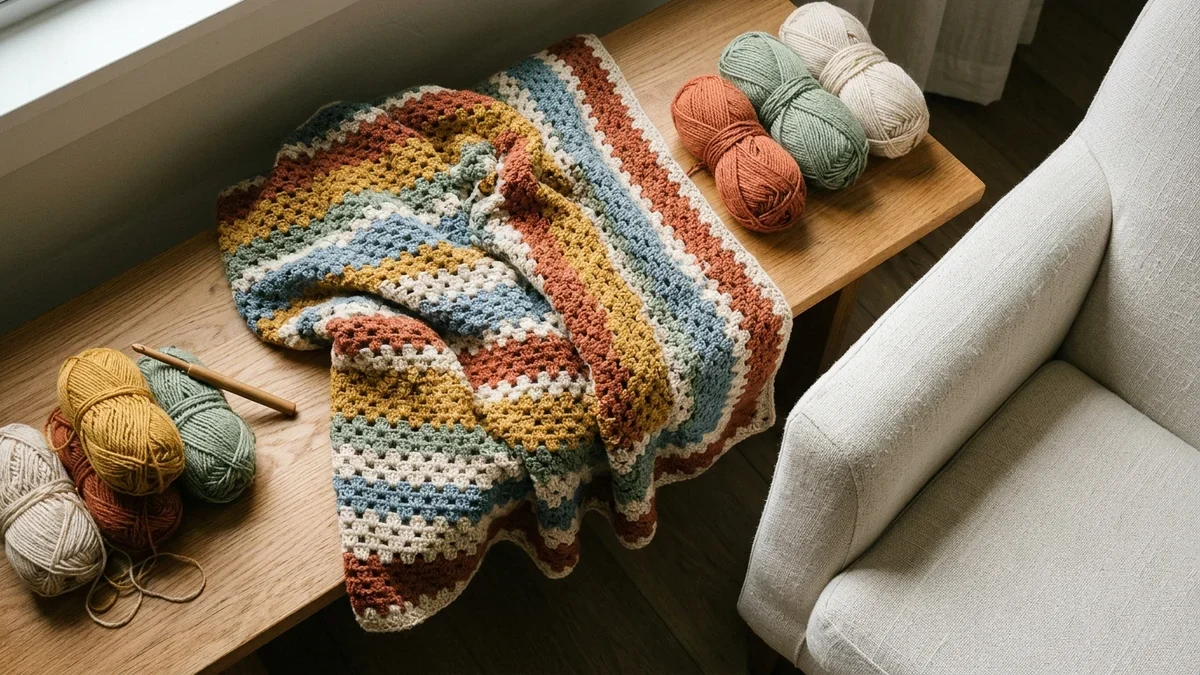
This free modern granny stripe blanket pattern takes the nostalgic 3-double-crochet cluster rhythm of a traditional granny square and works it in flat, back-and-forth rows with crisp, straight edges. By starting with a solid single crochet foundation row—a technique popularized by Lucy of Attic24 and Purl Soho's Granny Stripe Blanket—the bottom edge lies completely flat instead of dipping between clusters. Below you will find the exact Multiple of 3 + 2 starting chain formula, a 7-size chart from Baby Lovey to Queen, and step-by-step instructions for DK (#3) and Worsted (#4) yarn.
Terminology note: This pattern is written in standard US crochet terms. In UK crochet terminology, a US double crochet (dc) is called a treble crochet (tr), and a US single crochet (sc) is called a double crochet (dc).
Understanding the Granny Stripe Stitch Multiple (Multiple of 3 + 2)
Once you complete the solid setup row, every row of the granny stripe is worked entirely into the spaces between 3-dc clusters rather than into the top loops of individual stitches.

Here is how the Multiple of 3 + 2 arithmetic works on a sample 14-chain setup (3 × 4 + 2 = 14 chains):
- Foundation Chain (
14 ch): Chain any multiple of 3, plus 2 extra chains. - Row 1 (Solid Base Row —
13 sc): Work1 scin the 2nd chain from the hook and in each chain across. You now have 13 single crochets (3 × 4 + 1 = 13 sts). - Row 2 (Full-Cluster Edge Row —
4 clusters + 2 edge dc):Ch 3(counts as1 dcon the right edge) and work1 dcinto the very first stitch (or work3 dcin the first space depending on the edge style; in our straight-edge method below,ch 3counts as the edge stitch, skip 1 st, then work3 dcinto the next st,*skip 2 sts, 3 dc in next st*across, skip 1 st,1 dcin the final stitch).- That places 4 full
3-dcclusters across the interior, framed by1 dcat each side edge (4 × 3 + 2 = 14 dctotal).
- Row 3 (Half-Cluster Edge Row —
3 full clusters + two 2-dc edge clusters):- To stagger the clusters like brickwork so the side edges stay ruler-straight, Row 3 begins with
ch 3, 1 dcin the first space between the edge stitch and the first cluster (a 2-dc half-cluster), works3 dcinto each space between clusters across the center, and ends with2 dcin the final space before the turning chain.
- To stagger the clusters like brickwork so the side edges stay ruler-straight, Row 3 begins with
Master Blanket Sizing, Starting Chain & Yardage Chart (7 Sizes)
Every starting chain below is pre-calculated to an exact Multiple of 3 + 2. If you want to customize the width or length for a different yarn gauge, use our blanket size tool.
Blanket Size | Finished Dimensions (W × L) | Option A: DK (#3) Starting Chain ( | Option A: DK (#3) Row 1 Stitch Count ( | Option A: DK (#3) Total Rows | Option B: Worsted (#4) Starting Chain ( | Option B: Worsted (#4) Row 1 Stitch Count ( | Option B: Worsted (#4) Total Rows | Est. Yardage (DK #3 / Worsted #4) (estimate) |
|---|---|---|---|---|---|---|---|---|
Lovey / Security | 18 × 20 in (46 × 51 cm) | Ch 83 ( | 82 sc (27 clusters) | 46 rows | Ch 68 ( | 67 sc (22 clusters) | 40 rows | 380 yd / 320 yd (estimate) |
Stroller / Crib | 30 × 36 in (76 × 91 cm) | Ch 137 ( | 136 sc (45 clusters) | 82 rows | Ch 113 ( | 112 sc (37 clusters) | 72 rows | 1,100 yd / 950 yd (estimate) |
Receiving Baby | 36 × 40 in (91 × 102 cm) | Ch 164 ( | 163 sc (54 clusters) | 92 rows | Ch 134 ( | 133 sc (44 clusters) | 80 rows | 1,480 yd / 1,260 yd (estimate) |
Lapghan | 40 × 50 in (102 × 127 cm) | Ch 182 ( | 181 sc (60 clusters) | 114 rows | Ch 149 ( | 148 sc (49 clusters) | 100 rows | 2,050 yd / 1,750 yd (estimate) |
Standard Throw | 50 × 60 in (127 × 152 cm) | Ch 227 ( | 226 sc (75 clusters) | 138 rows | Ch 188 ( | 187 sc (62 clusters) | 120 rows | 3,050 yd / 2,600 yd (estimate) |
Twin Bed | 60 × 85 in (152 × 216 cm) | Ch 272 ( | 271 sc (90 clusters) | 194 rows | Ch 224 ( | 223 sc (74 clusters) | 170 rows | 5,150 yd / 4,400 yd (estimate) |
Queen Bed | 85 × 90 in (216 × 229 cm) | Ch 383 ( | 382 sc (127 clusters) | 206 rows | Ch 317 ( | 316 sc (105 clusters) | 180 rows | 7,700 yd / 6,600 yd (estimate) |
Gauge & Arithmetic Check
- Option A (DK #3 on 4.5 mm US 7 hook): Target gauge is 6 clusters (18 dc) × 9.2 rows = 4 × 4 in (10 × 10 cm) (4.5 sts/in; 2.3 rows/in) (estimate).
- Standard Throw (50 in wide): $50 ext{ in} imes 4.5 ext{ sts/in} = 225 ext{ sts}$. Nearest multiple of $3 + 2$ is $ ext{Ch } 227$ ($3 imes 75 + 2 = 227$).
- Option B (Worsted #4 on 5.0 mm US H-8 hook): Target gauge is 5 clusters (15 dc) × 8 rows = 4 × 4 in (10 × 10 cm) (3.75 sts/in; 2.0 rows/in) (estimate).
- Standard Throw (50 in wide): $50 ext{ in} imes 3.75 ext{ sts/in} = 187.5 ext{ sts}$. Nearest multiple of $3 + 2$ is $ ext{Ch } 188$ ($3 imes 62 + 2 = 188$).
Materials, Hooks & Abbreviations
- Yarn:
- Option A: CYC #3 Light / DK weight acrylic, cotton-blend, or superwash merino wool in 5 coordinating colors.
- Option B: CYC #4 Medium / Worsted weight acrylic, cotton-blend, or wool-blend yarn in 5 coordinating colors.
- Crochet Hook:
- Option A (DK #3): 4.5 mm (US 7) hook, plus a 5.0 mm (US H-8) hook for the starting chain.
- Option B (Worsted #4): 5.0 mm (US H-8) hook, plus a 5.5 mm (US I-9) hook for the starting chain.
- Abbreviations (US Terms):
- ch: chain
- sc: single crochet (UK double crochet —
dc) - dc: double crochet (UK treble crochet —
tr) - sp: space between 3-dc clusters
- st(s): stitch(es)
Complete Written Pattern: The Modern Granny Stripe Blanket
Setup: Foundation Chain & Row 1 (Solid Single Crochet Base)
- Using a hook 0.5 mm larger than your main body hook (so the bottom edge does not pull tight), chain the number listed in the chart for your size (any Multiple of 3 + 2; for a practice swatch, Ch 20).
- Row 1 (RS): Switch to your main hook. Work
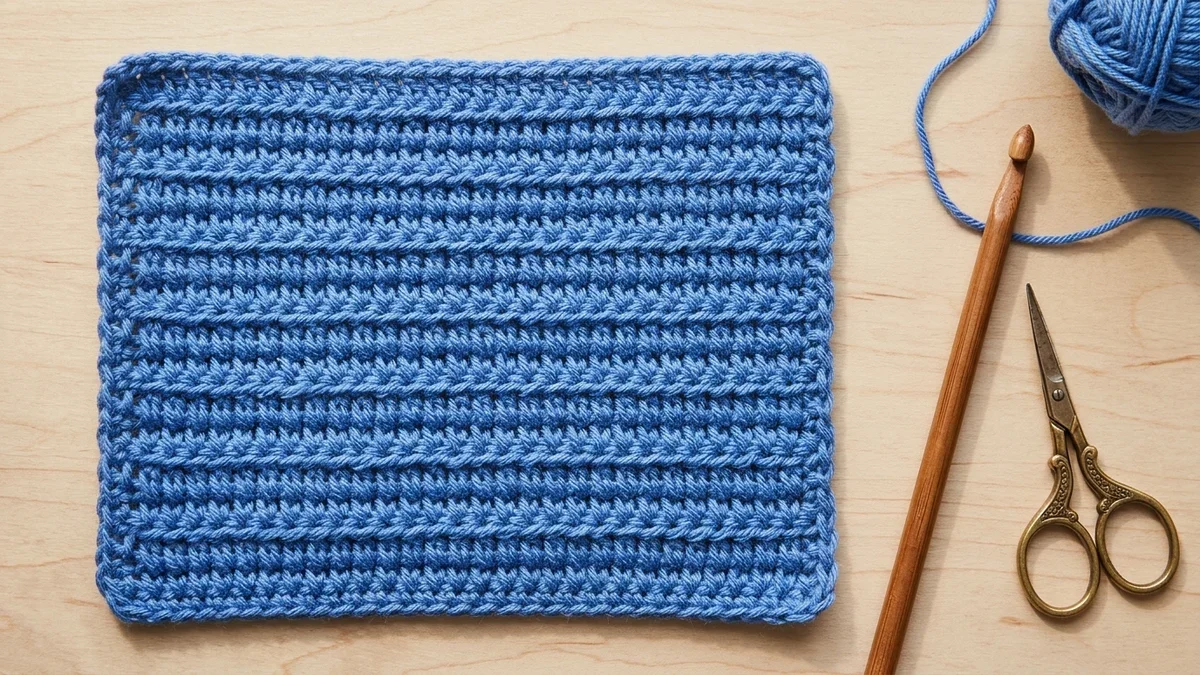
1 scinto the 2nd chain from the hook and into each chain across. Turn.- Swatch Stitch Count: 19 sc (
3 × 6 + 1 = 19).
- Swatch Stitch Count: 19 sc (
The Two-Row Granny Stripe Repeat (Rows 2 and 3)
Row 2 (Full-Cluster Row — WS):
Ch 3(counts as1 dchere and throughout).- Skip the very first stitch at the base of the
ch 3and skip the next stitch; work3 dcinto the 3rd stitch. *Skip the next 2 stitches, work 3 dc into the next stitch*;repeat from*to*across until 2 stitches remain.- Skip the next stitch, and work
1 dcinto the final stitch of the row. Turn. - Swatch Count: 6 full
3-dcclusters + two1-dcedge stitches (6 × 3 + 2 = 20 dc).
Row 3 (Half-Cluster Staggered Row — RS):
Ch 3(counts as1 dc), and work1 dcinto the very first space between the edgedcand the first3-dccluster below (thisch 3 + 1 dcforms a 2-dc half-cluster at the right edge).*Skip the next 3-dc cluster, and work 3 dc into the space before the next cluster*;repeat from*to*across until you reach the last cluster.- Skip the last
3-dccluster, and work2 dcinto the final space between the last cluster and thech 3turning chain (work1 dcinto the space and1 dcinto the top of thech 3turning chain for the crispest edge). Turn. - Swatch Count: 5 full
3-dcclusters + two2-dcedge half-clusters (5 × 3 + 4 = 19 dc).
Row 4 (Full-Cluster Row on Spaces — WS):
Ch 3(counts as1 dc).- Skip the first
2-dchalf-cluster, and work3 dcinto the space between the half-cluster and the next3-dccluster. *Skip the next 3-dc cluster, and work 3 dc into the next space between clusters*;repeat from*to*across to the final2-dchalf-cluster.- Skip the first
dcof the final half-cluster, and work1 dcinto the top of thech 3turning chain. Turn.
Remaining Rows:
- Repeat Rows 3 and 4 until your blanket reaches your target row count. Change colors every 2 rows for classic granny stripes, or use our stripe calculator to generate a random, Fibonacci, or ombré stripe sequence.
How to Change Colors Seamlessly with Standing Double Crochet Joins

When you change colors at the end of a row, you have two clean options:
- Final Pull-Through Method: On the final
dcof the old color row, work the stitch until 2 loops remain on the hook, yarn over with the new color, pull through the last 2 loops, andch 3to turn. - Standing Double Crochet Method: Fasten off the old color completely, turn your work, place a slip knot of the new color on your hook, and work a standing dc joins stitch directly into the first stitch or space—eliminating the visible
ch 3turning chain altogether.
3 Curated 5-Color Granny Stripe Palettes

To keep a multi-color granny stripe blanket looking cohesive rather than busy, build a 5-color palette that includes one light neutral (Cream, Ivory, or Oat), one deep anchor shade (Espresso, Navy, or Forest), and three mid-tone accent shades:
- Warm Desert: Terracotta, Ochre Gold, Sage Green, Warm Cream, and Deep Espresso.
- Coastal Mist: Deep Navy, Dusty Blue, Seafoam Green, Warm Sand, and Soft Ivory.
- Modern Botanical: Forest Green, Olive, Dusty Blush, Rust Orange, and Heathered Oat.
Adding a Crisp Linen Stitch (Moss Stitch) Border

Because every granny stripe row ends with a double crochet post, a 3-round Linen Stitch (Moss Stitch) border (*1 sc, ch 1, skip 1*) frames the colorful clusters cleanly without ruffling:
- Round 1: With your neutral border color, work
(1 sc, ch 2, 1 sc)in each corner,*1 sc, ch 1, skip 1 st*across the top and bottom edges, and 2 sc per double crochet row end (1 sc, ch 1per row) along the two side edges. - Rounds 2–3: Work
1 sc, ch 1into everych-1space around, working(1 sc, ch 2, 1 sc)into eachch-2corner space.
Common Mistakes & Troubleshooting
1. The Side Edges Indent Inward Every Other Row (Sawtooth Edges)
- Cause: Forgetting to alternate between 1 edge
dcon even rows (Row 2 / Row 4) and a 2-dc half-cluster (ch 3, 1 dcin first space) on odd rows (Row 3). - Fix: Check the start of your row before you begin: if the row below starts with a full
3-dccluster right next to the edge stitch, your current row must start with a2-dchalf-cluster (ch 3, 1 dcin the first space).
2. The Bottom Edge Pulls Tighter Than the Blanket Body
- Cause: Foundation chains and single crochet rows have less horizontal stretch than 3-dc cluster rows.
- Fix: Always work your starting chain with a hook 0.5 mm to 1.0 mm larger than your main blanket hook, or start with Foundation Single Crochet (
fsc).
Frequently Asked Questions
Do I need to chain 1 (ch 1) between each 3-dc cluster?
No! In a flat Granny Stripe blanket, you do not chain 1 between the 3-dc clusters on the interior of the row. The natural space between two adjacent 3-dc groups is wide enough to insert your hook on the next row, and omitting the ch 1 keeps the blanket warm and prevents your fingers from catching in wide holes.
Can I start a Granny Stripe blanket without the Row 1 single crochet base?
You can work Row 1 directly as 3-dc clusters into the foundation chain (3 dc in 4th ch from hook, *skip 2 ch, 3 dc in next ch*), which creates a vintage scalloped zig-zag bottom edge. Working the solid sc setup row first gives the blanket a straight, modern bottom edge that matches the top edge.
How do I avoid weaving in hundreds of yarn tails on a 2-row stripe blanket?
If you plan to add a solid border around the blanket at the end, crochet over your yarn tails for the first 2 clusters of the row, or carry a recurring neutral cream yarn up the side edge across 2-row jumps so it is hidden inside the border round later.



Questions & notes
No comments yet
Sign in or create a free account to comment under your profile and keep track of your replies.
Your email address is never published. Comments are moderated under our Community Guidelines; see our Privacy Policy for how we use your details.