Double crochet (dc): step-by-step stitch guide, turning chains and calculators
Double crochet (dc in US terms, treble or tr in UK terms) is the tall basic stitch behind most blankets, granny squares and garments. You wrap the yarn over the hook once, insert it, then pull through two loops twice. Learn it step by step below, or work out your starting chain and rows with the planner.
- Abbreviation
- dc (US), tr (UK)
- First stitch
- 4th chain from the hook
- Turning chain
- Chain 3 (counts) or chain 2 (does not)
- Height
- About twice a single crochet
- Flat circle
- 12 dc, then +12 each round
Step by step
How to make a double crochet stitch
Four moves, with a loop count to check after each one.
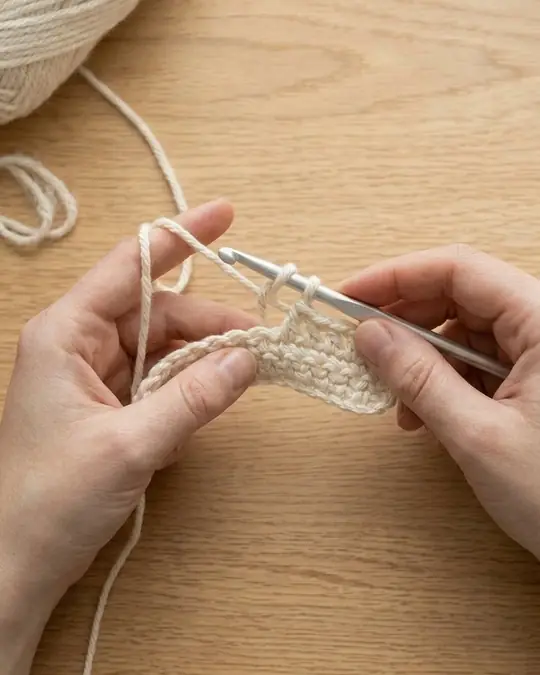
Step 1: Yarn over and insert the hook
Wrap the yarn over the hook from back to front. On the first row, insert the hook into the 4th chain from the hook, without counting the loop on the hook. On later rows, insert it under both top loops of the stitch.
2 loops on the hook
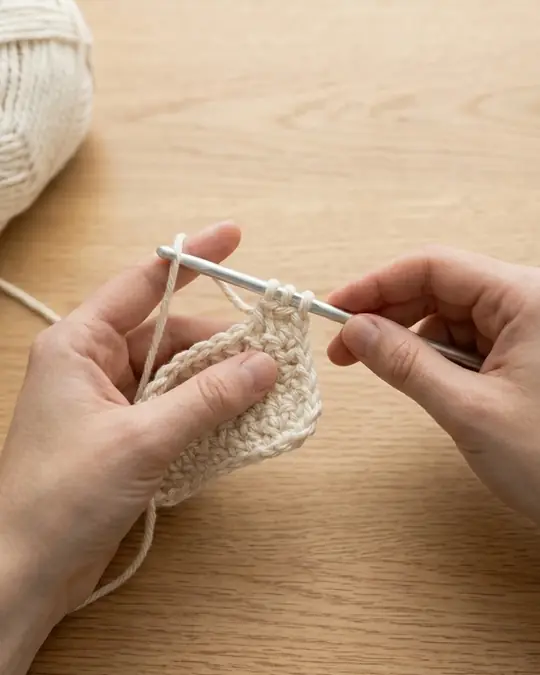
Step 2: Pull up a loop
Yarn over again and draw the yarn back through the chain or stitch. Check the hook before you go on.
3 loops on the hook
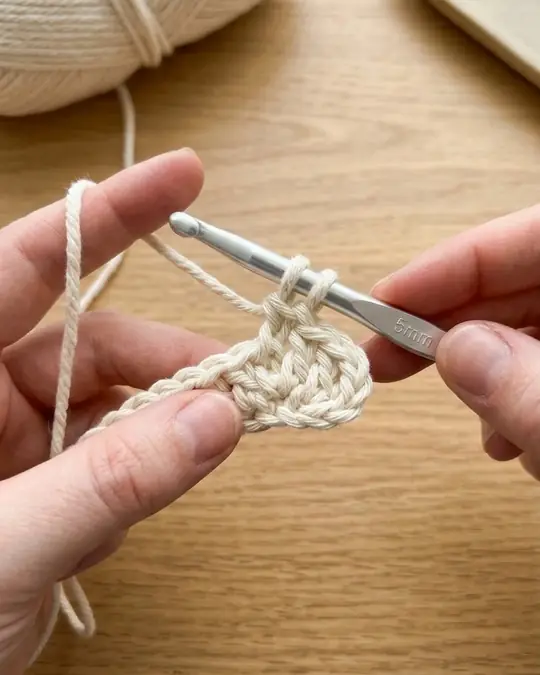
Step 3: Pull through the first two loops
Yarn over and pull through the first 2 loops only. The stitch is half finished.
2 loops on the hook
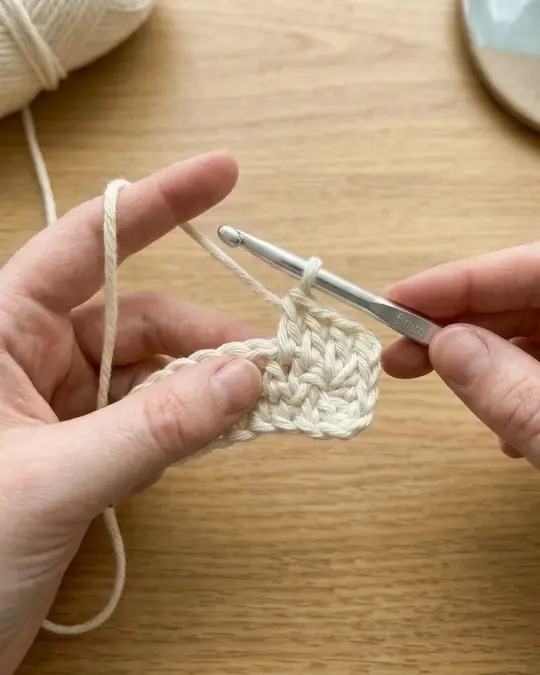
Step 4: Pull through the last two loops
Yarn over and pull through the remaining 2 loops. One double crochet is done.
1 loop on the hook
Row 1 vs row 2: where the first and last stitch go
Chain 16 and work the first dc into the 4th chain from the hook, then 1 dc in each chain to the end. The 3 chains you skipped count as a stitch, so the row has 14 stitches. To start row 2, chain 3 and turn. That chain is your first stitch, so skip the stitch directly below it and work the next dc into the second stitch. Work the last dc of the row into the top chain of the turning chain from the row below.
Chains
Double crochet foundation chain and turning chain rules
20stitches222chains
Plain double crochet with a chain 3 that counts as the first stitch.
Why patterns add chains for the turning chain
For a row of plain double crochet, chain the number of stitches you want plus 2, then work the first dc into the 4th chain from the hook. The 3 chains you skip stand up as the first stitch. For 20 stitches, chain 22.
If your pattern says the turning chain does not count as a stitch, chain your stitch count plus 3 and start in the 4th chain, or chain your count plus 2 for a chain-2 turn and start in the 3rd chain. Designers do this differently, and either way works if you follow it on every row. The foundation chain calculator handles stitch repeats too.
Straight edges: chain 2, stacked and standing double crochet
A chain 3 is thinner than a real stitch, so it can leave small gaps along the sides of a blanket. The table compares the usual fixes: a shorter chain 2 that does not count, a stacked stitch (a single crochet with a second single crochet worked into its side), and a standing double crochet that starts with the loop already on the hook.
Starting without a chain: foundation double crochet
Foundation double crochet (fdc) makes the chain and the first row at the same time. The edge stretches as much as the rows above it, so it suits garments, hat brims and wide blankets where a starting chain would pull in. Follow the foundation double crochet tutorial.
Ways to start a row of double crochet
Chain 3
- Counts as a stitch?
- Yes, as the first dc
- Next dc goes into
- 2nd stitch
- Edge
- The classic start; can leave small gaps at the edge
Chain 2
- Counts as a stitch?
- No
- Next dc goes into
- 1st stitch
- Edge
- Tighter edge with fewer gaps
Stacked stitch
- Counts as a stitch?
- Yes, as the first dc
- Next dc goes into
- 2nd stitch
- Edge
- Neat edge with almost no gaps
Standing dc
- Counts as a stitch?
- Yes, it is a real dc
- Next dc goes into
- It is the 1st stitch
- Edge
- No chain at all; often used to join new yarn or a new colour
Terminology
US vs UK double crochet terms
Why a US double crochet is a UK treble
US terms name a stitch by how it is worked. UK terms count the loops on the hook after you pull up the first loop. A US double crochet has 3 loops on the hook at that point, so UK patterns call it a treble (tr). That is why every UK name is one step taller than the US name for the same stitch.
How to tell which terms a pattern uses
- sc or hdc anywhere in the pattern: US terms. UK terms have no single crochet.
- htr (half treble): UK terms.
- Skip a stitch is US; miss a stitch is UK.
- Gauge is US; tension is UK.
Still unsure? Paste the pattern line into the US to UK crochet terms converter.
US and UK stitch names
| US terms | UK terms |
|---|---|
| slip stitch (sl st) | slip stitch (ss) |
| single crochet (sc) | double crochet (dc) |
| half double crochet (hdc) | half treble crochet (htr) |
| double crochet (dc) | treble crochet (tr) |
| treble crochet (tr) | double treble crochet (dtr) |
| double treble crochet (dtr) | triple treble crochet (trtr) |
Stitch library
Learn crochet stitches
US and UK names side by side, with instructions you can follow loop by loop.
Double Crochet Variations
4 stitchesHalf Double Crochet Variations
1 stitchTreble & Triple Stitches
1 stitchTextured Stitches
5 stitchesFoundation & Standing Stitches
2 stitchesDecreases
1 stitchPost Stitches
1 stitchBasic Stitches
3 stitchesIncreases
1 stitch


- Back loop double crochet
dc BLO / dc FLO - Chain
ch - Crossed double crochet
crossed dc (X-st) - Double crochet cluster
dc-cl, bobble, popcorn - Double crochet shell stitch
5dc shell - Double crochet
dc - Extended double crochet
edc - Foundation double crochet
fdc - Front post double crochet
FPdc / BPdc - Half double crochet
hdc - Herringbone double crochet
HBdc - Double crochet increase
dc inc
Gauge
Double crochet gauge, row height and yarn weight
How double crochet compares with other stitches
Each basic stitch is about one chain taller than the one before it, which is why the turning chains go up 1, 2, 3, 4. Double crochet is about twice as tall as single crochet, so the same length takes roughly half as many rows, and the fabric is softer with more drape. Compare it with half double crochet and treble crochet.
Yarn weights and the Craft Yarn Council gauge
The Craft Yarn Council's yarn weight standard gives a crochet gauge for each weight, measured in single crochet over 4 inches (10 cm), with a recommended hook range. Your double crochet gauge will be different, so treat these numbers as a starting point and swatch in double crochet before you plan a project.
Fixing gauge: hook size for width, loop height for rows
If you have too many stitches across 4 inches, go up a hook size; too few, go down. Row height in double crochet depends mostly on how tall you pull up the first loop, which some teachers call the golden loop. If your rows are too short, let that loop come up a little taller before you finish the stitch; if they are too tall, keep it closer to the hook. Block your swatch before you measure, then let the gauge calculator resize the pattern.
| Stitch (US) | UK name | Turning chain | Usually counts as a stitch? |
|---|---|---|---|
| single crochet (sc) | double crochet (dc) | Chain 1 | No |
| half double crochet (hdc) | half treble crochet (htr) | Chain 2 | No |
| double crochet (dc) | treble crochet (tr) | Chain 3 | Yes |
| treble crochet (tr) | double treble crochet (dtr) | Chain 4 | Yes |
| Weight | Also called | sc per 4 in (10 cm) | Hook |
|---|---|---|---|
| 1 Super Fine | sock, fingering, baby | 21–32 | 2.25–3.5 mm |
| 2 Fine | sport, baby | 16–20 | 3.5–4.5 mm |
| 3 Light | DK, light worsted | 12–17 | 4.5–5.5 mm |
| 4 Medium | worsted, afghan, aran | 11–14 | 5.5–6.5 mm |
| 5 Bulky | chunky, craft, rug | 8–11 | 6.5–9 mm |
| 6 Super Bulky | super bulky, roving | 7–9 | 9–15 mm |
Shaping
Shaping in double crochet: increases, decreases and flat circles
Increases
To increase, work 2 dc into the same stitch (written 2 dc in next st, or dc inc). That adds 1 stitch. Three dc in one stitch add 2 stitches and make the corners of granny squares and the points of shells.
Decreases: dc2tog and the invisible decrease
dc2tog joins two stitches into one:
- Yarn over, insert into the next stitch, pull up a loop, yarn over and pull through 2 loops (2 loops left).
- Yarn over, insert into the following stitch, pull up a loop, yarn over and pull through 2 loops (3 loops left).
- Yarn over and pull through all 3 loops.
For a smoother slope in garments, many makers use an invisible decrease worked through the front loops. The dc2tog tutorial shows both, and the increase and decrease calculator spaces them evenly across a row.
Working in the round: the 12-stitch flat circle
A flat double crochet circle usually starts with 12 dc in a magic ring and adds 12 stitches every round: 12, 24, 36, 48, 60, 72. In round 2 work 2 dc in every stitch; in round 3 alternate 1 dc and 2 dc; each round after that adds one more plain stitch between increases. If the circle ruffles, you have too many stitches or loose tension; if it cups, you have too few or are working tightly. Moving the increases a little each round stops the circle turning into a hexagon. The circle calculator writes the rounds out for you.
Troubleshooting
Common double crochet mistakes and how to fix them
The stitch count grows every row
WhyWorking into the stitch right below the chain 3 when that chain counts as a stitch
FixSkip that stitch and start in the second one. Count every row until it becomes a habit.
The stitch count shrinks every row
WhyMissing the last stitch, which is the top of the turning chain from the row below
FixWork the last dc into the top chain of that turning chain. A stitch marker in the first and last stitch of each row makes them easy to find.
Gaps at the start of rows
WhyA chain 3 is thinner than a real stitch
FixTry a chain 2 that does not count, a stacked stitch or a standing double crochet.
Holes or slanted stitches in the middle of a row
WhyWorking between stitches, or under one loop, by mistake
FixInsert the hook under both top loops of each stitch unless the pattern says otherwise.
The starting edge pulls in
WhyThe foundation chain is tighter than the rows above it
FixChain with a hook one size larger, or start with foundation double crochet.
Stitches come out shorter than a double crochet
WhyPulling through all 3 loops at once, which makes a half double crochet
FixPull through 2 loops, yarn over, then pull through the last 2. Say "two, two" in your head as you work.
Calculators
Essential crochet calculators
Starting chains, blanket sizes, gauge, circles, even increases and yarn amounts, worked out for your numbers.
See all 55 calculators- Crochet stitch and row calculatorFind the stitches per row, rows, starting chain and total stitch count for any size, with an allowance for a border added later.
- Crochet blanket size calculatorStarting chain, stitches and rows for 14 standard blanket sizes from lovey to king, at your gauge, with border and yarn estimates.
- Crochet gauge calculatorTurn a measured swatch into stitches and rows per inch, per 4 in and per 10 cm, and get the stitch and row counts for any size.
- Crochet circle increase calculatorRound-by-round instructions for a flat crochet circle of any diameter, with staggered increases so it stays round, in US or UK terms.
- Increase or decrease evenly calculatorSpace increases or decreases evenly across a row or round and get stitch-by-stitch instructions you can follow, in US or UK terms.
- Yarn yardage calculatorEstimate how much yarn and how many balls a project needs from a weighed swatch, a pattern's yardage or yarn per stitch.

Featured pattern
V-Stitch Baby Blanket Crochet Pattern
An airy one-row repeat of V-stitches that you can make any width. Size it with the blanket calculator, then repeat the same row until it is long enough.
- Skill level
- Easy
- Yarn weight
- 4 Medium
- Hook
- 5.5 mm (US I-9)
Patterns
Find something to make
Browse by project, then filter by skill level and yarn weight.
Blankets & Squares
9 patternsHome
8 patternsWearables
14 patternsHats & Beanies
7 patternsAmigurumi
13 patternsBags
14 patternsAccessories
8 patterns




Skill levels
Find patterns at your level
Every pattern uses the four standard Craft Yarn Council skill levels.
- Beginner
Basic stitches, minimal shaping. A first project.
Beginner patterns - Easy
Basic stitches, simple repeats and colour changes.
Easy patterns - Intermediate
Varied stitches, shaping and finishing.
Intermediate patterns - Experienced
Intricate stitch patterns, fine yarns and detailed shaping.
Experienced patterns
Guides
Learn to crochet
Plain-language guides to techniques, terminology, yarn and tools.

FAQ
Frequently asked questions about double crochet
Which chain from the hook do you start a double crochet in?
Work the first double crochet into the 4th chain from the hook, without counting the loop on the hook. The 3 skipped chains count as the first stitch. If your pattern uses a chain 2 that does not count, start in the 3rd chain from the hook.
Does double crochet use more yarn than single crochet?
Each double crochet uses more yarn than a single crochet, because it is taller and has an extra wrap. How that adds up over a whole project depends on your yarn, hook and tension, so swatch in the stitch you will use and let the yarn yardage calculator do the estimate.
Can you work double crochet in continuous spiral rounds?
Yes. Instead of joining each round with a slip stitch and chaining 3, keep working into the first stitch of the next round. There is no seam, but double crochet is tall, so the end of the last round leaves a step. Taper it with a half double crochet, a single crochet and a slip stitch.
What is the chart symbol for a double crochet?
In crochet charts a double crochet is drawn as a tall T with one short diagonal line across the post. The line stands for the single yarn over before you insert the hook; a treble crochet has two lines.
Want every step in detail?
Full double crochet tutorial
About
Made for people who crochet
Double Crochet is an independent crochet publication. Every pattern lists its skill level, yarn weight, hook size and finished size before you start, and uses US terms unless it says otherwise.
Whether you are working your first chain or planning a blanket, start with a pattern at your level or a guide to the stitch you need.
New to crochet?
Start with the basic stitches, then pick a beginner pattern to practise them.