Back Loop Only (BLO) and Front Loop Only (FLO) Double Crochet
Work under one loop instead of both: back loop only for stretchy ribbing, front loop only for a flatter drape, and how to find a double crochet's third loop.

10 min read

Stitch at a glance
- US terms
- Back loop double crochet
dc BLO / dc FLO
By the DoubleCrochet Team | Last Updated: November 2026 | Skill Level: Beginner
To work a back loop double crochet (dc BLO), yarn over, insert your hook under only the back strand of the top V (the loop farthest away from you), and complete a standard double crochet (yarn over, pull up a loop, [yarn over, pull through 2 loops] twice). To work a front loop double crochet (dc FLO), yarn over and insert your hook under only the front strand of the top V (the loop closest to you). Leaving one strand of the top V unworked creates a horizontal surface line across the fabric—producing elastic, accordion-style ridges when worked in BLO and a smooth, elongated drape when worked in FLO.
(Terminology note: This tutorial uses US crochet terms; in UK patterns, a US double crochet (dc) is called a treble crochet (tr), so dc BLO is written as tr BLO or BLtr.)
Inserting your hook under only the back loop (BLO) leaves the front strand of the V exposed on the surface, creating a flexible horizontal ridge.
Quick Reference: dc BLO & dc FLO Specifications
Attribute | Back Loop Double Crochet ( | Front Loop Double Crochet ( |
|---|---|---|
US Abbreviations |
|
|
UK Equivalent | Treble Crochet Back Loop Only ( | Treble Crochet Front Loop Only ( |
Hook Insertion Point | Center of top | Under the front strand (closest to you) → up through the center of top |
Chart Symbol | Standard | Standard |
Turning Chain |
|
|
Stitch Multiple | Any number of stitches (no special multiple required) | Any number of stitches (no special multiple required) |
Primary Fabric Effect | Reversible accordion ridges ( | Flatter, slightly taller rows with an exposed horizontal line on the back |
Front Loop vs. Back Loop Anatomy (And What Happens When You Turn Your Work)
When you look straight down at the top edge of a finished row of double crochet, every stitch is capped by a sideways teardrop or V shape made of two strands of yarn:

- The Front Loop (
FLO): The strand of the topVthat sits closest to your chest as you hold the work. - The Back Loop (
BLO): The strand of the topVthat sits farthest away from you on the far side of the stitch. - The 3rd Horizontal Loop (Back Bar): A horizontal strand lying on the back face of the stitch just below the back loop, created by the yarn-over before the final pull-through of the double crochet.
Why Front and Back Are Always Relative to the Side Facing You
One rule confuses almost every beginner at first: "Front Loop" and "Back Loop" are determined by how you are holding the piece right now—not by the Right Side (RS) or Wrong Side (WS) of the project.
When you finish Row 1 and turn your work over to start Row 2, the two strands of the V trade places relative to your body. Because you turn the fabric at the end of every flat row:
- Working
dc BLOon every turned row leaves the unworked front loop on the Right Side on odd rows and on the Wrong Side on even rows, creating reversible horizontal ridges on both sides of your fabric. - Working
dc BLOin continuous or joined rounds without turning (such as on a hat crown or amigurumi basket) leaves every unworked front loop on the outside (Right Side) of the project while the inside remains smooth.
How to Back Loop Double Crochet (dc BLO) Step-by-Step
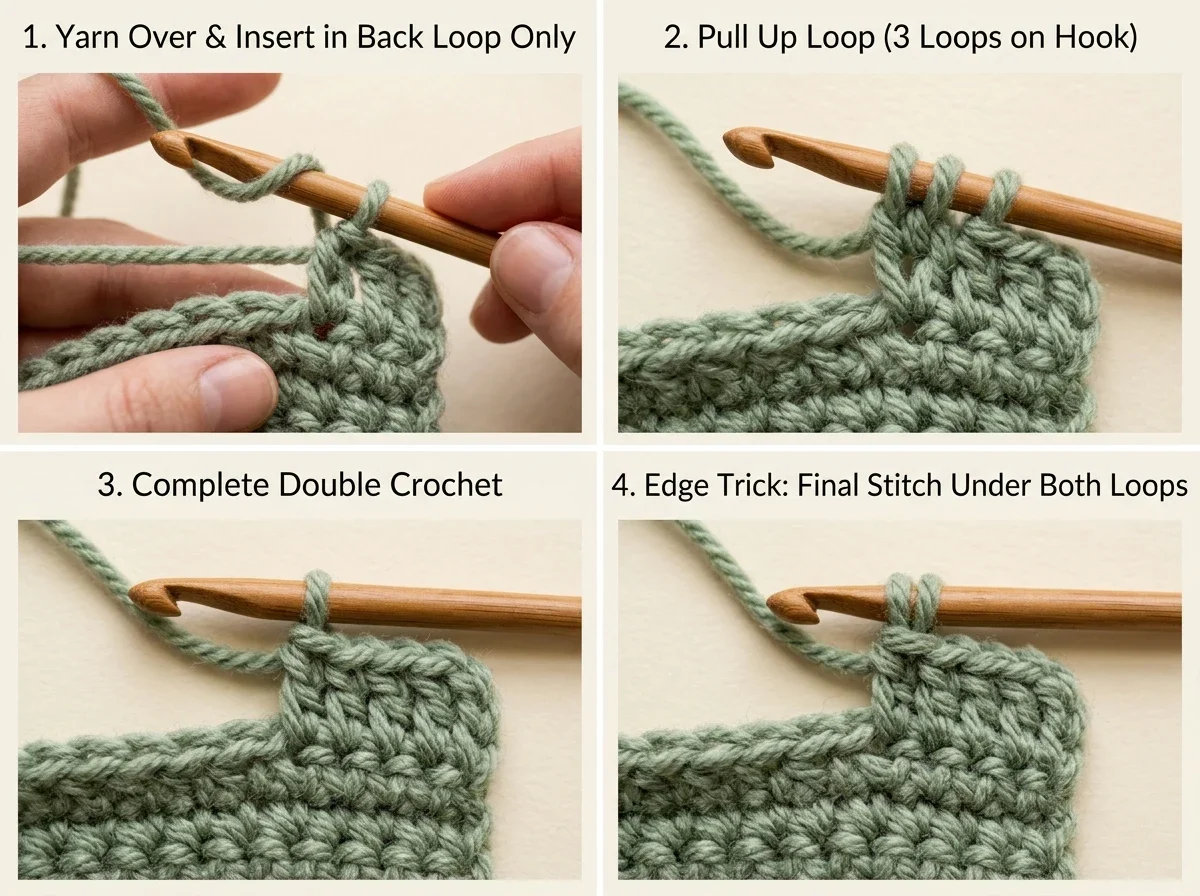
Step-by-Step Instructions: dc BLO
- Yarn Over (
yo): Wrap the working yarn from back to front over your crochet hook. - Insert into the Back Loop Only: Bring the tip of your hook down into the center of the top
Vof the next stitch and push it out underneath only the back strand (the loop farthest from you). Check that only 1 strand of theVis resting on top of your hook shaft, while the unworked front strand sits untouched in front of your hook. - Pull Up a Loop: Yarn over and draw a loop up through the back loop. You now have 3 loops on your hook.
- First Pull-Through: Yarn over and pull through the first 2 loops on your hook (2 loops remain).
- Final Pull-Through: Yarn over and pull through the remaining 2 loops on your hook. One
dc BLOis complete, and you will see a neat horizontal line formed by the unworked front loop right at the base of your stitch.
The Edge Lock Trick: Work Under BOTH Loops on the Final Stitch of the Row
When you work into only a single strand (BLO or FLO) at the very end of a row, the weight of the next turning chain pulls that single strand upward into a large, stretched-out eyelet.
- How to Fix It: Work
dc BLOacross every stitch of the row until 1 stitch remains. On that very last stitch of the row, insert your hook under both top loops (a standarddc)—or under the back loop AND the 3rd horizontal bar together. Anchoring the final stitch under two strands keeps both side edges of scarves, beanies, and blankets straight and firm.
How to Front Loop Double Crochet (dc FLO) Step-by-Step
- Yarn Over (
yo): Wrap the working yarn from back to front over your hook. - Insert into the Front Loop Only: Bring your hook tip from the front of the work underneath only the front strand of the next top
V(the loop closest to you), angling the hook upward so it exits right through the center between the front and back loops. - Complete the Double Crochet: Yarn over and pull up a loop (3 loops on hook), yarn over and pull through 2 loops (2 loops remain), yarn over and pull through the final 2 loops.
3 Practical Uses for Front Loop Only (FLO) Double Crochet
- Outward Hat Brims & Ruffled Edges: Working a single transition round in
dc FLO(as on Round 13 of our bucket hat) leaves the back loop inside to act as a hinge, kicking the fabric outward at a crisp angle. - Layered Surface Ruffles & Amigurumi Skirts: If you work one round of a garment or doll body in
BLO, you intentionally leave a neat horizontal row of unworked front loops (FLO) sitting on the surface. Later, you can attach new yarn directly into those exposed front loops to crochet a skirt, collar, or layered flower petals. - Alternating
FLOandBLOAcross the Same Row (Textured Weave): Alternating*1 dc FLO, 1 dc BLO*across each row staggers the stitch bases forward and backward, creating a pebbled, interlocking basket texture with zero gaps.
4 Swatches Compared: Standard DC vs. DC BLO vs. DC FLO vs. Post Ribbing (FPdc/BPdc)
How does working into a single loop change your fabric compared to standard double crochet or post-stitch ribbing? Compare the four textures side by side:

Swatch Type | Hook Insertion | Surface Texture | Stretch & Recovery | Relative Row Height & Thickness | Best Project Applications |
|---|---|---|---|---|---|
1. Standard | Under both top loops ( | Classic flat stacked posts | Moderate horizontal give; low vertical stretch | Baseline standard height and medium thickness | Blankets, granny squares, garments, totes |
2. | Under back loop only | Deep horizontal ridges on both sides every 2 rows | High vertical accordion stretch when turned sideways | Slightly compressed until stretched; cushy ridged profile | Sideways-constructed hats (like our BLO beanie), cuffs, cozy throws |
3. | Under front loop only | Flatter, subtler lines; alternate rows tilt slightly | Supple vertical drape; less springy recovery than | Slightly taller rows because the single front loop pulls upward | Drapey summer shawls, outward hat brims, layered surface trim |
4. Post Ribbing ( | Around the vertical post of the stitch below | Raised 3D vertical knit-like columns | Firm, springy horizontal elasticity | Shorter rows due to vertical compaction; thickest, densest fabric | Bottom-up sweater cuffs, neckbands, heavy winter brims |
When to ChooseBLORibbing vs. Post-Stitch Ribbing: If you are crocheting a hat or headband sideways in flat rows (where the rows run vertically from crown to brim and stretch around the head),dc BLO(orhdc BLO, as used in our ribbed ear warmer) gives you soft, flexible ribbing without extra bulk. If you are crocheting a sweater cuff or top-down hat brim in the round, use post-stitch ribbing (FPdc/BPdc) instead, because workingBLOin the round creates horizontal rings rather than vertical ribs.
Worked Practice Swatch: 16-Stitch dc BLO Ribbed Sample (With Arithmetic)
Want to feel how dc BLO behaves before starting a project? Grab scrap worsted-weight (#4) yarn and a 5.0 mm (H-8) hook to work this 16-stitch × 6-row sample swatch (approx. 4.5" × 3.25", estimate):
- Foundation Chain:
Ch 18(16 desired stitches + 2 chainsfor the startingdcturning height). - Row 1 (Base Row — Worked in Chain): Work
1 dcinto the 4th chain from the hook (the 3 skipped chains count as your firstdc), then work1 dcinto each of the remaining 14 chains across. Turn.- Row 1 Arithmetic:
1 starting ch-3 + 1 dc in 4th ch + 14 dc across = 16 dc total.
- Row 1 Arithmetic:
- Row 2 (
dc BLORow with Both-Loops Edge Lock):Ch 2(does not count as a stitch—using a non-countingch 2onBLOribbing keeps the side edges gap-free), work1 dc BLOinto the very first stitch at the base of thech 2, and work1 dc BLOinto each of the next 14 stitches across (15 dc BLOmade). In the 16th (final) stitch, work1 standard dcunder both top loops. Turn.- Row 2 Arithmetic:
15 dc BLO + 1 final dc under both loops = 16 sts total.
- Row 2 Arithmetic:
- Rows 3–6: Repeat Row 2 four more times (
15 dc BLO + 1 both-loops edge dc = 16 sts per row). Rotate the finished swatch 90 degrees and gently stretch it horizontally to test its accordion elasticity!
Does Double Crochet Have a 3rd Loop? (How to Find and Work Into It)
While half double crochet (hdc) is famous for its prominent 3rd loop (used for knit-look camel stitch), double crochet also has a 3rd horizontal loop tucked on the back side of the stitch just below the top V.

You can use the double crochet 3rd loop in two ways:
- 3rd Loop Only (
dc in 3rd loop— Faux-Knit Braid): Tilt the top of the previous row slightly toward you to spot the horizontal strand running right beneath the back loop. Insert your hook under only that 3rd horizontal bar. Because both the front loop and the back loop of theVare left unworked, the entireVtilts forward onto the front of the fabric like a raised knitted stockinette braid. - Back Loop + 3rd Loop Together (
Stabilized dc BLO): Sometimes working under a single back loop (dc BLO) pulls that lone strand upward and leaves small pinhole gaps along the ridge. If you insert your hook under both the back loop AND the 3rd horizontal bar at the same time, the front loop still forms a crisp horizontal ridge on the surface, but the two rear strands lock the stitch down so it cannot stretch open!
Frequently Asked Questions (FAQ)
Why is my Back Loop Double Crochet fabric getting wider or looser?
Working into a single loop (BLO or FLO) has less structural resistance than working under both loops of the V, so your hook can pull the loop up higher and looser than usual. Additionally, beginners often accidentally work into the turning chain at the start of the row AND the slip-stitch or edge stitch at the end. Count your stitches every 2 rows, work the final stitch of every row under both loops, and drop down 0.5 mm in hook size if your dc BLO fabric feels too loose.
When working dc BLO in the round, why do the ridges look different than in rows?
In flat turned rows, you alternate working on the Right Side and Wrong Side, which places a ridge on alternating sides of the fabric every two rows and creates an accordion pleat. In continuous or joined rounds without turning, you always work with the Right Side facing you, so every unworked front loop stays on the outside face of the tube—creating decorative concentric rings with less vertical stretch.
Should I work into the back loop on the foundation chain (Row 1)?
No—unless a pattern specifically tells you to work into the back bumps of the starting chain, work Row 1 as standard double crochet into the foundation chain, and begin working Back Loop Only (dc BLO) on Row 2 once you have true V stitch tops to insert your hook into.
What happens if a pattern doesn't specify BLO or FLO after a ribbed section?
In standard crochet pattern writing, working under both top loops is always the default. If Row 3 says "dc BLO across" and Row 4 simply says "dc in each st across", return to working under both loops on Row 4 unless the pattern explicitly says "Continue working in BLO throughout."
How do I count rows on a dc BLO ribbed piece?
Each raised horizontal ridge on the side facing you represents 2 rows of crocheting (one row worked away from you and one row worked back toward you). If you count 10 raised ridges on one side of a flat dc BLO panel, you have completed 20 rows.


Questions & notes
No comments yet
Sign in or create a free account to comment under your profile and keep track of your replies.
Your email address is never published. Comments are moderated under our Community Guidelines; see our Privacy Policy for how we use your details.