Crossed Double Crochet Stitch (Criss-Cross Stitch): Step-by-Step Tutorial, Multiples, and Swatch Pattern
Two ordinary double crochets worked out of order cross into a raised X, with a free washcloth pattern to practise on.

12 min read

Stitch at a glance
- US terms
- Crossed double crochet
crossed dc (X-st) - UK terms
- Crossed treble crochet
crossed tr
At first glance, a fabric worked in Crossed Double Crochet (also known as the Criss-Cross Stitch or X-Stitch) looks like an intricate woven cable or latticework braid that would require a cable needle and years of experience. When non-crocheters run their fingers across a Criss-Cross blanket border, washcloth, or market bag, they almost always ask how you wove the diagonal strands through one another.
The delightful secret is that Crossed Double Crochet requires zero new stitch movements. If you know how to make a standard double crochet (dc), you already know every movement required for this stitch!
Instead of working into Stitch #1 and then Stitch #2 in normal left-to-right order, you simply skip Stitch #1, work a regular double crochet into Stitch #2, and then reach your hook back to work a second double crochet into the skipped Stitch #1. Those two ordinary double crochets cross over each other at their waists to form a raised, three-dimensional "X".
In this tutorial, we will walk step by step through both Front-Crossed (Working in Front) and Back-Crossed (Working Behind) Double Crochet, work out the foundation chain for an even stitch count, explain why alternating Crossed rows with Single Crochet rows makes the X-pattern pop, and give you a complete Free Textured Cotton Washcloth Pattern to practice on today.
US vs. UK Terminology & Abbreviations
This tutorial and washcloth pattern use US crochet terminology, where dc (double crochet) is the tall stitch worked with one initial yarn-over (yo, insert, yo pull up loop, [yo pull through 2] twice). In UK terminology, this stitch is called Crossed Treble Crochet (crossed tr). Check our US vs. UK Crochet Terms Guide if you are converting a British pattern.
ch= chaindc= double crochetsc= single crochetsk= skipst(s)= stitch(es)Crossed dc(orX-st) = skip next st, work1 dcin following st, then work1 dcinto the skipped st
How Crossed Double Crochet Works (Front-Crossed vs. Back-Crossed)
When you skip a stitch, work 1 dc into the next stitch (forming Leg #1 of the X), and then yarn over to reach back into the skipped stitch (forming Leg #2 of the X), your hook has two possible paths to reach that skipped stitch:
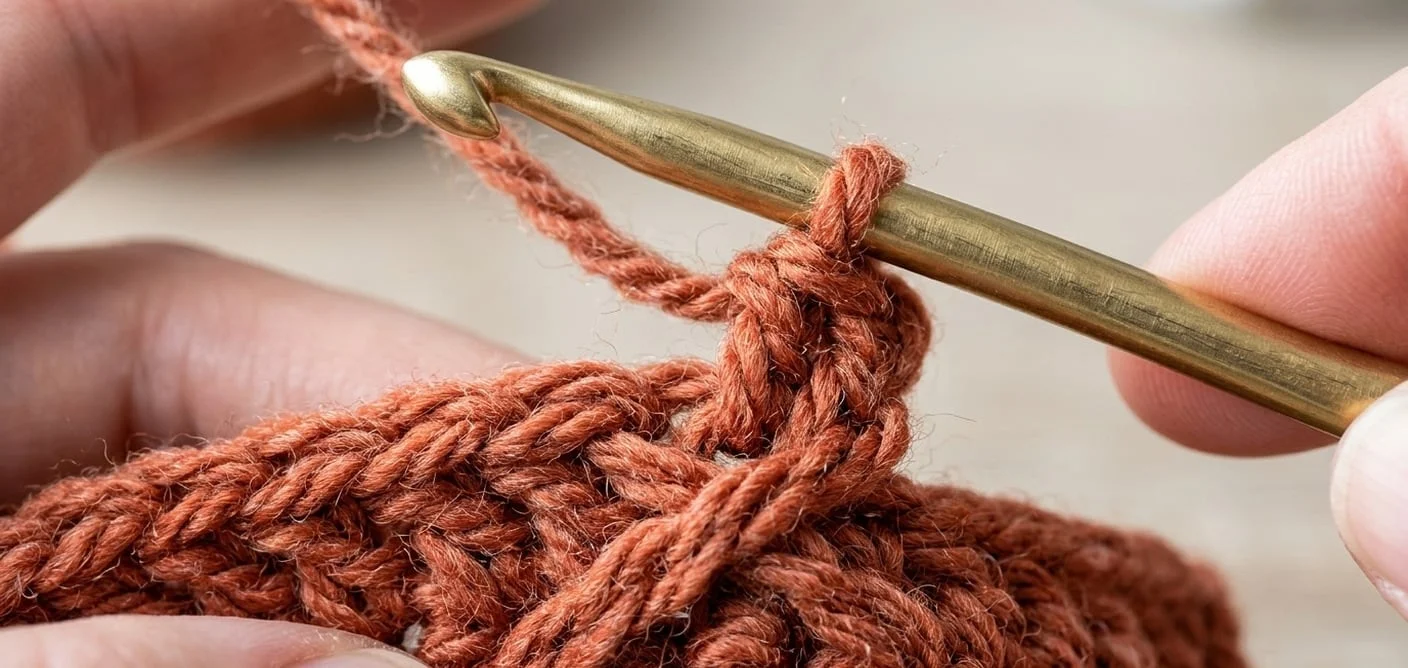
Method A: Crossing in Front (The Most Common Method)
- How Your Hook Moves: You bring the tip of your hook in front of the double crochet you just made (Leg #1), insert your hook from front to back into the skipped stitch, pull up a loop in front of Leg #1, and complete your second double crochet.
- How It Looks: Leg #2 lies cleanly across the front of Leg #1 like two crossed swords, forming a crisp, flat "X" where both top V-loops sit neatly side by side.
- Ergonomic Advantage: You can clearly see the skipped stitch right in front of you without twisting your wrist!
Method B: Crossing Behind (The Enveloped / Wrapped X)
- How Your Hook Moves: You reach the tip of your hook behind the back of Leg #1, insert your hook from front to back into the skipped stitch, and pull the loop up around the back of Leg #1 (enclosing Leg #1 inside the yarn wrap of Leg #2).
- How It Looks: Creates a thicker, slightly rounder, cord-like twist.
- Rule of Thumb: Unless a pattern specifically tells you "working behind the dc just made," standard US patterns (including the tutorial by Heart Hook Home and this video tutorial) default to Method A (Crossing in Front) or allow you to use whichever path feels most natural, provided you stay consistent across the entire project!
Understanding the Stitch Multiple (Even Number of Stitches)
Because every Crossed Double Crochet pair (1 X-stitch) spans 2 base stitches, and because you must frame the row with 1 standalone edge stitch on the far right and 1 standalone edge stitch on the far left (so the outer edges stay straight and flat), the row itself always contains an even number of total stitches:
Total Row Stitches = (2 × Number of X-Pairs) + 2 Edge Stitches (Always Even!)
What about the Starting Foundation Chain?
- If Working Row 1 as Plain
scor UncountedCh 2Setup: Chain an Odd Number (Multiple of 2 + 1, or Multiple of 2 + 2 if workingdcinto the 4th chain from the hook). - Let us verify with a 16-stitch row (which holds 1 left edge stitch + 7 X-stitches + 1 right edge stitch = 16 stitches):
- Using our Foundation Chain Calculator:
- If Row 1 starts with
scin the 2nd chain from the hook: Chain 17 (16 + 1 = 17, which is a multiple of 2 + 1). - If Row 1 starts with
dcin the 4th chain from the hook (where 3 skipped chains count as Stitch #1): Chain 18 (16 + 2 = 18, which is a multiple of 2 + 2).
- If Row 1 starts with
- Using our Foundation Chain Calculator:
Step-by-Step Tutorial: How to Crochet the Crossed Double Crochet (X-Stitch)
Let us walk step by step through working a Crossed Double Crochet row over an established base row of 16 stitches:
- Work Your Starting Edge Stitch:
At the beginning of the row, work 1 Stacked Single Crochet (orch 3, counting as your first standalone edgedc) in the very first stitch. (Never include the first or last stitch of the row in a crossed pair—keeping 1 straight pillar on each margin frames the row cleanly!) - Skip 1 Stitch and Work Leg #1 (
dcin Next Stitch):
Skip the next stitch in the row below. Yarn over, insert your hook into the following stitch, and complete a standard double crochet (yo, pull up loop, yo pull through 2, yo pull through 2). - Reach Back and Work Leg #2 (
dcin Skipped Stitch):- Yarn over.
- Bring your hook tip to the right and in front of the double crochet you just made (Leg #1).
- Insert your hook from front to back under both top loops of the skipped stitch sitting just to the right of Leg #1.
- Yarn over and pull up a loop through the skipped stitch (
3 loops on hook). - Important Tension Tip: Draw that pulled-up loop upward slightly (
Lifter style) so it has enough length to reach across the front of Leg #1 without pinching the row shorter! - Yarn over and pull through 2 loops; yarn over and pull through the remaining 2 loops. Your first Crossed Double Crochet ("X") is complete!
- Repeat Across the Row:
Look carefully at the base of the row before starting your next pair: make sure you do not accidentally re-enter the stitch that already holds Leg #1! Locate the next unworked stitch, skip it, work1 dcinto the stitch after it, and then cross back to work1 dcinto the skipped stitch. - Work Your Ending Edge Stitch:
When 1 stitch remains at the end of the row (the top of the previous row's turning chain or Stacked Single Crochet), work 1 standalonedcinto that final stitch. Turn.
Design Variations: All-Crossed Rows vs. Alternating with Single Crochet Rows
You can stack Crossed Double Crochet rows in two distinct ways depending on the look you want:
- Variation 1: Alternating 1 Row Crossed DC + 1 Row Single Crochet (Crispest X Definition):
When you work Row 2 as Crossed Double Crochet (Right Side) and Row 3 as plain Single Crochet (Wrong Side), every single Crossed Double Crochet row is worked with the Right Side facing you! Furthermore, the short row of single crochet acts like a horizontal picture frame between each tier of X's, making the braided lattice stand out sharply. - Variation 2: Every Row Crossed Double Crochet (Reversible Lattice Mesh):
Working Crossed Double Crochet on every row creates a reversible, springy diamond lattice that grows faster—wonderful for airy scarves, shawls, and baby blankets!
Free Practice Pattern: The Criss-Cross Textured Cotton Washcloth
Ready to test the stitch on a quick 30-minute project? This 8.0 × 8.0 inch (20 × 20 cm) Textured Kitchen Washcloth combines the crisp horizontal framing of Variation 1 with a clean single crochet border.
Materials & Gauge
- Yarn: 65 yards (60 m / ~38 grams) of CYC #4 Medium Worsted 100% Cotton yarn (such as KnitPicks Dishie or Lily Sugar'n Cream).
- Hook: 5.0 mm (US H-8) crochet hook.
- Gauge (4 × 4 in): 14 stitches (7 X-pairs) × 11 rows (5.5 repeats of
X-row + sc-row) = 4 inches.
Written Pattern Instructions
- Foundation Chain: Chain 29 (a multiple of 2 + 1).
- Row 1 (Wrong Side — Base Row): Work
1 scin the 2nd ch from hook and in each ch across. Turn. (28 sc— an even number!). - Row 2 (Right Side — Crossed DC Row):
- Work a Stacked Single Crochet (or
ch 3, counting as firstdc) in the very firstsc. *Skip next st, work 1 dc in next st, then working in front of the dc just made, work 1 dc into the skipped st*; repeat from * to *13 times across until 1 st remains.- Work
1 dcinto the very lastsc. Turn. (28 total sts: 2 edge dc + 13 Crossed DC pairs).
- Work a Stacked Single Crochet (or
- Row 3 (Wrong Side — Framing Row):
Ch 1 (does not count as a st), work1 scin the very first st and in each st across to the end. Turn. (28 sc). - Rows 4–21: Repeat Rows 2 and 3 nine more times (for a total of 10 Crossed DC bands separated by
scrows), ending after a Row 3 (sc) repeat. Do not turn at the end of Row 21. - Edging Round: Ch 1, work
1 scevenly around all four sides of the washcloth (working2 scalong the side of eachdcrow,1 scalong the side of eachscrow, and[1 sc, ch 1, 1 sc]in each of the 4 corners). Join with asl stto the firstsc, fasten off, and weave in ends!
Resizing Crossed Double Crochet for Blankets & Scarves (Worked Math)
Because every Crossed Double Crochet pair pulls two stitches across each other diagonally, a row of Crossed Double Crochet usually pulls in slightly compared to a row of plain double crochet worked with the same hook.
Suppose you want to crochet a 36-inch-wide baby blanket using Crossed Double Crochet:
- Measure a 4 × 4 inch swatch in Crossed DC and enter your numbers into our Crochet Gauge Calculator. Suppose your swatch measures 15 stitches (7.5 X-pairs) per 4 inches (3.75 sts/in).
- Multiply your target width by your stitch gauge: 36 in × 3.75 sts/in = 135 stitches
- Because Crossed DC requires an even number of stitches (Check in our Foundation Chain Calculator), round
135up to 136 stitches (which gives 1 left edge dc + 67 Crossed DC pairs + 1 right edge dc = 136 stitches). - If starting with Row 1 in
sc(multiple of 2 + 1), Chain 137 (136 + 1)!
Common Mistakes and Troubleshooting Fixes
1. Gaining Stitches Every Row (Working Twice into Leg #1's Base Stitch)
- Why It Happens: After you reach back to complete Leg #2 in the skipped stitch, your hook moves forward again for the next pair. Because the base of Leg #1 is stretched slightly to the left, it can look like an empty, unworked stitch! If you skip that already-worked stitch instead of skipping the next truly empty stitch, you will add 1 stitch on every pair!
- The Fix: Before skipping a stitch for your next X, use your left thumb and index finger to trace the post of Leg #1 down to its base loop so you can clearly see which stitch is already occupied.
2. The X-Row Pulls In Tighter Than the Single Crochet Rows
- Why It Happens: You are not pulling up the Golden Loop of Leg #2 tall enough when crossing back across the front of Leg #1, causing each X to cinch horizontally.
- The Fix: Consciously draw the loop of Leg #2 up an extra 2–3 millimeters as you pull it through the skipped stitch (using the "Lifter" Golden Loop technique) so the X sits flat and relaxed!
Frequently Asked Questions
Which top loop comes first when I work back across a Crossed Double Crochet row?
Each leg's top "V" sits above the stitch it was worked into. For right-handed crocheters, Leg #2 sits over the skipped stitch, so its top "V" is on the right, and Leg #1's top "V" is on the left. The posts cross in the middle, but the top "V" heads still sit side by side in a normal row. On the next row, simply work into every top "V" one by one in the exact order you meet them!
Can I work Crossed Double Crochet in the round for a hat or bag?
Yes—Crossed Double Crochet looks spectacular worked in joined rounds on market totes, beanies, and cowls! Simply start each round with a ch 3 (or Standing Double Crochet) in the first stitch, work your first dc into the last stitch of the round right behind the start to form a crossed pair over the seam, or keep 1 plain seam stitch and work Crossed pairs over an even number of remaining stitches.
Does Crossed Double Crochet use more yarn than plain double crochet?
Because the second leg of each pair travels diagonally across a two-stitch span, Crossed Double Crochet uses a little more yarn per square foot than standard vertical double crochet (roughly 10%, an estimate).
Conclusion and Next Steps
Crossed Double Crochet is proof that some of the most impressive textures in fiber arts come from the simplest tweaks. By skipping one stitch, working a double crochet into the next, and crossing back in front to fill the skipped stitch, you create a sculpted, braided X-lattice that elevates everyday washcloths, blanket borders, and handbags without adding a single complicated technique to your repertoire.
Ready to plan your next project?
- Calculate your exact even-numbered stitch counts and starting chains with our free Foundation Chain Calculator and Crochet Gauge Calculator.
- See how Crossed Double Crochet compares against six other structural stitches in our guide to the 7 Best Double Crochet Stitches for Sturdy Bags and Totes, or find more blanket inspiration in 25 Free Double Crochet Blanket Patterns.


Questions & notes
No comments yet
Sign in or create a free account to comment under your profile and keep track of your replies.
Your email address is never published. Comments are moderated under our Community Guidelines; see our Privacy Policy for how we use your details.