

Stitch at a glance
- US terms
- Double crochet two together
dc2tog - UK terms
- Treble two together
tr2tog
To work a double crochet two together (dc2tog), work the first half of a double crochet into the next stitch so two loops remain on your hook, work the first half of a second double crochet into the following stitch so three loops remain on your hook, then yarn over and pull through all three loops at once. This joins two neighbouring stitches at the top into a single V, decreasing your stitch count by one.
In US patterns, this decrease is abbreviated dc2tog or dc dec (double crochet decrease). In UK patterns, the exact same movement is called treble crochet two together (tr2tog)—whereas a UK dc2tog is a US single crochet decrease (sc2tog).
dc2tog and dc3tog Quick Reference
Property |
|
|
|---|---|---|
US Abbreviation |
|
|
UK Equivalent |
|
|
Stitches Used Below | 2 consecutive stitches | 3 consecutive stitches |
Stitches Left on Top | 1 stitch ( | 1 stitch ( |
Loops on Hook Before Final Pull-Through |
|
|
Chart Symbol | Two | Three |
How to Work dc2tog Step by Step (With Loop Counts)
Think of a dc2tog as starting two separate double crochets side by side, stopping each one right before its final pull-through, and then locking them together under a single cap.
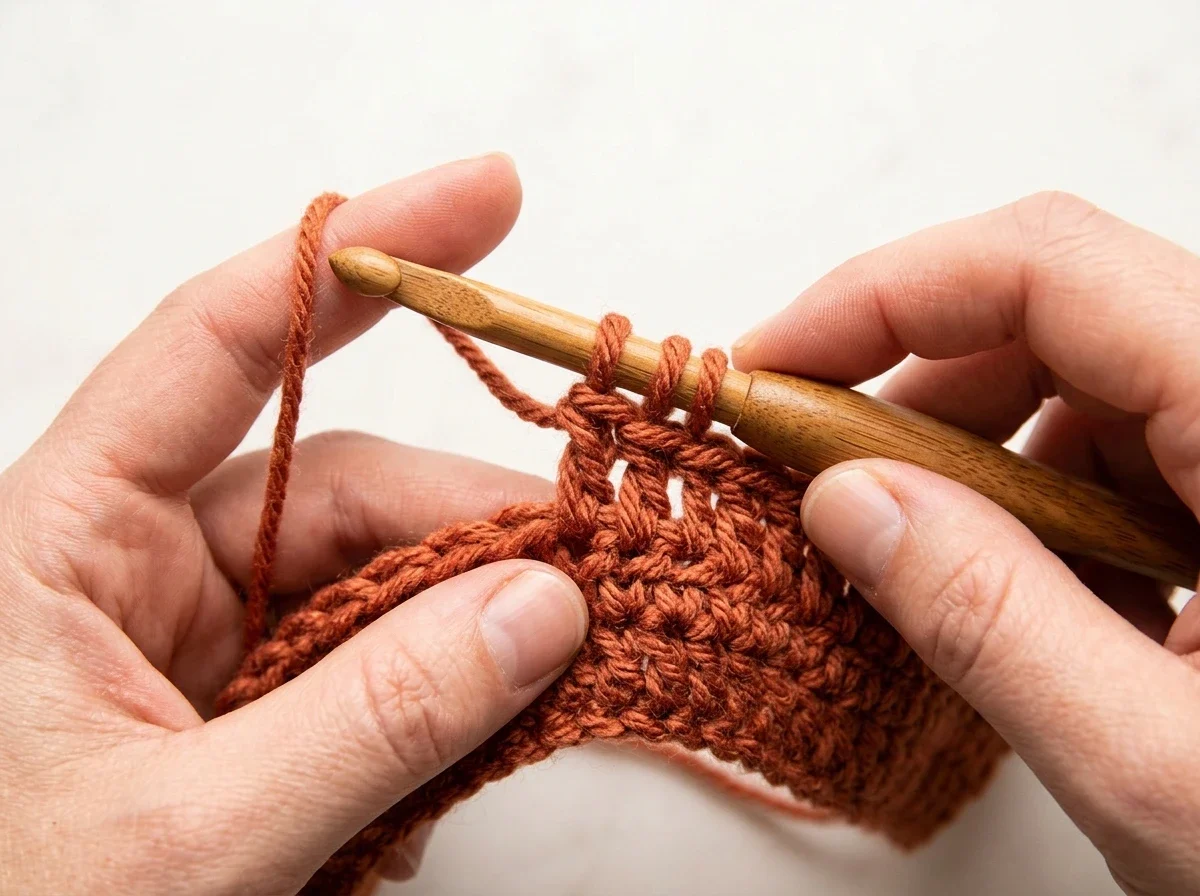
- Start the first leg in Stitch 1 (
1 → 3 loops): Yarn over (yo), insert your hook under both top loops of the first stitch to be decreased, yarn over, and pull up a loop. You now have 3 loops on your hook. - Half-finish the first leg (
3 → 2 loops): Yarn over and pull through the first 2 loops on your hook. Stop here—do not complete the double crochet. You have 2 loops on your hook (the original active loop plus the top of your first unfinished post). - Start the second leg in Stitch 2 (
2 → 4 loops): Yarn over, insert your hook under both top loops of the next stitch, yarn over, and pull up a loop. You now have 4 loops on your hook. - Half-finish the second leg (
4 → 3 loops): Yarn over and pull through the first 2 loops on your hook. You now have 3 loops sitting side by side on your hook shaft, and two slanted posts below. - Close both legs together (
3 → 1 loop): Yarn over one final time and pull the yarn straight through all 3 loops on your hook. - Check the top
V: One active loop remains on your hook, and a single topVsits centered over the two combined posts. On the next row or round, treat that shared topVas one stitch.
Step-by-Step Loop Tracker (dc2tog)
Stage | Action | Loops on Hook After Step |
|---|---|---|
Start | Active loop from previous stitch |
|
Step 1 |
|
|
Step 2 |
|
|
Step 3 |
|
|
Step 4 |
|
|
Step 5 |
|
|
dc2tog vs. dc dec vs. 2-DC Cluster (Solving the #1 Pattern Mix-Up)
One of the most frequent questions crocheters ask is whether dc2tog, dc dec, and a 2-dc cluster are the same thing—because the hand movements on the hook are identical (yo, pull through 2 twice, then yo, pull through 3). The difference comes down to where the legs are planted at the bottom:
dc2toganddc dec(Decrease across 2 stitches): You insert your hook into two separate, neighbouring stitches (Leg 1 in Stitch A, Leg 2 in Stitch B). Two stitches at the base merge into one stitch at the top—an upside-downV(/\) that reduces your stitch count by 1. It is the exact opposite of the matching increase, where one base stitch splits into two top stitches (\/).- 2-DC Cluster (
2dc-cl, worked in 1 stitch): You insert your hook into the exact same stitch or chain space for both legs. Because it uses 1 stitch at the bottom and leaves 1Vat the top, your stitch count does not change; it simply creates a thicker textural post. (See our guide to clusters for 2dc, 3dc, and 4dc cluster stitches.) - *Watch out for blanket patterns that say "dc2tog in same st": Occasionally, a pattern writer uses the abbreviation
dc2togto describe a 2-dc cluster worked into one space. Always check the sentence right after the abbreviation: if it says "over next 2 sts," it is a true decrease; if it says "in same st" or "in ch-sp,"* it is a cluster.
How to Work dc2tog at the Start and End of a Row
Garment panels—such as sweater armholes, V-necks, andraglan sleeves—usually place decreases right at the outer edges of a row.

Beginning-of-Row Decrease (Using the Turning Chain)
If your pattern counts the turning chain as a stitch, you do not need to chain 3 and then work a full dc2tog after it:
- Turn your work and
ch 2. This short turning chain acts as the first half-completed double crochet sitting over the very first stitch of the row. - Yarn over, insert your hook into the second stitch of the row, yarn over, and pull up a loop (
3 loopson hook). - Yarn over and pull through the first 2 loops (
2 loopsremain on hook). - Yarn over and pull through the remaining 2 loops. The
ch 2and the second stitch are now joined into a single top stitch at the start of the row.
(If your pattern states that the turning chain does not count as a stitch, simply ch 2, then work a standard 6-step dc2tog starting in the very first stitch and finishing in the second stitch.)
End-of-Row Decrease
Work across the row until 2 stitches remain before the turning chain. Work one dc2tog across those final 2 stitches. Remember to check whether the previous row's turning chain counts as the final stitch—if it does, the second leg of your dc2tog goes into the top of that turning chain.
Worked Example: Tapered Swatch With Edge Decreases
To practice symmetric edge shaping across 4 rows:
- Foundation & Setup Row:
Ch 16. Work1 dcin the 4th ch from hook (skipped 3 chs count as 1st dc) and in each ch across. Turn. — Arithmetic check:13 chs worked + 1 ch-3 = 14 dc. - Row 2 (Decrease 1 st at each end):
Ch 2(does not count as a st). Work1 dc2togover the first 2 sts (−1 st), work1 dcin each of the next 10 sts, then work1 dc2togover the last 2 sts (−1 st). Turn. — Arithmetic check:14 sts − 2 decreased sts = 12 sts(1 dc2tog + 10 dc + 1 dc2tog). - Row 3:
Ch 2,1 dc2togover first 2 sts,1 dcin next 8 sts,1 dc2togover last 2 sts. Turn. — Arithmetic check:12 sts − 2 = 10 sts. - Row 4:
Ch 2,1 dc2togover first 2 sts,1 dcin next 6 sts,1 dc2togover last 2 sts. — Arithmetic check:10 sts − 2 = 8 sts.
The Invisible Double Crochet Decrease
When you work a standard dc2tog in the round—such as closing the crown of a beanie or shaping a stuffed toy—gathering four strands of yarn across two stitches can leave a noticeable bump and a small gap underneath. The invisible double crochet decrease solves this by picking up the front loops only (FLO) of both stitches at the same time before pulling up your loop.
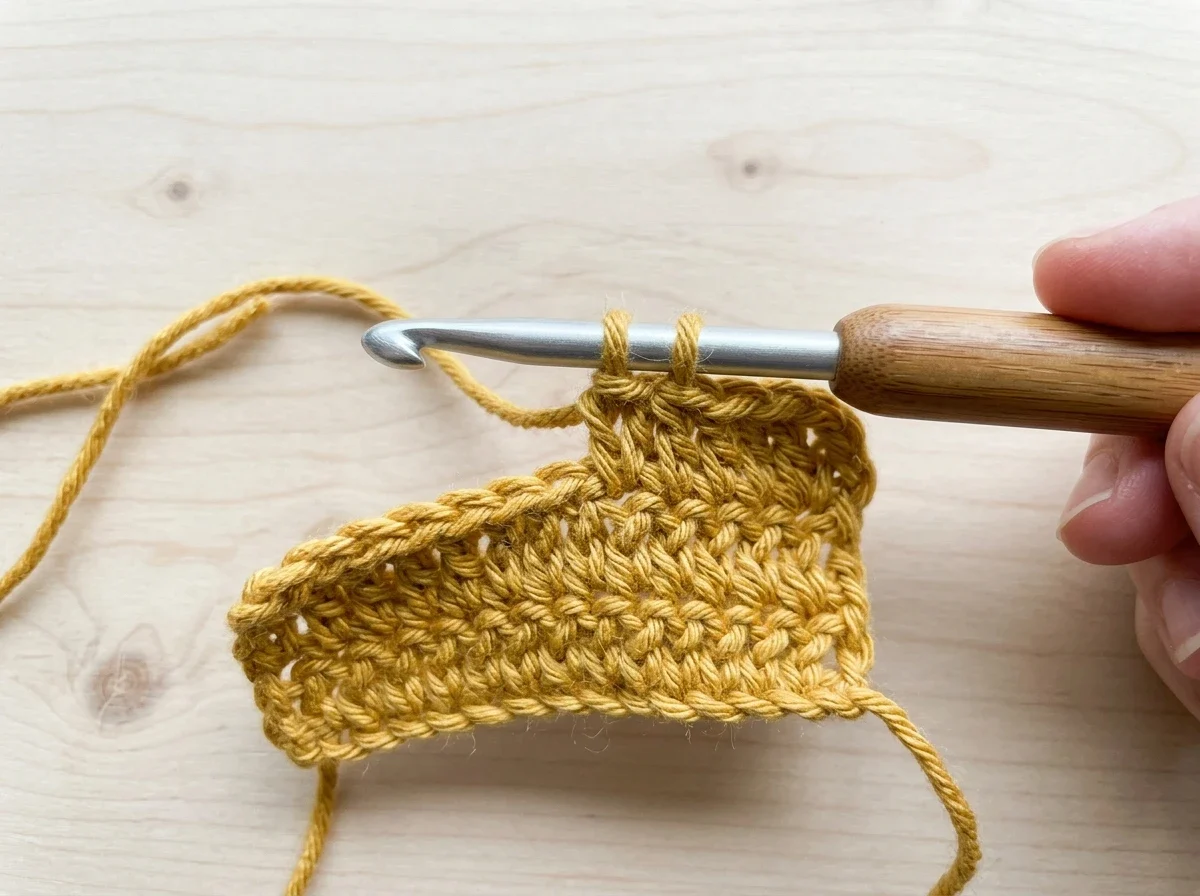
- Yarn over once as normal.
- Pick up both front loops together: Insert your hook under the front loop only (
FLO) of the first stitch, then—without yarning over—immediately swing the hook tip into the front loop only (FLO) of the second stitch. You now have the initial loop, the yarn-over, and 2 front loops sitting on your hook. - Pull up one shared loop: Yarn over and draw the loop through both front loops at once. You now have 3 loops on your hook—the exact same loop count as a single regular double crochet!
- Finish like a regular double crochet: Yarn over and pull through 2 loops (
2 loopsremain on hook), then yarn over and pull through the final 2 loops (1 loopremains).
Because both front loops are drawn together at the base before the post is built, the stitch has the exact thickness of one double crochet while the two untouched back loops stay hidden behind the fabric to block any gap.
dc3tog: How to Double Crochet Three Together
A double crochet three together (dc3tog, UK tr3tog) works the exact same way as dc2tog, except you add a third unfinished leg before the final pull-through. Because it merges 3 consecutive stitches into 1, each dc3tog decreases your stitch count by 2 stitches and forms a symmetrical, centered peak (/|\\)—making it the go-to decrease for chevron/ripple blanket valleys and steep crown shaping.

- Leg 1 (Stitch 1):
Yo, insert hook in 1st st,yo, pull up a loop (3 loopson hook).Yo, pull through 2 loops (2 loopsremain). - Leg 2 (Stitch 2):
Yo, insert hook in 2nd st,yo, pull up a loop (4 loopson hook).Yo, pull through 2 loops (3 loopsremain). - Leg 3 (Stitch 3):
Yo, insert hook in 3rd st,yo, pull up a loop (5 loopson hook).Yo, pull through 2 loops (4 loopsremain on hook). - Close all 3 legs:
Yoand pull straight through all 4 loops on your hook (1 loopremains).
Spreading Decreases Evenly Across a Row or Round
When shaping a hat crown, bag top, or sweater yoke, you rarely work all your decreases right next to each other; instead, you space them evenly around the circle so the fabric tapers smoothly without puckering.
- Standard 12-stitch flat circle decrease formula: If your crown increased by
12 dcper round, decrease by12 stsper round in reverse:- 48 sts → 36 sts:
*[Dc in next 2 sts, dc2tog] 12 times*(12 × 3 = 36 sts). - 36 sts → 24 sts:
*[Dc in next st, dc2tog] 12 times*(12 × 2 = 24 sts). - 24 sts → 12 sts:
*[dc2tog] 12 times*(12 × 1 = 12 sts).
- 48 sts → 36 sts:
- Custom stitch counts: If you need to reduce a row or round by an uneven number—for example, going from 58 stitches down to 45 stitches—use our calculator to spread decreases evenly across the row with stitch-by-stitch instructions.
Common dc2tog Mistakes and Troubleshooting
- Ending up with 4 loops instead of 3 on
dc2tog: You forgot Step 2 (yo and pull through 2 loops) on the first leg before inserting your hook into the second stitch. Always complete the firstpull through 2so only 2 loops are on your hook when you start Leg 2. - Loose gap between the two decreased stitches: If you let the active loops on your hook stretch out while reaching for the second stitch, the horizontal bar connecting the two posts will sag. Snug up the working yarn slightly after Step 2 (
2 loopson hook) and keep the two stitches pinched together between your thumb and middle finger as you enter the second stitch. - Stitch count didn't change: Check the base of your
dc2tog. Both legs must stand in two separate stitches from the row below. If both legs are planted in the same stitch, you worked a 2-dc cluster instead of a decrease.
Frequently Asked Questions
What does "2 dc2tog" mean in a crochet pattern?
When a pattern writes "2 dc2tog" (or "dc2tog twice"), it means you work one dc2tog decrease across the next 2 stitches, and then immediately work a second dc2tog decrease across the following 2 stitches. Together, those two decreases consume 4 stitches from the row below and leave 2 stitches on top (reducing your total stitch count by 2). It does not mean double crocheting four stitches together (dc4tog).
Are dc2tog and dc dec the exact same thing?
Yes. In US crochet patterns, dc2tog (double crochet two together) and dc dec (double crochet decrease) refer to the exact same stitch: working two adjacent double crochets together so they share one top loop and reduce the stitch count by 1.
How many loops are on the hook for dc2tog vs. dc3tog?
Right before the final yarn-over and pull-through, a dc2tog has 3 loops on the hook (1 active loop from the previous stitch + 2 unfinished legs), while a dc3tog has 4 loops on the hook (1 active loop + 3 unfinished legs). In general, a double crochet N-together decrease always has N + 1 loops on the hook before the final pull-through.
What is dc2tog in UK crochet terms?
In UK crochet terminology, a US dc2tog is called tr2tog (treble crochet two together) or tr dec. Be careful when reading a UK pattern that says dc2tog—in UK terms, dc2tog means a single crochet decrease (sc2tog in US terms), which has no initial yarn over.
Should I use a standard dc2tog or an invisible double crochet decrease?
Use a standard dc2tog when working flat back-and-forth rows (so both sides of the fabric match) or when the slanted two-post texture is a visible design feature, such as along a raglan line or chevron valley. Use the invisible double crochet decrease (through the front loops only) when working in the round with the right side facing out—such as top-down or bottom-up beanies, sleeves, and stuffed shapes—where you want the decrease to blend seamlessly into plain double crochet fabric.
How do you count a dc2tog when counting stitches at the end of a row?
A completed dc2tog (and a completed dc3tog) always counts as 1 stitch at the end of the row or round, because its two or three lower posts merge into a single V at the top edge.


Questions & notes
No comments yet
Sign in or create a free account to comment under your profile and keep track of your replies.
Your email address is never published. Comments are moderated under our Community Guidelines; see our Privacy Policy for how we use your details.