Calculators · Yarn and hooks
Remaining yarn calculator
Weigh a partly used ball to find how many yards or metres are left, and whether it is enough to finish your next rows or motifs.
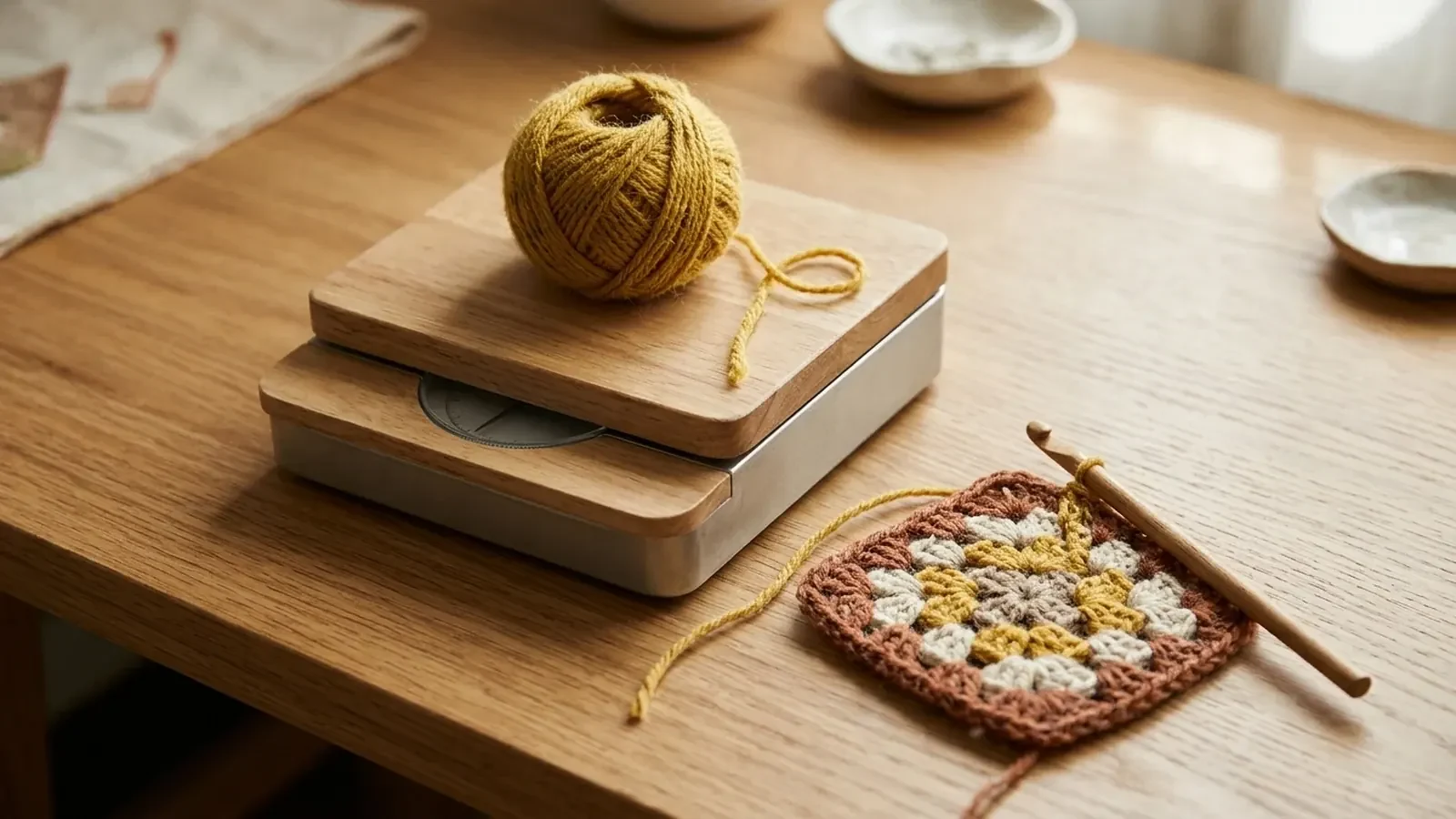
Not sure whether the end of a ball will finish the row? Weighing it tells you. This calculator turns the weight of a partly used ball into the length left, and, if you know how much one row or motif uses, how many more you can complete and how much will be spare.
How to use the calculator
- Weigh the ball on a kitchen scale in grams, ideally with the paper band removed. If the band is still on, tick the box and 3 g is taken off.
- Enter the full ball's weight and length from the label.
- Optionally, weigh the ball before and after one row, round or motif, and enter the difference to see how many more you can make.
How the calculator works
Yarn of one kind has the same length in every gram, so the length left is the same share of the ball as the weight left:
Length left = weight now ÷ full ball weight × full ball length
If you entered the yarn one unit uses, the number of complete units is the weight now divided by that amount, rounded down, and the rest is your spare:
Complete units = weight now ÷ weight per unit, rounded down
Reading your results
- Yarn left: in yards and metres.
- Of the ball: the share of the full ball that remains.
- Complete rows or motifs: how many more identical units you can finish, with the spare yarn in grams and length. If the spare is small, the calculator warns you to weigh again before the last one.
Worked example
You are making granny squares from a 100 g, 220 yd ball. What is left weighs 35 g without its band, and one finished square weighs 8.2 g.
- Share of the ball: 35 ÷ 100 = 35%.
- Yarn left: 35 ÷ 100 × 220 = 77 yd (70 m).
- Squares: 35 ÷ 8.2 = 4.27, so 4 complete squares, using 32.8 g.
- Spare: 35 − 32.8 = 2.2 g, about 4.8 yd. Enough for the tails, not for a fifth square.
Accuracy and limits
- The arithmetic is exact and covered by our automated tests, assuming the yarn is the same thickness throughout.
- Label weights can be 3 to 5% off, because natural fibres take up or lose moisture from the air. Leave a little margin.
- The paper band is taken as 3 g; weigh it yourself if you want to be exact.
- If the ball weighs more than the label says, two balls may be wound together, or the ball was heavier from the factory.
- The units count assumes every unit uses the same yarn. Rounds that grow, as in a centre-out blanket, need the continuous granny square blanket calculator, which can check whether your ball will finish the next round.
Common mistakes
- Weighing in ounces. A scale that reads in tenths of an ounce jumps nearly 3 g at a time. Switch to grams.
- Letting the strand hang off the scale. Keep the whole ball, and any loose yarn, on the platform.
- Measuring one row too early. Weigh one complete row or motif, including joins, so the figure reflects what each one really uses.
Tips for more accurate results
- When you put a part-ball back in your stash, weigh it and write the grams and length on a tag. The yarn stash batch planner can then tell you what it will make.
- For the last few rows of a blanket, weigh before each row; the margin shrinks fast.
Frequently asked questions
How do I turn grams of leftover yarn into yards or metres?
Divide the weight left by the full ball's weight, then multiply by the full ball's length. 35 g left from a 100 g, 220 yd ball is 35 ÷ 100 × 220 = 77 yd.
How can I tell whether I have enough for one more row or square?
Weigh the ball before a row and again after it, and subtract. Enter that amount, and the calculator counts how many more complete rows or squares the ball can make.
I lost the label. What now?
If you know the yarn's name, look up its weight and length online. If it is unlabelled, wrap it around a ruler and use the wraps per inch calculator to find its weight category.
Why does a new 100 g ball weigh 96 g or 104 g?
Yarn takes up moisture from the air in humid weather and loses it in a dry, heated room, so its weight changes a little while its length does not.
Does it work for centre-out blankets?
The length left is always right, but the count of complete units assumes each one uses the same yarn. For rounds that grow, use the continuous granny square blanket calculator.
More yarn and hooks calculators
All calculatorsCrochet hook size converter
Convert crochet hook sizes between millimetres, US letters, old UK numbers, Japanese sizes and steel thread hooks, with brand differences flagged.Open the calculatorScrap yarn blanket size calculator
Find the biggest blanket or scarf you can make from the yarn you already have, from a weighed swatch, with checkpoints for corner-to-corner.Open the calculatorTunisian crochet calculator
Choose a Tunisian hook size, the hook and cable length for your width, and the loops to cast on, for tss, tks, tps and more.Open the calculator


Questions about this calculator
No comments yet
Sign in or create a free account to comment under your profile and keep track of your replies.
Your email address is never published. Comments are moderated under our Community Guidelines; see our Privacy Policy for how we use your details.