Double-Ended Crochet Hooks: What They Are and How to Choose One
A double-ended hook has a working end on each side. Here is what it is used for, how it differs from a standard hook, and what to look for when you buy one.

10 min read

By Double Crochet Editorial Team | Last Updated: November 2026
A double-ended crochet hook has a working hook tip on both ends of a single shaft (or on both ends of a flexible cable) with no stopper cap at the back. Instead of always pulling loops off the front tip like a standard hook, a true double-ended hook has a smooth, uniform cylinder from end to end so you can pick up live loops with the front hook and slide them to the back hook to work them off—enabling seamless Tunisian crochet in the round and reversible two-color flat fabric.
US vs. UK Terminology Note: Hook anatomy, millimeter shaft diameters (mm), and double-ended forward/return pass mechanics are identical in US and UK crochet. For converting US letter designations (likeH-8,I-9, orJ-10) to metric millimeters or UK numbers, see our master hook size chart.
First Rule Before You Buy: "Same-Size" vs. "Dual-Size" Double-Ended Hooks
When you search online for a double-ended crochet hook, retailers mix two completely different tools under the same name. Buying the wrong one is the #1 frustration for beginners.
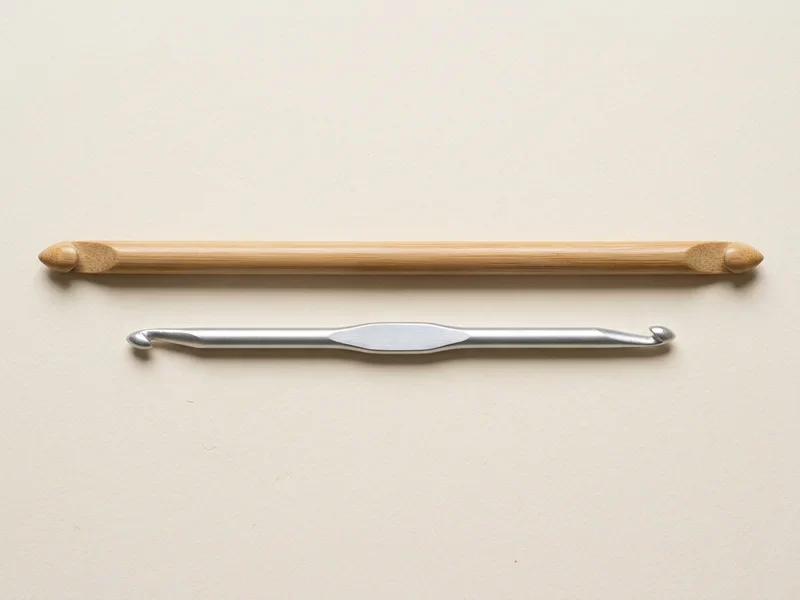
Feature | 1. True Same-Size Double-Ended Hook (Tunisian / Croknit) | 2. Dual-Size Standard Hook (Two-in-One Travel Hook) |
|---|---|---|
Hook Size on Each End | Identical size on both ends (e.g., | Two different sizes (e.g., |
Center Shaft Shape | Completely cylindrical and uniform from tip to tip (no flat thumb rest) | Flattened thumb rest in the middle of the shaft |
Typical Length |
|
|
Can Loops Slide From End to End? | Yes—loops glide freely from the front hook to the back hook | No—the flattened center thumb grip blocks loops from sliding across |
What It Is Used For | Tunisian crochet in the round, reversible croknit, and two-color Brioche-style crochet | Standard single-loop crochet ( |
Buyer's Rule: If your pattern calls for Tunisian in the round, cro-hooking, or double-ended crochet, you must choose a same-size, uniform-shaft double-ended hook without a flattened center thumb rest. Everything below focuses on choosing and using true double-ended hooks.
What a Double-Ended Crochet Hook Is Used For
Having an active hook on both ends of a smooth shaft unlocks three techniques that are impossible on a standard single-ended hook or a stopper-capped Tunisian hook:

- Seamless Tunisian Crochet in the Round (Hats, Cowls, and Sleeves):
- With a single-ended Tunisian hook, a stopper cap blocks the back end, forcing you to work flat back-and-forth rows.
- With a double-ended hook and two balls of yarn, you pick up
15to25forward-pass loops around a tube with Hook End A (using Ball 1), slide those live loops to Hook End B, and work the return pass off the back end (using Ball 2). You never turn your work, creating a continuous, seamless spiral tube with the right side always facing you.
- Flat Reversible Two-Color Fabric (Croknit / Cro-Hooking):
- When working flat, sliding the loops to the opposite end of the hook and turning the piece after every pass distributes yarn tension equally between the front and back faces.
- The resulting fabric lies 100% flat with zero Tunisian curl and produces a plush, double-sided ribbed weave that looks different on each side when worked with two contrasting yarn colors.
- Fixing Dropped Stitches and Pulling Decorative Cord:
- Even when you aren't working a full double-ended pattern, a short (
15 cm/6 in) double-ended hook is a favorite studio tool for picking up dropped knit or Tunisian stitches from the back of a row and threading i-cords or drawstrings.
- Even when you aren't working a full double-ended pattern, a short (
Types and Lengths of Double-Ended Crochet Hooks
Double-ended hooks come in two structural designs: rigid straight hooks and flexible cabled hooks. Match the style and length to the circumference or width of your project:

Hook Type | Standard Lengths | How Many Stitches It Holds | Best Projects |
|---|---|---|---|
Short Rigid Straight |
|
| Dishcloths, mug cozies, cuffs, sleeves, and small-circumference hats worked in sections |
Standard Rigid Straight |
|
| Scarves, cowls, baby blankets, placemats, and standard flat Croknit projects |
Extra-Long Rigid Straight |
|
| Wide wraps and lapghans (can feel heavy on the wrists during long sessions) |
Fixed Cabled Double-Ended |
|
| Full-size afghans, wide throws, shawls, and large seamless sweater bodies |
Interchangeable Cabled | Two screw-on hook tips ( | Customizable ( | All-in-one versatility—lets you swap cord lengths and hook sizes as needed |
Worked Stitch-Capacity Example (Why You Don't Need a 60 cm Rigid Hook for Hats)
When working in the round on a rigid 25 cm (10 in) double-ended hook, your hook does not need to hold all 80 stitches of a hat at the exact same moment!
- The Section-by-Section Math: Suppose your hat circumference is 80 stitches.
- You pick up
20forward-pass loops with the right end of your25 cmhook (20loops on shaft). - Before the shaft gets crowded, you slide those
20loops to the left end of the hook and work the return pass off the back until3to4live loops remain (so the edge doesn't pull tight). - Then you slide back to the right end, pick up the next
20forward-pass loops, and repeat4times around the80-stitch circle (20 × 4 = 80 stitches). Because you work in20-stitch sections, a comfortable20 cmor25 cmstraight hook can make a hat or sweater of any circumference!
How to Choose the Right Hook Size (+1 mm to +2 mm Rule)
Just like traditional Tunisian crochet, double-ended stitches interlock both vertical bars and horizontal return chains, creating a fabric that is roughly twice as thick as standard single crochet.
If you use the hook size printed on your yarn label, your double-ended fabric will feel stiff and dense. Always size up your double-ended hook by 1.0 mm to 2.0 mm above the yarn label's standard recommendation:
Yarn Weight Category | Standard Crochet Hook on Label | Recommended Double-Ended Hook Size |
|---|---|---|
#1 Fingering / Sock |
|
|
#2 Sport / Fine |
|
|
#3 DK / Light Worsted |
|
|
#4 Worsted / Medium |
|
|
#5 Bulky / Chunky |
|
|
The Interchangeable Cable Trick (Using Two Slightly Different Sizes): If you own a single interchangeable Tunisian hook set, you only have one tip of each millimeter size. To work in the round without buying a duplicate set, screw your main hook size (for example,6.5 mm) onto the forward-pass end of the cable, and screw the next size down (6.0 mm) onto the return-pass end of the cable. Because the forward-pass hook sets the loop height, a0.5 mmsmaller return-pass hook does not change your gauge—and actually glides through the return loops even more easily!
Materials and Throat Shapes Compared
Because you constantly slide dozens of live loops back and forth from one end of the shaft to the other, surface friction and throat geometry matter even more on a double-ended hook than on a standard hook.

1. Shaft Materials
- Bamboo & Laminated Birchwood: Warm in the hand, lightweight, and provides gentle natural surface grip ("drag") that keeps slippery cotton, bamboo, or silk loops from sliding off the open back hook while you work the front hook.
- Care Tip: Store long
25–35 cmwooden and bamboo hooks flat in a case or drawer; storing them upright in a mug or jar over many months can cause thin shafts (4.0–5.0 mm) to bow slightly.
- Care Tip: Store long
- Anodized Aluminum: Ultra-smooth and virtually indestructible. Loops slide from end to end with zero effort, making aluminum ideal for wool and acrylic yarns that grab onto wood. However, heavier metal shafts (
7.0 mm+) add more wrist weight on30 cmstraight hooks. - Acrylic / Smooth Plastic: Lightweight and inexpensive in jumbo sizes (
8.0 mmto12.0 mm), making them comfortable for chunky blankets without weighing down your hands, though they have more flex than metal or hardwood.
2. Hook Throat Geometry (Inline vs. Tapered)
- Inline Heads: The hook lip sits flush with the width of the shaft, and the throat is carved with deep, straight walls. Inline heads keep every loop on your forward pass at the exact same diameter and prevent yarn from slipping out when pushing through tight return passes.
- Tapered Heads: The throat slopes gradually and the tip is slightly rounded. Tapered heads glide rapidly under vertical bars without splitting multi-ply yarns.
Brand-Neutral Buying Checklist: What to Look For
Before purchasing a single double-ended hook or a full set, check these 6 details:
- Confirm both ends are the exact same millimeter size: Check the product description to verify it is a same-size Tunisian/Croknit double-ended hook (
6.0 mm / 6.0 mm), not a dual-size standard hook (5.0 mm / 6.0 mm). - Verify a 100% cylindrical center shaft: Look closely at the middle of the shaft in product photos. If there is a flattened thumb rest in the center, loops will jam when you try to slide them across. (Laser-etched size markings or a flush printed label in the center are fine.)
- Check cable-to-shank joins (on cabled hooks): If buying a cabled double-ended hook, look for smooth metal ferrules and swivel cords (
360°rotating joins) so the cable never kinks or catches live loops as you slide stitches across. - Start with a
25 cm(10 in) rigid hook in6.0 mmor6.5 mm: For a beginner practicing with#4worsted-weight yarn, a single25 cmstraight hook in6.0 mm(J-10) or6.5 mm(K-10.5) handles both flat Croknit scarves and in-the-round cowls or hats comfortably. - Match material to your favorite yarn: Choose bamboo or laminated wood if you love smooth cottons and blends, or anodized aluminum if you mostly crochet with wool and everyday acrylic.
- Keep rubber point protectors handy: Because both ends are open hooks, slipping a small silicone or rubber knitting-needle point protector over the back hook tip while pausing (or tossing your project in a bag) guarantees zero dropped loops!
Best First Projects for a Double-Ended Hook
- Two-Color Reversible Mug Cozy or Dishcloth: Chain
21, work flat Croknit (turning after every forward and return pass with two contrasting cotton yarns) to learn the rhythm of sliding loops from end to end in 30 minutes. - Seamless Spiral Cowl or Ear Warmer: Chain
70to80, join into a ring without twisting, and work Tunisian Simple Stitch in the round using two contrasting worsted-weight yarn balls—no seam to sew and zero edge curling. - Reversible Striped Scarf: Work a
30-stitch flat panel in two colors where Side A shows bold vertical columns in Color 1 and Side B shows horizontal woven ribs in Color 2.
Frequently Asked Questions (FAQ)
What is the difference between a double-ended crochet hook and a Tunisian crochet hook?
A standard Tunisian crochet hook is single-ended: it has one hook tip at the front and a permanent cap or stopper at the back end (or at the end of a cord) so loops can only enter and exit from the front. A double-ended crochet hook is a specialized member of the Tunisian hook family that replaces that back stopper with a second active hook tip, allowing you to slide live loops to the back of the shaft and work the return pass from the opposite end.
Are both ends of a double-ended crochet hook the same size?
On a true double-ended hook made for Tunisian crochet in the round or Croknit, yes—both ends are the exact same millimeter size and the shaft is a smooth cylinder from end to end. However, craft stores also sell short (14 cm) "double-ended" standard hooks with two different sizes (such as G-6 on one end and H-8 on the other) and a flat thumb rest in the center. Always check that both ends match before buying for Tunisian or Croknit work.
Can you use a double-ended crochet hook for regular crochet?
Yes, you can work standard single-loop crochet (sc, hdc, dc) using one end of a double-ended hook in a knife grip, though a 25 cm (10 in) shaft feels longer and heavier than a standard 15 cm (6 in) hook, and the back hook tip can occasionally catch on your sleeve if you aren't paying attention.
How do I stop loops from falling off the back end of a double-ended hook?
When working on a rigid straight double-ended hook, keep 3 to 5 unworked loops on the shaft at the end of each return pass before sliding the work to the other end, and choose a bamboo or wood shaft if your yarn is slippery. Whenever you set your project down, push the live loops to the center of the shaft and pop a rubber knitting point protector over each hook tip.


Questions & notes
No comments yet
Sign in or create a free account to comment under your profile and keep track of your replies.
Your email address is never published. Comments are moderated under our Community Guidelines; see our Privacy Policy for how we use your details.