Croknit Hooks and Cro-Hooking: A Beginner's Guide
Croknit is another name for cro-hooking, a double-ended hook technique that makes reversible two-colour fabric. Here is how it works and what hook you need.

9 min read

Croknit—also widely known as cro-hooking, crochet on the double, or flat double-ended Tunisian crochet—is a crochet technique worked on a hook with points at both ends using two balls of yarn. Instead of always working from the same end of the hook like standard Tunisian crochet, you pick up loops across the row with one hook tip, turn the work, and slide the loops to the opposite hook tip to work them off in a second color—creating a plush, completely flat, reversible two-color fabric where Color A dominates one side and Color B dominates the other.
US vs. UK terminology note: Because cro-hooking builds on Tunisian crochet passes (forward pass and return pass) rather than standard US/UK stitch heights, the instructions and terms are identical in both US and UK crochet patterns.
What Croknit Is (And Its Other Names)
If you have ever come across vintage pattern booklets or inherited a long crochet hook with a hook head carved on both ends, you have likely seen this technique called by several different names. All five terms below refer to the exact same tool and technique:
- Cro-Hook / Cro-Hooking: The classic name popularized in the 1970s and 1980s by Boye and Annie's Attic pattern leaflets.
- Croknit / Cro-Knit: Short for "crochet-knit", named because the vertical ribs on both sides of the fabric resemble knitted 1×1 ribbing or brioche.
- Crochenit: A trademarked name from the 1990s (by Mary Middleton) for large-gauge, 12-to-14-inch double-ended hooks (
10.0 mm–13.0 mm) used to make thick, reversible two-color afghans. - Crochet on the Double / Two-Fisted Crochet: Traditional craft-book names emphasizing that both ends of the hook are active.
- Flat Double-Ended Tunisian Crochet: The modern descriptive name used by today's Tunisian crochet designers.
Croknit vs. Tunisian in the Round vs. Knooking
Beginners often mix up three specialty hook techniques that sound similar. Use this table and visual guide to tell them apart immediately:

Technique | Hook Used | How It Is Worked | Finished Fabric |
|---|---|---|---|
Croknit / Cro-Hooking (Flat) | Double-ended crochet hooks (hook at both ends) | Pick up loops on Forward Pass → turn work → work off loops from the opposite hook end with a 2nd yarn ball | Flat, curl-free, reversible 2-color woven/ribbed fabric |
Tunisian in the Round | Straight or cabled double-ended hook | Pick up loops on the front with Hook End 1 → slide to Hook End 2 to work off from the wrong side in a continuous spiral | Seamless circular tubes (hats, cowls, sleeves) with a distinct right and wrong side |
Single-Ended Tunisian Crochet | Single-ended Tunisian hooks (stopper or cord at back) | Pick up loops and work them off from the same front hook end without turning | One-sided woven grid (curls forward unless blocked or bordered) |
Knooking | Short hook with a needle-eye hole at the base of the handle | A holding cord threaded through the handle eye holds live stitches while the hook forms true knit and purl loops | True knitted fabric (identical to 2-needle knitting) |
How the Two-Color Cro-Hooking Technique Works (The 4-Pass Rhythm)
If you already know how to work the basic Tunisian simple stitch (tss), you only have to change one habit to master cro-hooking: you turn your work at the end of every forward pass, and you only switch yarn colors at the start of a return pass.
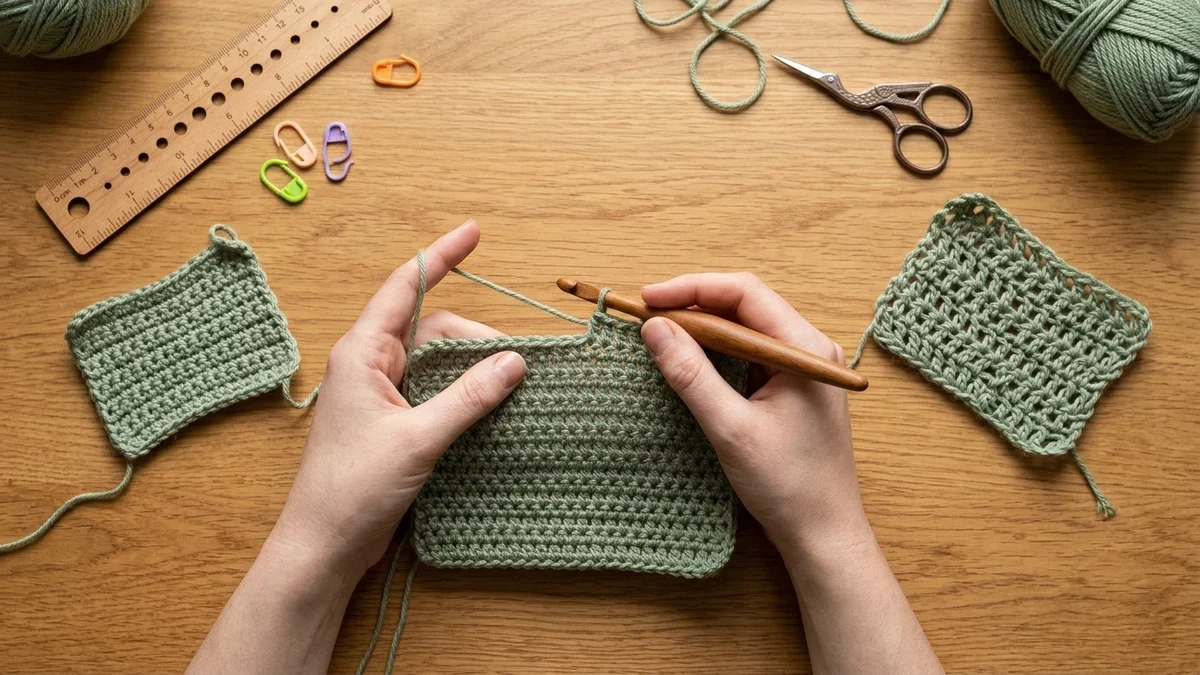
Here is the 4-pass rhythm that creates two-color reversible Croknit fabric using Color A (Forest Green) and Color B (Cream):
Pass 1: Forward Pass in Color A (Pick Up Loops)
- Using Color A (Green), make a foundation chain of your desired length (for example,
ch 12). - Insert your hook into the 2nd chain from the hook, yarn over with Color A, and pull up a loop. Continue inserting your hook and pulling up a loop in each remaining chain across.
- Keep all loops (
12 green loops) resting in the center of your double-ended hook shaft. Drop Color A (do not cut it)—it will wait right here for Pass 4.

Pass 2: Turn & Return Pass in Color B (Work Off Loops)
- Turn your work 180 degrees (just like turning a page in a book) and slide all
12 green loopstoward the opposite hook tip (which is now pointing to your left, if you are right-handed). - Fold a slip knot or loop of Color B (Cream) onto that active hook tip and pull it through the first green loop only (this is your edge
ch 1, so12 loopsstill sit on the hook:1 cream + 11 green).

- Using Color B (Cream),
*yarn over and pull through 2 loops on the hook*(1 cream loop + 1 green loop). Repeat from*across until only 1 cream loop remains on your hook.
Pass 3: Forward Pass in Color B (Do NOT Turn or Change Color!)
- Do not turn your work, and keep using Color B (Cream)—the exact same strand already on your hook!
- Working across the row in front of you, insert your hook under each vertical bar (or front/back bar) and pull up a loop of Color B (Cream) in each stitch across (
12 cream loopsnow sit on the center of the hook shaft). - Notice that both Color A and Color B are now sitting at the same edge of your swatch. Drop Color B.
Pass 4: Turn & Return Pass in Color A
- Turn your work 180 degrees and slide all
12 cream loopsto the opposite hook tip—right where Color A (Green) has been patiently waiting since Pass 1! - Pick up Color A (Green), give it a gentle tug so the side edge isn't loose, chain 1 (pull through 1 cream loop), and then
*yarn over with Color A and pull through 2 loops*across until 1 green loop remains on your hook. - Repeat Pass 3 and Pass 4: Continue working your next Forward Pass with the color already on your hook (
Color A), turning only before the Return Pass!
Memory Shortcut: Always work your Forward Pass with the yarn color already on your hook. Turn your work and switch colors ONLY when starting a Return Pass.
Why Croknit Fabric Is Reversible and Never Curls
Anyone who has tried standard single-ended Tunisian crochet knows that Tunisian simple stitch curls tightly toward the front. Croknit solves that curl completely:

- Zero Curling: Because you turn the fabric over before every return pass, the forward-pulling tension of Pass 1 is canceled out by the opposite-facing tension of Pass 3. The fabric lies 100% flat right off the hook without needing a heavy border or aggressive steam blocking.
- True Two-Color Reversibility: When you work the return pass in Color B through loops of Color A, the horizontal chain of Color B wraps around the back of the Color A loops. That creates vertical columns of Forest Green over a Cream background on Side A, and vertical columns of Cream over a Forest Green background on Side B—with zero loose colorwork floats to snag fingers!
The Hook You Need (And Sizing Up)
To work Croknit, you need a hook with identical millimeter hook heads on both ends and no thumb grip in the middle of the shaft:
- Straight Double-Ended Hooks (
10 to 14 inches): Ideal for scarves, cowls, dishcloths, place mats, and baby blankets up to ~25–30 inches wide. - Cabled Interchangeable Double-Ended Hooks: By screwing two identical hook tips (for example, two
6.5 mmtips) onto opposite ends of a flexible swivel cord, you can cro-hook wide throw blankets without holding the weight on a rigid stick. - Size Up
1.5 mm to 2.5 mm: Because Croknit interlocks two yarn strands in every row, use a hook 2 to 3 sizes larger than your yarn label suggests (for example, a6.5 mm (K-10.5)to8.0 mm (L-11)double-ended hook for worsted-weight#4yarn).
For a full breakdown of hook lengths, materials, and cabled setups, see our hardware guide to double-ended crochet hooks.
Yarn and Color Choice for Reversible Fabric
- Pick two high-contrast colors in the exact same yarn weight: Pairing a light neutral (cream, oatmeal, or light gray) with a rich solid or variegated yarn (forest green, navy, rust, or a self-striping cake yarn) makes the vertical columns pop on both sides.
- Use smooth, plied worsted or DK yarn for your first swatch: Avoid fuzzy mohair or loosely spun single-ply roving while learning, as sliding loops from one hook tip to the other is smoothest with a well-twisted 4-ply wool or acrylic yarn.
Starter Project: A 12-Stitch Reversible Two-Color Mug Rug
Practice the 4-pass Croknit rhythm on this quick 5×5 inch reversible coaster/mug rug:
- Yarn: Smooth worsted-weight (#4) cotton or acrylic yarn in Color A and Color B (~15 yards each).
- Hook:
6.5 mm (K-10.5)double-ended crochet hook. - Foundation (
12 loops): With Color A,ch 12. Insert hook into 2nd ch from hook and pull up a loop; pull up a loop in each remaining ch across (12 Color A loopson hook). - Row 1 Return (
Color B): Turn work, slide loops to opposite hook tip. Join Color B withch 1(pull through 1 loop), then*yo, pull through 2 loops*11 times (1 Color B loopremains). - Row 2 Forward (
Color B): Do not turn. Insert hook under the next 10 vertical bars, pulling up a loop of Color B in each (11 loopson hook), then insert hook under both outer strands of the final edge stitch and pull up a 12th loop (12 Color B loopson hook). - Row 2 Return (
Color A): Turn work, slide loops to opposite hook tip. Pick up waiting Color A, tug gently to snug the edge,ch 1, then*yo, pull through 2 loops*11 times (1 Color A loopremains). - Rows 3–12: Repeat the Forward Pass with the color already on your hook and the Return Pass (after turning) with the waiting color until your square measures 5 inches tall.
- Bind Off: Working with the color on your hook, insert into each vertical bar and work a standard slip stitch (
yo, pull through bar and loop on hook) across all 11 stitches. Fasten off both colors and weave in ends.
Frequently Asked Questions
Why do I need two balls of yarn for Cro-hooking?
Because you slide your active loops to the opposite end of the hook before working the return pass, your first yarn strand (Color A) is stranded back at the other end of the row! Joining a second yarn ball (Color B) at the new end lets you work the return pass immediately without cutting your yarn on every row. (If you want a solid single-color reversible piece, simply use two balls of the same color—or pull from both the inside and outside of a single center-pull skein.)
Why are the side edges of my Croknit swatch loose?
When you pick up the resting yarn strand (Color A or Color B) after turning your work, that strand has been waiting one row below. Before you work the ch 1 to start your return pass, give the waiting yarn a gentle tug so the edge loop matches the height of the stitch below—just avoid pulling it so tight that the side border puckers.
Can you work Cro-hooking with one ball of yarn?
Yes, if you pull one strand from the center of a skein and the second strand from the outside of the same skein! That gives you the two working ends required to alternate return passes without buying a second ball.
Is Croknit faster than knitting?
Most crocheters find Croknit faster and easier on the hands than two-needle fisherman's rib or brioche knitting because all loops stay safely on a single shaft and are worked off two by two with a hooked tip rather than transferred between two separate needles.


Questions & notes
No comments yet
Sign in or create a free account to comment under your profile and keep track of your replies.
Your email address is never published. Comments are moderated under our Community Guidelines; see our Privacy Policy for how we use your details.