How Fast Is Double Crochet? Fastest Stitches & Blanket Times
Why double crochet grows fabric faster than single crochet, with hour estimates for four blanket sizes and a 3-minute test to time yourself.

5 min read
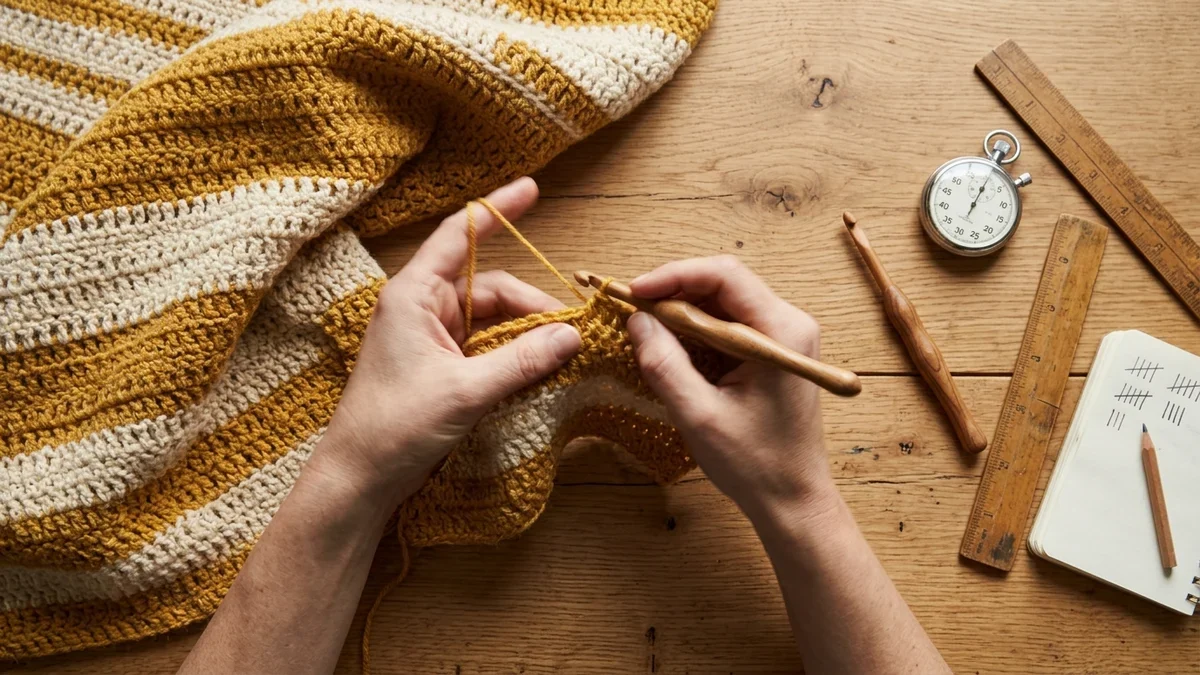
Double crochet (dc) is widely considered the fastest everyday stitch for building fabric area because each stitch stands roughly 2.5 to 3 times taller than a single crochet (sc) while requiring only one extra yarn-over-and-pull-through motion. Even though an individual single crochet takes fewer hand movements than a double crochet, you have to work roughly 16 to 18 rows of single crochet in #4 worsted yarn to cover the same 4-inch vertical height that 8 rows of double crochet cover. If you want to work up a blanket even faster than plain row-by-row double crochet, chain-space variations like the Granny Stripe (3-dc clusters), Double Crochet V-Stitch, and Corner-to-Corner (C2C) are the fastest crochet stitches overall because you insert your hook into wide open spaces instead of aiming under tight top V-loops.
US vs. UK Terminology Note: This guide uses standard US crochet terms. In UK patterns, double crochet (dc) is called treble crochet (tr), and single crochet (sc) is called double crochet (dc). See our US vs. UK crochet terms guide for full conversions.
Stitch Speed Showdown: Stitch Rate vs. Fabric Area Growth
When asking "Which crochet stitch is fastest?", it helps to separate stitches per minute (SPM) from square inches of fabric completed per hour. A stitch that is fast per individual loop (sc) is actually the slowest way to finish a blanket because each row adds so little height.

Note: The figures below are illustrative mathematical comparisons based on typical worsted-weight (#4) gauges (15 sc × 17 rows, 14 hdc × 11 rows, and 14 dc × 8 rows per 4" × 4") at a steady hobbyist pace (~15–22 dc per minute) (estimate).
Crochet Stitch | Typical Worsted Gauge ( | Stitches Needed per Square Foot ( | Insertion Target | Overall Fabric Growth Speed |
|---|---|---|---|---|
|
| Under 2 tight top V-loops | Slowest (Baseline | |
|
| Under 2 top V-loops (1 pull through 3 loops) | Moderate–Fast ( | |
|
| Under 2 top V-loops | Fast ( | |
|
| Wide | Very Fast (No aiming at top loops after Row 1) | |
Granny Stripe ( |
|
| Wide gap between clusters | Fastest Overall (Rhythmic 3-stitch clusters in open gaps) |
Corner-to-Corner ( |
|
| Wide | Very Fast (Short diagonal rows at start and end) |
Why Open-Space Double Crochet Stitches Work Up Even Faster
Once your hands build muscle memory for yarning over and pulling through two loops twice, the biggest bottleneck in crocheting is visual aiming—finding the exact gap beneath the front and back strands of the top V-loop on the stitch below.

In open-space double crochet stitches—like our modern granny stripe blanket, V-stitch baby blanket, and classic granny square—your hook plunges directly into a wide chain space or inter-cluster gap. You can crochet almost entirely by feel without looking down at every single stitch top.

How Long Does It Take to Crochet a Double Crochet Blanket? (Worked Estimates)
How many hours will your next blanket actually take? The table below shows worked mathematical estimates generated using the formula in our calculator to estimate your project time, assuming standard solid double crochet worked at a comfortable pace of 18 to 22 stitches per minute (~1,080–1,320 dc/hour) plus basic finishing time for weaving in ends (estimate).
Blanket Size | Dimensions | Approx. Total | Estimated Hook Time ( | Estimated Hook Time ( | Estimated Hook Time ( |
|---|---|---|---|---|---|
Lovey / Security |
|
| 1.5 – 2.5 hours | 1 – 1.5 hours | Under 1 hour |
Baby Blanket |
|
| 7 – 11 hours | 4.5 – 7 hours | 2.5 – 4 hours |
Lapghan / Stroller |
|
| 11 – 16 hours | 7 – 11 hours | 4 – 6.5 hours |
Standard Throw |
|
| 19 – 28 hours | 12 – 18 hours | 7 – 11 hours |
Twin Blanket |
|
| 38 – 55 hours | 24 – 35 hours | 14 – 21 hours |
Queen Blanket |
|
| 55 – 80 hours | 35 – 50 hours | 20 – 30 hours |
Planning Commissioned or Craft-Fair Pieces? Once you know your estimated hook hours from the table above, plug your hours and yarn cost into our crochet pricing calculator to price handmade blankets and accessories fairly.
The Biggest Speed Multiplier: Yarn Weight & Hook Size
While switching from single crochet to double crochet cuts your blanket time dramatically, stepping up in yarn weight and hook size multiplies your speed even more.

In the photo above, all three swatches contain the exact same 40 double crochet stitches (10 dc × 4 rows) and took roughly two minutes to crochet:
- DK (#3) Yarn (
4.0 mmhook): Covers roughly~5.5 square inches. - Worsted (#4) Yarn (
5.5 mmhook): Covers roughly~8.0 square inches. - Super Bulky (#6) Yarn (
10.0 mmhook): Covers roughly~20+ square inches—nearly 4 times the surface area for the exact same number of hand motions!
4 Practical Ways to Crochet Double Crochet Faster (Without Hand Fatigue)
- Pull From the Center of the Skein (or Use a Yarn Bowl): Stopping every 90 seconds to yank three feet of yarn off a bouncing skein quietly eats up 10% to 15% of your session time. Pull from the center of a cake so the yarn feeds with zero resistance.
- Choose a Comfortable Hook Grip & Shaft Material: Whether you use a Pencil Grip or a Knife Grip makes far less difference to your speed than avoiding wrist strain—read our full guide on pencil vs knife grip to find the hold that keeps your fingers relaxed, and match slick aluminum hooks to grippy wool or warm wood/bamboo hooks to slippery cotton.
- Skip Counting Every Stitch After Row 2: Instead of counting 150 stitches across every row of a throw blanket, clip a locking stitch marker into the first and last stitch of the row (and every 25 or 50 stitches in between). Your hook will never miss the turning chain at the end of a row.
- Carry Stripes Up the Side (or Use Self-Striping Yarn): Every color change that cuts the yarn leaves two tails that take 2 to 3 minutes to weave in. Carrying two alternating colors up the side edge (and hiding them inside the final border) saves hours of finishing work.
Frequently Asked Questions (FAQ)
Is double crochet faster than half double crochet?
In terms of square inches of fabric per hour, double crochet (dc) is slightly faster than half double crochet (hdc) because 8 rows of dc cover the same height as roughly 11 rows of hdc in worsted yarn. However, some crocheters find hdc very close in speed because pulling through all 3 loops at once saves one yarn-over motion per stitch.
How many double crochet stitches per minute is average?
Most relaxed intermediate crocheters work around 15 to 25 double crochet stitches per minute (900 to 1,500 stitches per hour) during continuous row work (estimate). Beginners typically average 8 to 14 stitches per minute while building rhythm.
How do I calculate how long my specific crochet project will take?
Set a timer on your phone for 5 minutes, crochet at your normal, relaxed television-watching pace, and count how many stitches you completed. Multiply that 5-minute stitch count by 12 to find your personal stitches per hour, then enter your project's dimensions and gauge into our crochet time calculator.


Questions & notes
No comments yet
Sign in or create a free account to comment under your profile and keep track of your replies.
Your email address is never published. Comments are moderated under our Community Guidelines; see our Privacy Policy for how we use your details.