How to Count Crochet Stitches and Rows
Counting is how you catch mistakes early. Here is how to count chains, stitches and rows, and the three things you should never count.

10 min read

To count crochet stitches across a row, tilt the top edge of your work toward you and count the interlocking V-shaped loops along the top of the row—or count the vertical posts on taller stitches like double and treble crochet—while never counting the active loop on your hook or the starting slip knot. To count completed rows, start at the bottom above the foundation chain and count each horizontal band of vertical posts (for double or treble crochet) or count the paired horizontal ridges by twos (for turned single crochet and back-loop-only ribbing).
US vs. UK terminology note: The rules for counting top Vs, posts, rows, and rounds are identical in both US and UK crochet patterns—just remember that a US single crochet (sc) is called a UK double crochet (dc), and a US double crochet (dc) is called a UK treble (tr).
The Three Golden Rules of Counting Crochet
Before you count a single chain, stitch, or row, lock these three rules into memory—breaking any one of them is the reason beginners end up one stitch off:
- Never count the loop on your hook: The live loop sitting around your crochet hook shaft is waiting to become your next stitch. It never counts as a completed chain or stitch.
- Never count the slip knot (or the foundation chain as a row): The tightened slip knot at the tail end of your starting chain is an anchor, not a stitch. Likewise, when counting rows from the bottom up, Row 1 is the first row of stitches worked into the chain—the foundation chain itself does not count as Row 1.
- Know whether your turning chain counts as a stitch: In short stitches (
sc), the turning chain almost never counts as a stitch; in tall stitches (dcandtr), the turning chain almost always does count as the first stitch of the row.
How to Count Chains in a Long Foundation Chain
Counting 150+ chains for a blanket is where mistakes happen fastest. Each chain forms a neat V shape on the front of the cord. Lay the chain flat on a table so it isn't twisted, start with the first V right above the slip knot as #1, and count up to the last V right below your hook.
- Place a locking stitch marker every 20 chains: Instead of recounting from #1 every time someone interrupts you, clip a stitch marker into the 20th, 40th, 60th, and 80th chain. When you finish, you only have to count the markers by 20s!
- Leave markers in the first and last stitch of Row 1: As soon as you make the very first stitch of Row 1, clip a marker under its top
V. That marker will save you when you turn for the second row and need to know exactly where the final stitch belongs.
How to Count Stitches Across a Row (Top Vs vs. Posts)
There are two ways to count the stitches in a completed row, and you can use them together to double-check your work:

- Count the top
Vs (Best for all stitches, especiallyscandhdc): Tilt the top edge of your fabric toward you so you are looking straight down at the top ridge. Every completed stitch creates a horizontal braid of two strands shaped like aV(the front loop and back loop). Count eachVfrom one end of the row to the other. - Count the vertical posts (Fastest for
dcandtr): On tall stitches like double crochet (dc) and treble crochet (tr), each stitch has a distinct vertical column (post) you can pinch between your fingers. Counting the vertical posts across the front of the row is fast and lets you spot the thinner turning-chain post at the edge immediately.
Does the Turning Chain Count as a Stitch?
Whether you count the turning chain at the start of the row as Stitch #1 depends on the stitch height and your pattern's notes:
Stitch Type (US / UK) | Standard Turning Chain | Does the Turning Chain Count as Stitch #1? | How to Count the Row |
|---|---|---|---|
Single crochet ( |
| No (for height only) | Count only the top |
Half double crochet ( |
| Usually No in modern patterns (Yes in some traditional patterns—check pattern notes) | If it does not count, count only the worked |
Double crochet ( |
| Yes (counts as 1st | Count the |
Treble crochet ( |
| Yes (counts as 1st | Count the |
How to Count Rows by Stitch Type (sc, hdc, dc, tr & BLO)
The taller the stitch, the easier its rows are to see. Here is how to read the fabric texture of every core stitch so you can count rows in seconds:

1. Counting Single Crochet (sc) Rows by Twos
When you work single crochet back and forth in turned rows, the front and back of the stitches alternate, grouping every two rows into one raised horizontal ridge (separated by a thin recessed valley line of small holes).
- The Fast "Count by 2s" Trick: Instead of squinting at individual tiny stitches, count the raised horizontal ridges from the bottom up and multiply by 2 (
4 ridges = 8 rows).
2. Counting Half Double Crochet (hdc) Rows Using the Third Loop
Because half double crochet starts with a yarn-over, it leaves a horizontal third loop across the face of the stitch. When worked in turned rows, that third loop appears on the front of the fabric on every second row, creating neat horizontal bars you can count by twos just like single crochet ridges.
3. Counting Double (dc) and Treble (tr) Crochet Rows
On tall stitches, each row forms a distinct band of vertical posts separated by a clear horizontal line of top Vs. Simply point to the vertical posts of Row 1 at the bottom edge and count straight up the column (Row 1, Row 2, Row 3…).
4. Counting Back-Loop-Only (BLO) Ribbing Rows by Twos
When you crochet in the back loop only (sc BLO or hdc BLO) for hat brims and sweater cuffs, the unworked front loops push forward to form deep accordion peaks and valleys.

- How to count
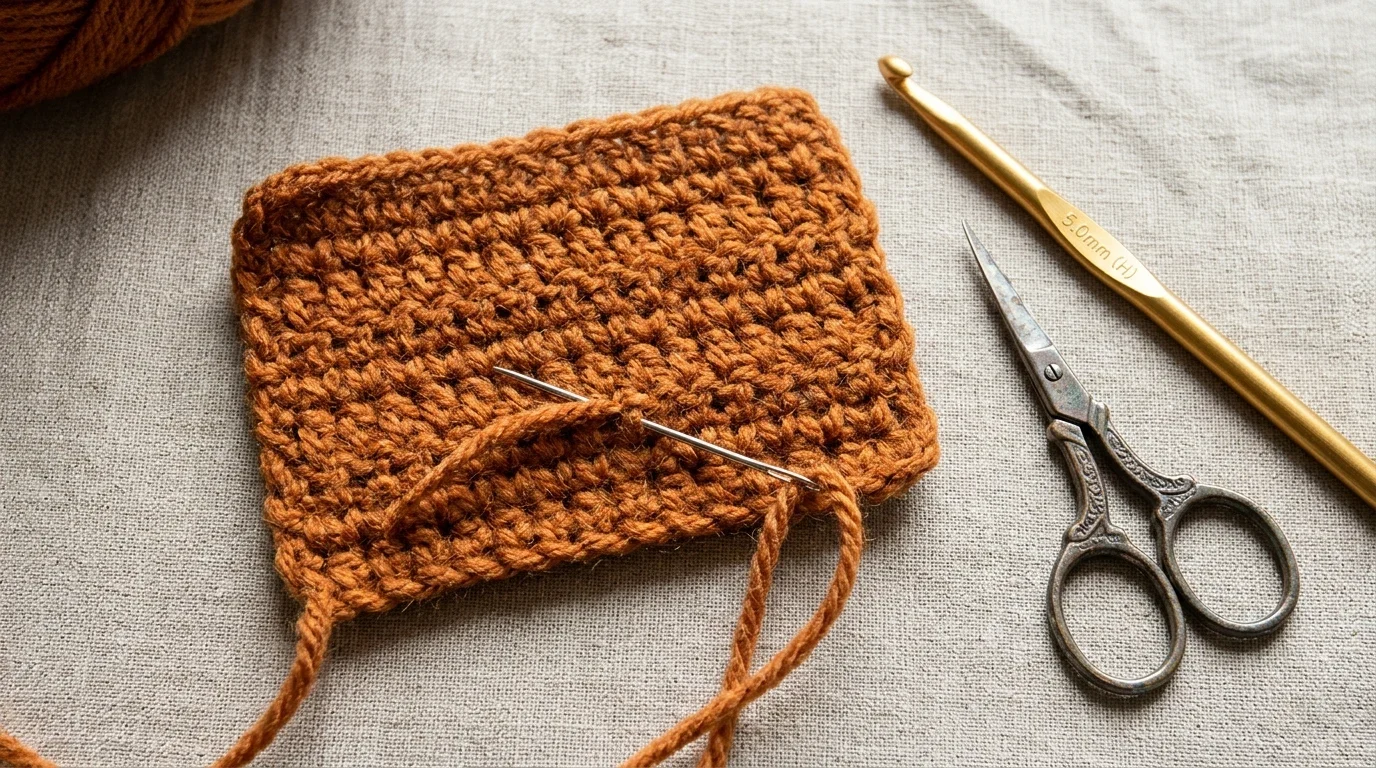
BLOribbing: Each raised accordion peak = 1 row, and each recessed valley between peaks = 1 row. That means 1 raised peak + 1 valley = 2 rows. In the swatch above, there are 4 raised horizontal ridges, which equals4 × 2 = 8 completed rows.
Pro Trick: Use Your Starting Yarn Tail to Tell Odd vs. Even Rows Instantly
Stuck between wondering if you just finished Row 25 or Row 26? Look at the bottom corner of your project to see which side the starting slip-knot yarn tail is on (assuming a standard foundation chain start):
- For right-handed crocheters: Row 1 moves from right to left, leaving the starting tail on the bottom right. Therefore, whenever the starting tail is on your left (or your hook is at the left end of a row), you just finished an odd-numbered row (
1, 3, 5…). Whenever your hook finishes on the right (the same side as the starting tail), you just finished an even-numbered row (2, 4, 6…)! - (Note: If you are left-handed—or if you started with a chainless foundation row—the sides are reversed.)
How to Count Rounds and Continuous Spirals
When crocheting in the round (such as coasters, hats, and amigurumi), you never turn your work, so every round has the right side facing out:

- Counting concentric rings from the center: Start with the small circle of stitches worked into the center magic ring as Round 1, and count the concentric rings radiating outward to the edge (
Round 1, 2, 3, 4, 5, 6). - Use a "running stitch marker" for amigurumi spirals: In continuous spirals (where you do not join rounds with a slip stitch), there is no seam to show where one round ends and the next begins. Lay a 6-inch scrap of contrasting-color yarn across your work before making the first stitch of Round 2, then flip that yarn scrap back and forth to the front and back before the first stitch of every new round. It weaves a vertical dashed line straight up the side of your toy so you can count both your rounds and the exact first stitch of every round at a glance.
Counting Clusters, Shells, Decreases, and V-Stitch Rows
Once you move beyond solid basic stitches, patterns count either individual stitches or pattern groups at the end of a row:
- Decreases (
sc2tog,hdc2tog,dc2tog) and Clusters count as 1 stitch: Even though a decrease spans 2 base stitches at the bottom (and a 3-dc cluster has 3 posts), their tops are pulled together into one single topV. When counting stitches for the next row, every completed decrease or cluster counts as1 stitch. - Shells and V-Stitches: A
5-dc shellfans 5 double crochets into 1 base stitch (5 top V's), and a classicV-stitchworks(dc, ch 1, dc)into 1 base stitch (2 dc posts + 1 ch-1 space = 3 stitch units). Most patterns list the count by group—for example,[4 V-sts, 2 edge dc].
If a complex pattern row combines increases, decreases, chain spaces, and repeats and you want to verify how many stitches the row should have before you start, paste the row instruction into our interactive check a row's stitch count tool.
When Your Stitch Count Is Wrong (Quick Diagnosis)
If you count your row and discover you have gained or lost a stitch, don't rip out the whole project—check these two spots at the edges first:
- You have 1 TOO FEW stitches (
−1 stitch): Look at the very end of the row you just finished. Nine times out of ten, you stopped one stitch early because the final stitch of the previous row was tilted downward on the edge (or you forgot to work into the top chain of a countingch-3turning chain). - You have 1 TOO MANY stitches (
+1 stitch): Look at the very beginning of the row. In double crochet (dc), where thech 3turning chain already counts as Stitch #1, working your firstdcinto the base of thatch 3(instead of skipping to the second stitch) adds an accidental extra stitch at the start of every row.
For a full visual guide on fixing slanting or narrowing blanket borders, read our troubleshooting guide on why the count drifts.
Frequently Asked Questions
Do you count the V's on top or the posts on the front of crochet stitches?
You can count either! Counting the top Vs works on every stitch (and is easiest on short stitches like single crochet), while counting the vertical posts is fastest on tall stitches like double and treble crochet. Just remember that if your turning chain counts as a stitch (like the ch 3 in double crochet), its top V is slightly tighter than the worked stitches, so counting the vertical posts makes it much harder to miss.
Does the foundation chain count as Row 1?
No. Your starting foundation chain is the base cord (Row 0), not a row of stitches. Row 1 is only complete after you have worked your first pass of stitches all the way across the foundation chain.
How do I count rows in single crochet when they all blend together?
Look for the horizontal ridges (or the horizontal lines of tiny holes between rows). Because you turn your work at the end of every row, every two rows of single crochet pair up to form one raised horizontal ridge on the fabric. Count the raised ridges from the bottom up and multiply by 2.
If I need 20 rows of BLO ribbing, does that mean 20 ridges or 10 ridges?
10 raised ridges (on one side of the fabric). In back-loop-only (BLO) ribbing, each raised accordion peak is 1 row and each recessed valley is 1 row, so 1 peak + 1 valley = 2 rows. When you count 10 raised peaks on the front of your cuff, you have completed 20 rows.


Questions & notes
No comments yet
Sign in or create a free account to comment under your profile and keep track of your replies.
Your email address is never published. Comments are moderated under our Community Guidelines; see our Privacy Policy for how we use your details.