Simple Double Crochet Dishcloth Crochet Pattern
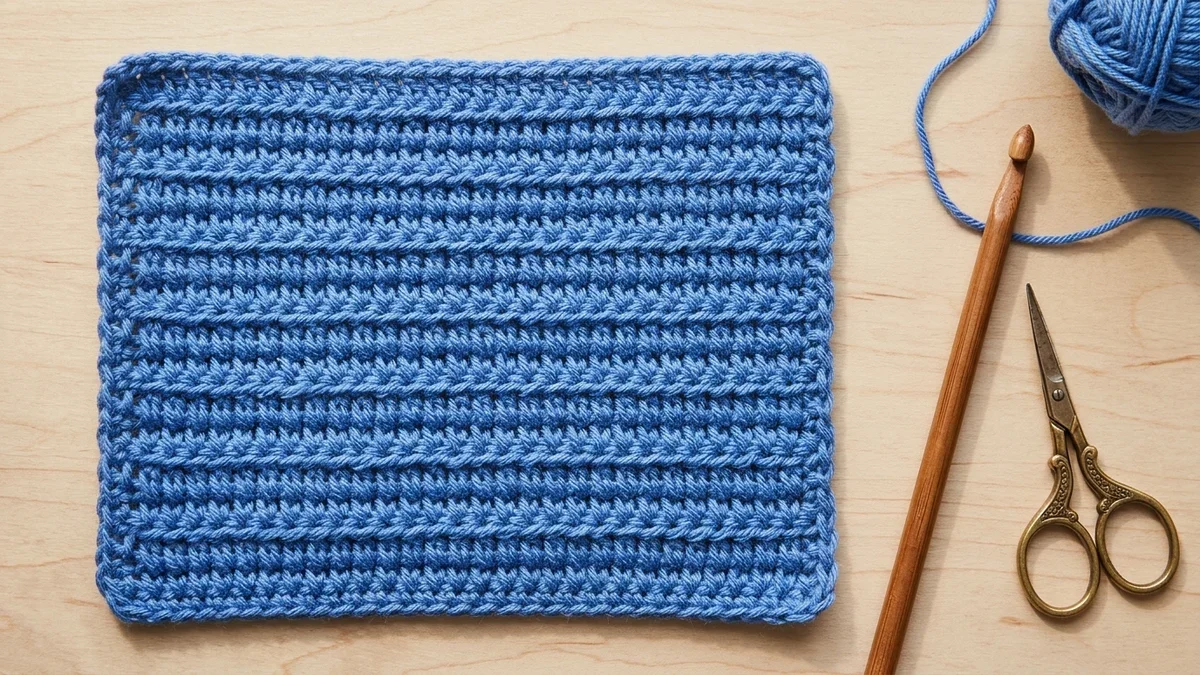
A square cotton dishcloth worked entirely in double crochet rows. A good first project once you know how to chain and double crochet.

10 min read

Pattern at a glance
- Hook
- 5.0 mm (US H-8)
- Yarn
- Worsted-weight cotton, about 60 yd (55 m)
- Finished size
- About 8 × 8 in (20 × 20 cm)
- Gauge
- Not critical for this project
- Terms
- US terms
Materials
- Worsted-weight (#4) cotton yarnAbout 60 yd (55 m); cotton is absorbent and washable
- 5.0 mm (US H-8) crochet hookOr the size that gives a firm, even fabric
- Tapestry needleFor weaving in ends
- Scissors
Abbreviations
- ch
- chain
- dc
- double crochet
- st(s)
- stitch(es)
This simple double crochet dishcloth pattern creates a classic, absorbent kitchen square worked in flat back-and-forth rows of standard double crochet (dc) using 100% worsted-weight cotton yarn. Starting with a foundation chain of 30 chains, you will work 28 double crochet stitches across for 14 rows—making it the ideal first project once you know how to chain and work a basic double crochet stitch. You can leave the edges plain for a fast, flexible washcloth or frame the square with a neat single crochet border and hanging loop.
This pattern is written in US crochet terms (where US double crochet dc is called treble crochet tr in UK terms, and US single crochet sc is called double crochet dc in UK terms). If you are brand new to the stitch or following shorthand for the first time, review our homepage guide on how to double crochet and our step-by-step tutorial on how to read a pattern.
Pattern At a Glance & Skill Notes
Specification | Details |
|---|---|
Skill Level | Beginner (uses only chain |
Foundation & Stitch Count | Ch 30 → 28 |
Finished Size | Approx. |
Recommended Yarn | 100% Worsted-Weight (#4 Medium) Unmercerized Kitchen Cotton |
Yardage Required | Approx. 75–90 yds ( |
Recommended Hook |
|
Materials and Gauge
Materials Needed
- Yarn: 1 ball of 100% Worsted-Weight (#4 Medium) Cotton Yarn (~75–90 yds / 69–82 m total, or ~65 yds Main Color + ~15–20 yds Contrast Border Color, estimate).
- Crochet Hook:
5.0 mm (US H-8)aluminum or ergonomic crochet hook. - Notions: Blunt metal tapestry needle (#16) for weaving in cotton ends, 2 locking stitch markers (highly recommended for marking the top of the turning chain on each row), and scissors.
Gauge
- Target Gauge:
14 dc × 7 rows = 4" × 4" (10 cm × 10 cm)in double crochet with a 5.0 mm hook. - Because this is a kitchen cloth rather than a fitted garment, slight gauge differences will simply make your square a half-inch smaller or larger.
Choosing the Best Cotton Yarn: Unmercerized vs. Mercerized

- Unmercerized 100% Kitchen Cotton (Best for Dishwashing & Spills): Yarns like Lily Sugar 'n Cream, Peaches & Creme, Bernat Handicrafter, or WeCrochet Dishie have a matte, unsealed fiber surface that drinks up water and soaps up quickly.
- Mercerized 100% Cotton (Best for Face Washcloths & Scrubbing): Yarns like Lion Brand 24/7 Cotton or Schachenmayr Catania are treated under tension to seal the outer fiber wall, giving them a smooth sheen, zero splitting, and crisp stitch definition that resists mildew—though they absorb standing water slightly slower than unmercerized kitchen cotton.
- Why Avoid Acrylic or Cotton-Acrylic Blends?: Acrylic is a hydrophobic plastic fiber that repels water instead of absorbing it, traps kitchen odors, and will melt if you accidentally grab a hot pan lid with your dishcloth.
Stitches and Abbreviations (US Terms)
ch— chaindc— double crochet (UK: treble crochettr)sc— single crochet (UK: double crochetdc)sl st— slip stitchst(s)— stitch(es)sp— spaceyo— yarn overRS/WS— Right Side / Wrong Side
Pattern Notes
- Turning Chain Rule (
Ch 3Counts as the First Stitch):- On Row 1, you work your first
dcinto the 4th chain from your hook. The 3 skipped chains stand beside that stitch and count as the very firstdcof Row 1 (1 turning-chain dc + 27 worked dc = 28 dc total). - On Rows 2–14, the
ch 3at the beginning of the row counts as the firstdc. Therefore, you must skip the very first stitch at the base of yourch 3and work your first fulldcinto the 2nd stitch of the row.
- On Row 1, you work your first
- Don't Forget the 28th Stitch: Because every row starts with a
ch 3that counts as a stitch, the 28th (final) stitch of every row must be worked into the top chain (3rd chain) of the previous row's turningch 3. - Stitch Marker Trick for Beginners: Each time you chain 3 to start a new row, clip a locking stitch marker into the 3rd chain (the top chain just below your hook). When you crochet back to that edge on the next row, you won't have to guess where the 28th stitch goes—just work right into the marked chain!
- Customizing Width: Since there is no complex stitch multiple in solid double crochet, you can chain any number of stitches + 2 extra chains for the foundation turning height.
Step-by-Step Instructions
Part 1: Dishcloth Square Body (Ch 30 → 28 dc × 14 Rows)

Foundation Chain: With 100% worsted cotton yarn and a 5.0 mm (H-8) hook, make a slip knot and ch 30 loosely so your bottom edge stays as flexible as your top edge.
- Row 1 (RS):
Yo, insert hook into the 4th ch from hook (the 3 skipped chains count as your 1stdc),yoand pull up a loop (3 loops on hook),[yo, pull through 2 loops]twice (2nddcof the row made). Work 1dcinto each of the remaining 26 chains across. Turn. — 28 dc (Math check: 3 skipped chs = 1st dc; 4th ch from hook = 2nd dc; remaining 26 chs = 26 dc;1 + 1 + 26 = 28 dcacross 30 chains).

- Row 2 (WS): Ch 3 (counts as 1st
dchere and throughout; clip a stitch marker into the 3rd ch if desired). Skip the very first stitch at the base of thech 3. Work 1dcunder both top loops of the 2nd stitch, and work 1dcinto each of the next 25 stitches across. Work your final (28th)dcinto the top chain (3rd chain) of the previous row's turning chain. Turn. — 28 dc (Math check: turning ch-3 = 1 dc + 26 dc in regular stitches + 1 dc in top of turning chain = 28 dc). - Rows 3–14: Repeat Row 2 twelve more times until you have 14 completed rows and your dishcloth forms an even
~8" × 8"square.- For a Plain Unbordered Dishcloth: Fasten off after Row 14, leaving a 6-inch (15 cm) tail, and weave in both ends securely.
- For a Bordered Dishcloth: Do not fasten off after Row 14 (or fasten off Main Color and join your Contrast Border Color in the top corner); proceed to Finishing.
Finishing: Single Crochet Border & Optional Hanging Loop
Adding a single crochet border frames the raw side posts of the double crochet rows and helps the square hold its shape through dozens of laundry cycles.

Single Crochet Edging Round (Worked Around All 4 Sides = 124 sc Total)
Because our dishcloth is 28 stitches wide and 14 rows tall, working 2 single crochets (2 sc) into the side of each dc row end gives you 14 × 2 = 28 sc along each vertical side—matching the 28-stitch top and bottom edges!
- Top Edge: With
RSfacing, ch 1 (does not count as a st). Work 1scin each of the 28 stitches across Row 14. - Corner 1: Work 3
scinto the corner stitch to turn 90 degrees smoothly. ( Note: If you count the 28th stitch as the center of the corner, work 2 morescinto that corner so each side has 28 side stitches plus 3 corner stitches; or work(sc, ch 2, sc)in each corner space.) - Left Side Edge (Row Ends): Rotate 90 degrees to work down the side of the rows. Work 2
scinto the side of each of the 14dcrows (inserting your hook around the side post or into the post space of each row end). — 28 sidesc - Corner 2: Work 3
scinto the bottom-left corner space. - Bottom Edge (Foundation Chain): Rotate 90 degrees to work across the bottom of Row 1. Work 1
scinto each of the 28 foundation stitch bases across. — 28 bottomsc - Corner 3: Work 3
scinto the bottom-right corner space. - Right Side Edge (Row Ends): Rotate 90 degrees to work up the second vertical side. Work 2
scinto the side of each of the 14dcrows up to the starting corner. — 28 sidesc - Corner 4 (With Optional Hanging Loop):
- Standard Flat Corner: Work 3
scinto the final corner space and join with asl stto the firstscof the round. - Corner Hanging Loop: Work 2
scinto the final corner space, ch 10, work 1scback into that same corner space to close the loop, andsl stto the firstscof the round.
- Standard Flat Corner: Work 3
- Weave In Ends: Cut yarn leaving a 6-inch (15 cm) tail, pull through to lock, and weave the tail through the inside of the border stitches in 3 alternating directions with a metal tapestry needle so it never works loose in the washing machine.
Variations (Sizes, Stripes, and Textures)
1. Four Custom Dishcloth & Towel Sizes
Since solid double crochet rows use any starting chain count (Desired dc count + 2), you can make a full kitchen set using this table:
Item Type | Target Finished Size (estimate) | Starting Chain | Stitches Per Row | Total Rows | Est. Cotton Yardage (estimate) |
|---|---|---|---|---|---|
Mini Facial Scrubbie / Coaster |
| Ch 20 | 18 | 9 rows | ~35 yds (32 m) |
Standard Dishcloth (Pattern Size) |
| Ch 30 | 28 | 14 rows | ~75–90 yds (69–82 m) |
Large Spa Washcloth |
| Ch 37 | 35 | 18 rows | ~125 yds (114 m) |
Matching Kitchen Hand Towel |
| Ch 44 | 42 | 31 rows | ~270 yds (247 m) |
2. Two-Row Farmhouse Gingham Stripes
Work 2 rows in Natural Cream, then switch to Sage Green (or Navy Blue) for 2 rows, carrying the unused yarn loosely up the side edge so you only have two tails to weave in at the end. When you work the 2 sc per row end border around the perimeter, crochet right over the carried side floats to hide them completely inside the border!
3. Textured Scrubby Variations
- Back Loop Only (
dc BLO) Ridge Scrubbie: Work Rows 2–14 in the back loop only (except the 28th stitch in the turning chain, which should go through two strands for edge strength). The exposed front loops create raised horizontal scrubbing ridges that scrape dried food off plates effortlessly. - Criss-Cross Textured Washcloth: Once you've mastered plain double crochet rows, try alternating crossed stitches using our criss-cross washcloth tutorial, or pair your dishcloth with a matching heat-safe linked double crochet pot holder.
Troubleshooting Common Double Crochet Dishcloth Mistakes
Problem / Symptom | Cause | How to Fix It |
|---|---|---|
Dishcloth gets wider every row (29, 30, 31 stitches) | Working into the very first stitch at the base of the | Remember: |
Dishcloth gets narrower every row (trapezoid shape) | Stopping after the 27th stitch and forgetting to work the 28th | Clip a stitch marker into the 3rd chain of every turning |
Visible gap along the side edges next to the | A standard | Either chain 2 tightly instead of 3 (treating |
Bottom edge bows inward or feels tight | Chaining the foundation row ( | Make the |
Frequently Asked Questions
How much yarn does it take to make one double crochet dishcloth?
One standard 8" × 8" (20 cm × 20 cm) double crochet dishcloth uses approximately 75 to 90 yards (69–82 m / 45–55 g) of worsted-weight (#4) cotton yarn (estimate). A single standard small skein of kitchen cotton (2.5 oz / 70.9 g / 120 yds) is more than enough to make one full dishcloth plus a single crochet border.
Why do my double crochet dishcloth edges look bumpy before adding a border?
Because every row alternates between a ch-3 turning chain on one side and a full dc stitch on the other, unbordered double crochet rows naturally show slight scallops along the sides. Working a single round of single crochet (2 sc per dc row end) straightens and frames both edges cleanly.
Do double crochet dishcloths have too many holes for washing dishes?
No—when worked in worsted-weight (#4) unmercerized cotton with a 5.0 mm or 4.5 mm hook, the cotton fibers swell slightly when wet, creating a flexible, sudsy cloth that rinses clean and dries much faster (with less mildew risk) than dense single crochet cloths.
How do I wash and sanitize cotton crochet dishcloths?
Machine wash your 100% cotton dishcloths in warm or hot water with regular laundry detergent (avoid fabric softener, which coats cotton fibers and reduces water absorbency), reshape while damp, and tumble dry on low or hang by the corner loop to air-dry.
Can a complete beginner make this dishcloth as their very first project?
Yes! Because a dishcloth is a small flat square where slight tension variations won't affect how well it washes dishes, it is one of the best first projects in crochet. You will practice foundation chains, turning chains, counting to 28 stitches, and working a simple border in under an hour.
About the Author
Claire Vance is a crochet pattern designer, technical editor, and fiber educator at DoubleCrochet.io. She designs practical, beginner-tested home patterns and teaches stitch geometry using Craft Yarn Council standards.



Questions & notes
No comments yet
Sign in or create a free account to comment under your profile and keep track of your replies.
Your email address is never published. Comments are moderated under our Community Guidelines; see our Privacy Policy for how we use your details.