Double Crochet for Garments: Drape, Hook Sizing & Fiber Guide
Why double crochet drapes better than single crochet in sweaters, with a hook-upsizing chart, fiber guide and blocking maths.

5 min read

Double crochet (dc) is one of the most versatile stitches for crocheting wearable sweaters, cardigans, and summer tops because its tall three-step post creates a noticeably lighter, more flexible fabric than shorter stitches like single crochet (sc). To get a fluid, store-bought drape rather than a stiff, boxy sweater, pair double crochet (or its drape-friendly variations like extended double crochet for drape and linked double crochet) with a lighter yarn weight (Fingering #1, Sport #2, or DK #3) and step up 0.5 mm to 1.0 mm above the yarn label's standard hook size.
US vs. UK Terminology Note: This guide uses standard US crochet terms. In UK patterns, double crochet (dc) is called treble crochet (tr), and half double crochet (hdc) is called half treble (htr). See our US vs. UK crochet terms guide for full conversions.
Comparing Crochet Stitches for Sweaters and Garments
Not every part of a sweater needs the same stitch. While standard dc excels on draped cardigan bodies and sleeves, you may want a denser variation for unlined bodices or an elastic stitch for cuffs.

Stitch Type | Garment Drape & Movement | Opacity (See-Through Gaps?) | Relative Fabric Weight per Area | Best Garment Application |
|---|---|---|---|---|
Firm & structured; can feel stiff in heavy yarns | High opacity | Heaviest per square inch (estimate) | Structured collars, button bands, and fitted crop tops | |
Balanced everyday flexibility | Moderate–High opacity | Moderate weight | Everyday pullovers, raglans, and kids' sweaters | |
Fluid, soft, and wearable | Moderate (slight vertical spaces between posts) | Lighter than | Cardigans, sweaters, summer tees, and lace-trimmed tops | |
Ultra-fluid, knit-like drape | Moderate | Light and airy | Boxy drop-shoulder sweaters, shawls, and draped dusters | |
Structured with moderate drape | 100% Opaque (Zero gaps) | Slightly denser than standard | Unlined fitted bodices, bralettes, and warm winter yokes | |
BLO Ribbing ( | High horizontal elasticity | High opacity | Medium–thick (corrugated) | Cuffs, hemlines, and neckbands (see BLO/FLO guide) |
Why Stitch Height and Hook Size Control Garment Drape
"Drape" simply describes how gracefully a fabric bends and flows under its own weight over your shoulders and torso. In crochet, two mechanical factors control whether a sweater flows softly or stands up like cardboard:
- Fewer Horizontal Knots per Inch (Stitch Height): Every time you complete the top V-loop of a stitch, you create a firm horizontal intersection. Because a row of double crochet is roughly two to three times taller than a row of single crochet, a
dcsweater has far fewer rigid horizontal row junctions per vertical inch—allowing the fabric to hinge and fold smoothly. - Loop Slack Around the Post (Hook Size): The hook size printed on a yarn ball band is usually chosen for a medium-firm all-purpose gauge. If you work a sweater at that tight ball-band tension, the yarn fibers have zero room to slide against each other.
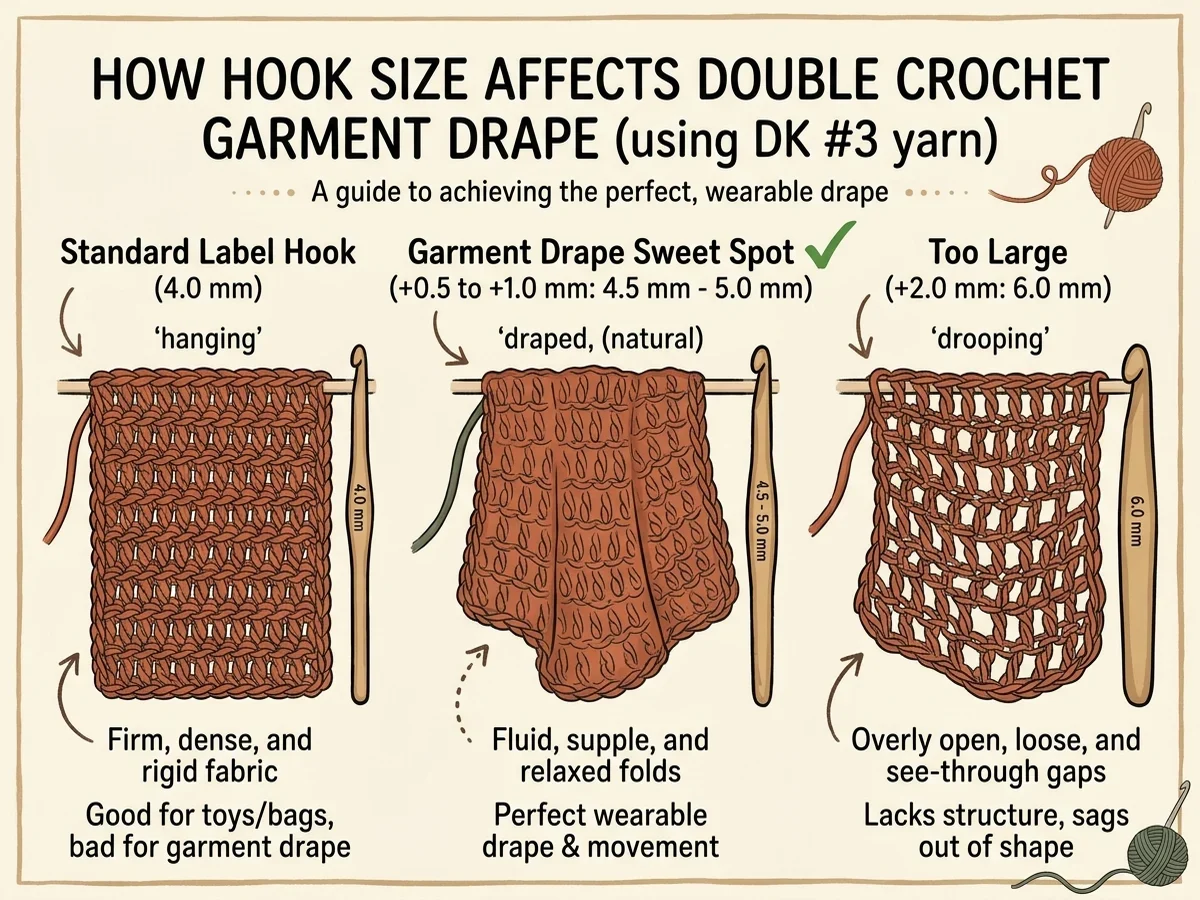
The +0.5 mm to +1.0 mm Garment Hook Rule
When swatching for a double crochet sweater or cardigan, start with a crochet hook 0.5 mm to 1.0 mm larger than the yarn label's standard recommendation (always matching your pattern's target gauge):
Yarn Weight Category | Typical Ball-Band Hook | Recommended Garment Drape Hook Range ( | Ideal Garment Types |
|---|---|---|---|
#1 Fingering / Sock |
|
| Lightweight summer tees, lacy cardigans, and layering tops |
#2 Sport / Fine |
|
| Three-season pullovers and fine-gauge raglans |
#3 DK / Light Worsted |
|
| The #1 sweet spot for wearable double crochet sweaters |
#4 Worsted / Aran |
|
| Cozy winter cardigans, outer jackets, and oversized hoodies |
Fiber Guide & Post-Wash Blocking Behavior for Double Crochet Sweaters
Because double crochet has taller vertical posts than single crochet, gravity pulls more noticeably on a dc garment when wet or worn over a full day. Different fibers respond very differently to water, steam, and gravity during blocking:
Note: Dimensional shifts below are general fiber tendencies (estimate).
Yarn Fiber | Drape Character | Typical Wet / Steam Blocking Behavior (estimate) | Best Care & Construction Strategy |
|---|---|---|---|
Non-Superwash Wool | Crisp, lofty, and elastic with strong memory | Holds its blocked dimensions well; minimal vertical drop when dried flat | Best for structured yokes, cables, and winter cardigans |
Superwash Merino Wool | Silky, supple, and fluid | Tends to relax and grow noticeably in length when wet (often around 5%–15% longer if hung wet, estimate) | Always dry flat; swatch and wet-block before choosing sleeve and body lengths |
100% Cotton & Cotton Blends | Cool, heavy, and fluid with low memory | Inelastic fiber; weight of the yarn can pull tall | Add sturdy slip-stitch shoulder seams so shoulder lines do not stretch out |
Linen, Hemp & Bamboo (Rayon) | Liquid, silky summer drape | Softens dramatically with every wash; can relax vertically | Ideal in |
100% Premium Acrylic | Lightweight and springy | Does not grow in water; responds permanently to gentle steam blocking (never touch iron to yarn) | Great for heavy oversized cardigans where cotton or wool would feel too heavy |
Alpaca & Silk Blends | Ultra-soft, haloed luxury drape | Low natural elasticity; grows lengthwise if worked in heavy yarn weights | Choose blends with 50%–70% wool for bounce, or work in lightweight DK/Sport yarn |
Choosing the Right Garment Ease for Double Crochet
Ease is the difference between your actual body measurement (usually full bust/chest circumference) and the finished circumference of the sweater. Because double crochet fabric is slightly thicker than machine-knitted jersey, giving your garment the right amount of ease is critical for a flattering fit. You can calculate your exact target dimensions for any size using our garment ease calculator.

- Negative Ease (
-1 into-2 insmaller than body): Best reserved for ribbed camisoles, bralettes, or body-skimming tops worked in elastic BLO ribbing orLinked DC. - Classic / Standard Fit (
+2 into+4 inPositive Ease): Skims the torso comfortably without clinging or feeling bulky. Ideal for set-in sleeve and top-down raglan pullovers. - Relaxed / Oversized Drop-Shoulder (
+6 into+10 inPositive Ease): Creates modern, cozy cardigans and slouchy sweaters—requires fluid drape (DK #3yarn +4.5 mm–5.0 mmhook) so the extra width folds softly under the arms.
How to Do the "Hanging Swatch Test" Before Starting a Sweater
Measuring a gauge swatch flat on a table tells you how wide your sweater is on the hook, but it does not tell you how long your sweater will be after wearing it for four hours.

- Crochet a Generous
6" × 6"Swatch: Work at least 6 inches square in your garment stitch, yarn, and hook. - Measure Pre-Block Gauge: Lay the swatch flat, measure your stitch and row count over the center
4" × 4", and record the numbers. - Wash and Block Exactly How You Will Wash the Sweater: Soak and flat-dry (or steam-block) the swatch, then use our blocking calculator to see how your row gauge changed.
- Hang with Light Weight Overnight: Clip the top edge of the dry blocked swatch to a skirt hanger and clip two small metal washers (or earrings/clothespins) to the bottom edge for 12–24 hours. Re-measure your row gauge while hanging—that hanging row gauge is the true length your sweater body and sleeves will settle into when worn!
Frequently Asked Questions (FAQ)
Is double crochet too holey for a sweater?
Standard double crochet worked with a huge hook in stiff yarn can show small vertical spaces between posts. To make a double crochet sweater more opaque without losing drape, either (1) use a DK (#3) or Sport (#2) yarn where smaller stitches naturally sit closer together, (2) use Herringbone Double Crochet (HBdc) or Extended Double Crochet (edc), or (3) switch to Linked Double Crochet (ldc) over the bust/yoke section.
Why do my crochet sweater shoulders sag down my arms?
Double crochet fabric stretches when the weight of the sleeves pulls on the shoulder seam. Always stabilize the shoulder seams and back neckline by working a row of firm slip stitches (sl st) along the seam allowance or sewing a narrow ribbon/twill tape inside the shoulder seam during assembly.
How much yarn do I need for a double crochet sweater?
An adult medium long-sleeved pullover or cardigan worked in standard double crochet typically requires roughly 1,100 to 1,500 yards in DK (#3) yarn or 1,000 to 1,350 yards in Worsted (#4) yarn (estimate). Use our yarn yardage calculator to estimate exact yardage from your swatch.


Questions & notes
No comments yet
Sign in or create a free account to comment under your profile and keep track of your replies.
Your email address is never published. Comments are moderated under our Community Guidelines; see our Privacy Policy for how we use your details.