

Pattern at a glance
- Hook
- 6.0 mm (US J-10)
- Yarn
- 95–100 g (about 200 yd) of assorted worsted-weight scraps for the adult snood
- Finished size
- Adult snood 26.5 in (67 cm) around × 9.5 in (24 cm) tall; child, tall and double-loop infinity sizes in the chart
- Gauge
- 13.5 dc × 8 rounds = 4 in (10 cm)
- Terms
- US terms
Materials
- YarnWorsted-weight scraps, about 100 g for the adult snood
- Crochet hook6.0 mm (US J-10)
- NotionsSharp tapestry needle (for the Russian join), locking stitch marker, kitchen scale in grams
Abbreviations
- ch
- chain
- dc
- double crochet
- fdc
- foundation double crochet
- FPdc / BPdc
- front / back post double crochet
- sl st
- slip stitch
- st(s)
- stitch(es)
This zero-waste scrap yarn crochet cowl pattern turns leftover mini-balls—or a single 100 g skein of self-striping or worsted yarn—into a soft, reversible double crochet neckwarmer without leaving awkward 3-yard scraps behind. You can make the Single-Loop Snood with just 180–220 yards total (one standard skein's worth of yarn) or the Double-Loop Infinity Cowl with 360–420 yards, using either crisp joined rounds for clean horizontal color blocks or a continuous spiral with the knotless Russian join so you have zero ends to weave in.
Terminology note: This pattern uses standard US crochet terms. In UK crochet terminology, a US double crochet (dc) is called a treble crochet (tr), and a US single crochet (sc) is called a double crochet (dc).
Cowl Sizing Chart: Single-Loop Snood vs. Double-Loop Infinity Wrap
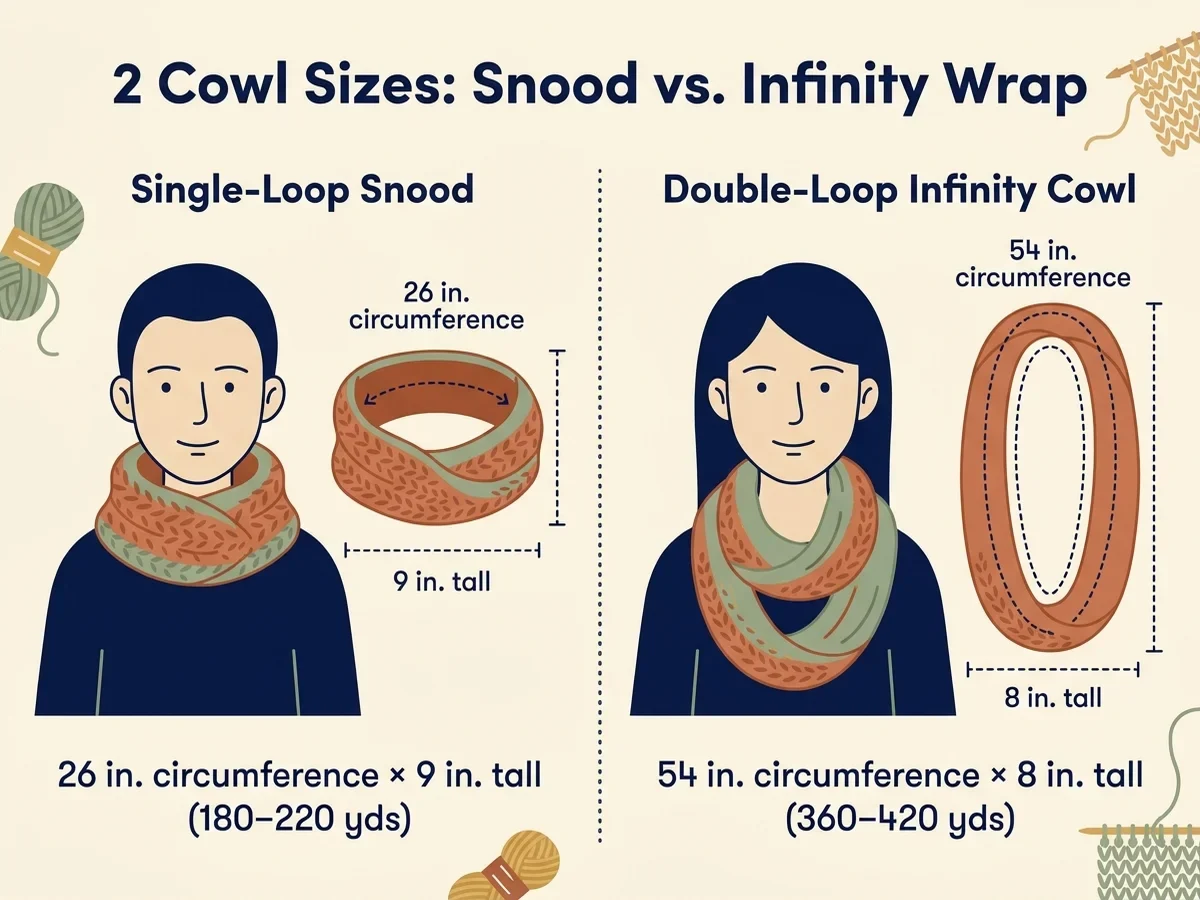
Both sizes are worked in the round with CYC #4 Medium / Worsted weight yarn and a 5.5 mm (US I-9) crochet hook at a relaxed, drapey gauge of 14 dc × 7.5 rounds = 4 × 4 in (10 × 10 cm) (3.5 sts/in; 1.875 rounds/in) (estimate).
Size Option | Finished Circumference | Finished Height | Starting Chain / Foundation Round | Total Rounds | Approx. Yards per Round (estimate) | Total Yardage Required (estimate) |
|---|---|---|---|---|---|---|
Size 1: Single-Loop Snood (1-Skein Equivalent) | 26.0 in (66 cm) | 9.0 in (23 cm) | 91 ch / 91 dc | 17 rounds | ~11.5 yds / round (estimate) | 180–220 yds (165–201 m) (~100 g total) (estimate) |
Size 2: Double-Loop Infinity Wrap (2-Skein Equivalent) | 54.0 in (137 cm) | 8.0 in (20.5 cm) | 189 ch / 189 dc | 15 rounds | ~24.5 yds / round (estimate) | 360–420 yds (329–384 m) (~200 g total) (estimate) |
Stitch Count Arithmetic Check
- Size 1 (Single-Loop Snood): $26 ext{ in} imes 3.5 ext{ sts/in} = 91 ext{ dc}$ per round. At $1.875 ext{ rounds/in}$, $17 ext{ rounds} \div 1.875 = 9.07 ext{ in}$ tall.
- Size 2 (Double-Loop Infinity Cowl): $54 ext{ in} imes 3.5 ext{ sts/in} = 189 ext{ dc}$ per round. At $1.875 ext{ rounds/in}$, $15 ext{ rounds} \div 1.875 = 8.0 ext{ in}$ tall.
How to Beat "Yarn Chicken" Forever: The Gram-Scale Scrap Formula
When working with partial leftover balls, the biggest frustration is running out of a color 15 stitches before the end of a round. A digital kitchen gram scale eliminates guesswork in two quick steps (or you can plug your numbers directly into our remaining yarn tool):

Step 1: Calculate Your Scrap Ball's Remaining Yardage
$$ ext{Remaining Yards} = ext{Scrap Weight (g)} imes rac{ ext{Full Skein Label Yards}}{ ext{Full Skein Label Grams}}$$
- Worked Example: Suppose your leftover ball of worsted wool-blend yarn weighs 24 g on your kitchen scale, and a full 100 g skein holds 220 yards:
$$ ext{Remaining Yards} = 24 imes rac{220}{100} = 24 imes 2.2 = 52.8 ext{ yards}$$
Step 2: Calculate Exact Full Rounds Available
$$ ext{Full Rounds Available} = \left\lfloor rac{ ext{Remaining Yards}}{ ext{Yards per Round}} ight floor$$
- Worked Example (for Size 1 Snood at ~11.5 yds/round):
$$52.8 ext{ yds} \div 11.5 ext{ yds/round} = 4.59 ext{ rounds} ightarrow \mathbf{4 ext{ full rounds}}$$ You know before you even join the yarn that this 24 g ball will complete 4 full rounds (46 yards) with 6.8 yards to spare! If you have a larger basket of leftover skeins after finishing your cowl, see our scrap yarn planning calculator to turn the rest into a throw.
Step-by-Step Tutorial: The Knotless Russian Join (Zero Ends to Weave In)
When combining multiple scrap balls, weaving in 16 separate yarn tails on a reversible cowl is tedious and can leave visible bumps. The Russian Join interlocks two plied yarn ends back into their own plies so there are no knots and zero tails to weave in.

- Thread Yarn A & Fold a Loop: Thread the 4-inch tail of your old yarn (Yarn A) onto a sharp-tipped tapestry needle. Leave a small 0.75-inch loop at the fold.
- Weave the Tail Back Through Yarn A's Plies: Push the needle directly through the center core of Yarn A's plies for about 1.5 inches (4 cm), splitting the plies rather than wrapping around the outside. Pull the needle through so a small closed eye remains at the tip, and slide the tail out of the needle.
- Interlock Yarn B: Thread the 4-inch tail of your new yarn (Yarn B) onto the tapestry needle, pass it through the closed eye loop of Yarn A, and fold Yarn B back on itself.
- Weave Yarn B's Plies & Pull Tight: Push the needle through the center core of Yarn B's own plies for 1.5 inches (4 cm). Pull both main strands firmly in opposite directions so the two interlocked loops tighten together, then snip the two tiny protruding tips flush with the yarn strand.
Complete Written Pattern: Zero-Waste Double Crochet Cowl
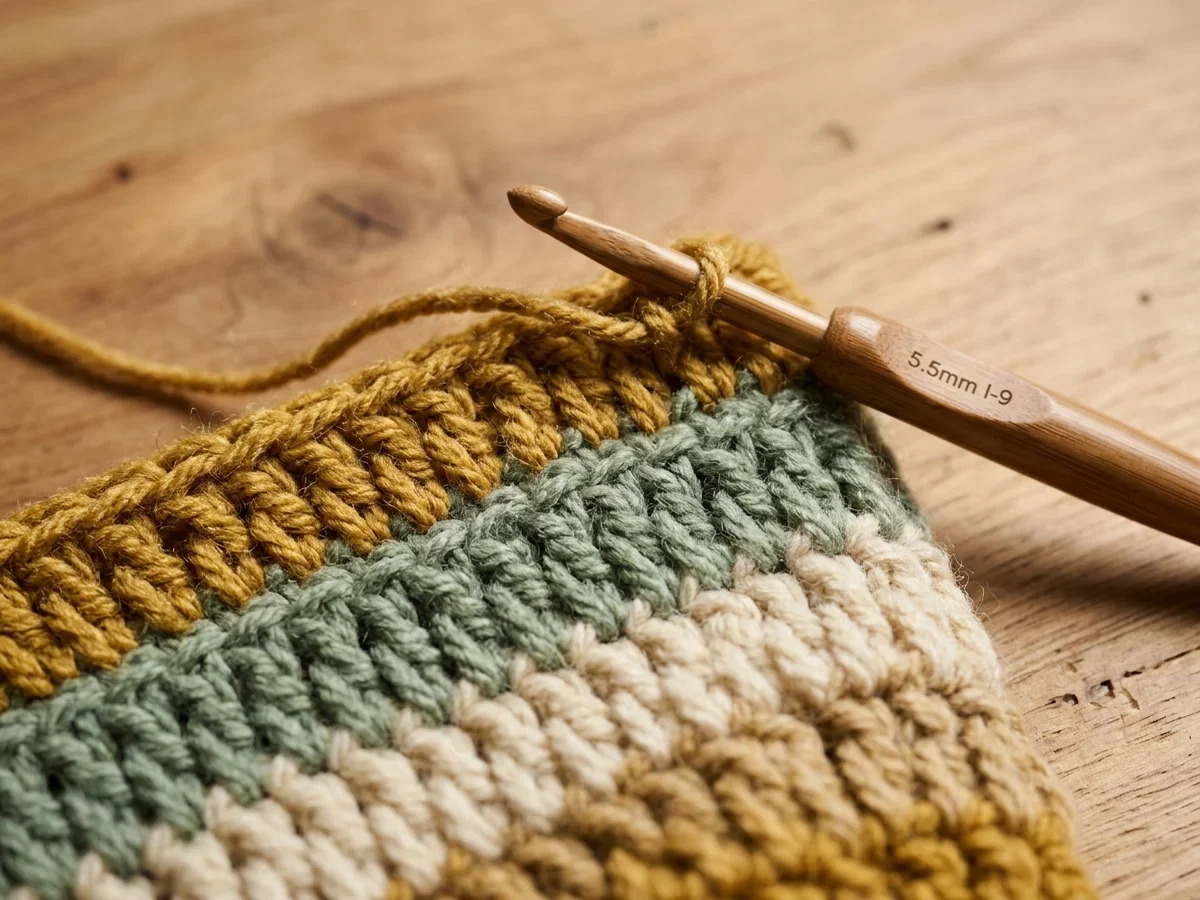
Materials & Notions
- Yarn: 180–220 yds (Size 1 Snood) or 360–420 yds (Size 2 Infinity Cowl) of CYC #4 Worsted weight yarn (leftover scrap balls of the same thickness, or 1–2 skeins of self-striping worsted yarn) (estimate).
- Hook: 5.5 mm (US I-9) crochet hook (plus an optional 6.0 mm US J-10 hook for a looser starting chain).
- Notions: Digital kitchen gram scale (optional, for scrap math), tapestry needle, 1 locking stitch marker, scissors.
Method A: Crisp Horizontal Color Blocks (Joined Rounds)
Use Method A when you have weighed your scrap balls and want clean, level horizontal stripes where each color starts and ends at the back seam.
- Foundation Chain: Using your 6.0 mm hook (or working loosely with your 5.5 mm hook), chain 91 for Size 1 (Snood) or 189 for Size 2 (Infinity Cowl). Being careful not to twist the chain,
sl stinto the first chain to form a large ring. - Round 1 (Base & First Edge Rib): Switch to your 5.5 mm hook.
Ch 2(does not count as a stitch here and throughout). Work1 dcinto the very first chain (same ch as join) and into each chain around.Sl stto the top of the firstdc. (91 dc for Size 1; 189 dc for Size 2). - Rounds 2–16 (Size 1) or Rounds 2–14 (Size 2):
Ch 2(does not count as a st). Work1 dcinto the very first stitch at the base of thech 2and into each stitch around.- When changing colors at the end of a round, complete the final yarn-over pull-through of the last
dcwith your new color, thensl stto the top of the firstdc.
- Final Round (Round 17 for Size 1; Round 15 for Size 2):
- Repeat the previous round once more, fasten off, and weave in the starting and ending tails on the inside of the cowl.
Method B: True Zero-Waste Continuous Spiral (Mid-Round Joins)
Use Method B when you want to use every last inch of each scrap ball without stopping at the end of a round, joining each new ball with the Russian Join wherever the old ball runs out.
- Foundation Ring: Chain 91 (Size 1) or 189 (Size 2) and join with a
sl stto form a untwisted ring. - Round 1 (Spiral Transition):
Ch 1, work1 scin the first chain,1 hdcin the next chain, and1 dcin each of the remaining 89 (or 187) chains around. Place a locking stitch marker in the firstscto mark the start of the round. - Continuous Spiral Body:
- Do not slip-stitch or chain at the end of the round! Instead, work
1 dcdirectly into the top of the markedsc, move your stitch marker up into this newdc, and continue working1 dcin every stitch around and around in a continuous spiral. - Whenever a scrap ball is about 6 inches from running out, join the next scrap ball using the Russian Join and keep crocheting seamlessly.
- Do not slip-stitch or chain at the end of the round! Instead, work
- Tapering Down the Final Spiral Round:
- When your cowl reaches 9 inches tall (Size 1) or 8 inches tall (Size 2) and you approach the stitch marker, taper the step down smoothly by working
1 hdcin the next stitch,1 scin the next stitch, and1 sl stin the next 2 stitches. Fasten off and weave in the final tail.
- When your cowl reaches 9 inches tall (Size 1) or 8 inches tall (Size 2) and you approach the stitch marker, taper the step down smoothly by working
Common Stash-Busting Mistakes & Troubleshooting
1. One Color Block Pulls Noticeably Tighter Than the Others
- Cause: Even when two yarns both say "CYC #4 Worsted" on the label, a light 4-ply acrylic (like Caron Simply Soft at ~14 WPI) is thinner than a heavy worsted wool (like Lion Brand Fisherman's Wool at ~9 WPI).
- Fix: Wrap each scrap yarn around a ruler for 1 inch before starting; if one scrap ball is noticeably thinner (more wraps per inch), go up 0.5 mm in hook size for that color block, or hold two thin DK (#3) scraps together.
2. Twisted Foundation Ring on Round 1
- Cause: A 91-chain or 189-chain loop easily flips 180 degrees before you join the ring.
- Fix (Flat-Row Start Trick): Work Row 1 flat before joining into a ring! Chain 93 (Size 1) or 191 (Size 2), work
1 dcin the 3rd chain from the hook and in each chain across (91 or 189 dc), then bring the two ends of Row 1 together without twisting andsl stto the firstdcto begin Round 2 in the round. Use the 8-inch starting tail to whip-stitch the tiny 1-row gap at the bottom edge closed.
Frequently Asked Questions
Can I add an intentional half-twist (Möbius twist) to the Double-Loop Infinity Cowl?
Yes! On Size 2 (Double-Loop Infinity Cowl) only, rotating the foundation ring by a single 180-degree half-twist before joining Round 1 creates a classic Möbius infinity loop that drapes naturally when wrapped twice around the neck. Never twist the shorter Size 1 Snood, as a 26-inch circumference is too snug for a permanent twist.
What if my scrap pieces are too short for the Russian Join (under 3 yards each)?
For very short mini-scraps or slippery 100% cotton yarns that do not grip well in a Russian join, use Method B (Continuous Spiral), change colors on the final pull-through of a stitch, and crochet directly over both 5-inch yarn tails for the next 8 to 10 double crochet stitches to lock them inside the fabric.
How can I blend two slightly different dye lots of cream or grey yarn?
Instead of working two solid blocks of nearly identical cream or grey side by side (which highlights the dye-lot shift), alternate 1 round of Skein A and 1 round of Skein B for 4 rounds at the transition boundary to create a soft, intentional marled gradient.



Questions & notes
No comments yet
Sign in or create a free account to comment under your profile and keep track of your replies.
Your email address is never published. Comments are moderated under our Community Guidelines; see our Privacy Policy for how we use your details.