Calculators · Shapes and amigurumi
Crochet triangle shawl and polygon calculator
Rows and stitch counts for top-down and sideways triangle shawls, and increases and sizes for flat hexagons, pentagons and octagons.
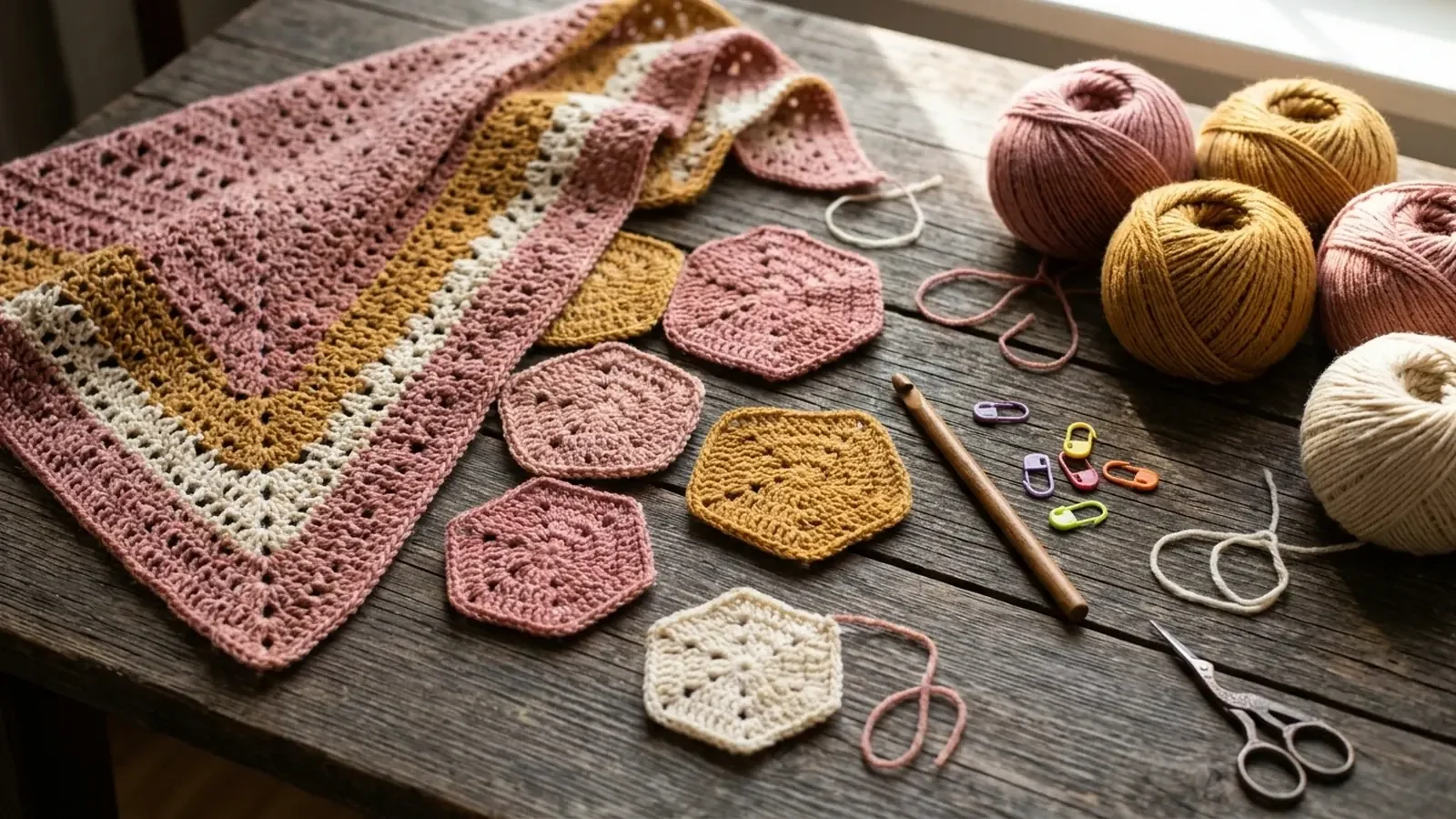
Triangle shawls grow by a fixed number of stitches each row, and flat polygons by a fixed number each round. This calculator works out the rows, last-row count and total stitches for a shawl, checks that your stitches will give it a good shape, or works out the increases and dimensions for a flat hexagon, pentagon or octagon.
How to use the calculator
- Choose a top-down triangle shawl, a sideways (asymmetric) shawl or a flat polygon.
- Enter the wingspan for a shawl, or the width from one flat side to the opposite side for a polygon.
- For a shawl, enter the stitches in the first row.
- Enter your stitch and row gauge over 4 in (10 cm).
How the calculator works
Top-down triangle shawl. Each row adds 4 stitches: 1 at each outer edge and 2 at the centre spine. The top edge is made of the ends of the rows, so the rows come from the row gauge: the centre depth is half the wingspan, and
Rows = (wingspan ÷ 2) × row gauge
Last row = first row + 4 × (rows − 1)
Each lower edge is half of the last row, so its length comes from the stitch gauge: lower edge = (last row ÷ 2) ÷ stitch gauge. For a right-angled triangle each lower edge should be the depth × √2. If your stitches make it more than 10% shorter or longer, the calculator warns you and suggests what to change.
Sideways shawl. One stitch is added at the same edge every row, so rows = wingspan × row gauge, and the depth at the widest end comes from the last row and your stitch gauge.
Flat polygon. A flat shape with p sides needs about
Increases per round = 2 × p × tan(180° ÷ p) × (stitch gauge ÷ row gauge)
rounded to a multiple of p, so every corner gets the same. Corner to corner is the flat width ÷ cos(180° ÷ p), and each side is the flat width × tan(180° ÷ p).
Reading your results
- Shawls: rows, stitches in the last row, stitches in the whole shawl, the centre depth and the length of each lower edge, with a shaping line to follow.
- Polygons: rounds, increases each round and per corner, corner-to-corner width and the length of each side.
Worked examples
- Top-down shawl: a 60 in wingspan with 4 stitches in the first row, at 12 stitches and 8 rows per 4 in. The depth is 30 in, so 30 × 2 = 60 rows; the last row has 4 + 4 × 59 = 240 stitches, and the shawl 7,320 in all. Each lower edge is 120 ÷ 3 = 40 in; a right angle would need 42.4 in, within 10%, so blocking will open it to shape.
- Sideways shawl: the same wingspan and gauge give 120 rows, with 123 stitches in the last row and a depth of 41 in at the widest end.
- Hexagon: 10 in from flat side to flat side, at 12 stitches and 8 rows per 4 in. The ideal is 10.4 increases a round, rounded to 12 (2 at each corner); 10 rounds; 11.55 in from corner to corner, with 5.77 in sides.
Accuracy and limits
- The arithmetic is exact and covered by our automated tests. How well the shape lies flat depends on your tension and blocking.
- Wet-blocking usually opens a triangle shawl up; later rows are much longer, so most of the yarn goes into the last third.
- A hexagon cardigan is not a flat hexagon: it uses square corners so the extra fabric folds into sleeves. Follow that pattern's own increases.
- Polygons here have 5, 6 or 8 sides.
Common mistakes
- Measuring the depth as the wingspan. In a top-down triangle the depth is only half the wingspan.
- A tight top edge. The top edge is made of row ends; if it pulls in, work the first and last stitch of each row a little looser, or add a few chains at each edge.
- Increasing in the same place in every round of a polygon. Keep the increases at the corners; that is what makes the points.
Tips for more accurate results
- Swatch in the shawl's stitch and block the swatch, since the shape check relies on your blocked gauge.
- If the calculator warns that your lower edges are short, a taller stitch or a looser hook helps; if they are long, a shorter stitch or a smaller hook.
- To plan yarn, weigh a swatch and use the yarn yardage calculator with the shawl's area (wingspan × depth ÷ 2).
Frequently asked questions
How many stitches does a top-down triangle shawl add each row?
Four: one at each outer edge and two at the centre spine.
Why does the stitch gauge matter for a triangle shawl?
The rows set the top edge, but the stitches set the lower edges. If your stitches are much wider or narrower than your rows suit, the point comes out too shallow or the edges ruffle. The calculator checks this for you.
How many increases does a flat hexagon need?
It depends on your stitch shape: about 2 × 6 × tan(30°) × your stitch gauge ÷ row gauge. For square single crochet stitches that is about 7, rounded to 6 or 12 so all corners match.
Why can't pentagons or octagons tile a blanket on their own?
Their corners do not meet neatly around a point: octagons leave square gaps, and pentagons leave gaps of no regular shape. Hexagons tile on their own; octagons tile with small squares.
How far is a hexagon from corner to corner?
The flat-to-flat width ÷ cos(30°), about 1.155 times it. A 10 in hexagon is 11.55 in from corner to corner.
More shapes and amigurumi calculators
All calculatorsAmigurumi proportion and safety eye calculator
Plan head, body and leg sizes for chibi, kawaii or doll proportions, plus eye size and placement, with safety guidance for young children.Open the calculatorAmigurumi size calculator
Predict a toy's new height, yarn and stuffing when you change yarn and hook, or scale a pattern up or down.Open the calculatorAmigurumi sphere calculator
Round-by-round instructions for a crochet ball of any size: the classic +6 pattern or a rounder version that follows a true sphere.Open the calculator


Questions about this calculator
No comments yet
Sign in or create a free account to comment under your profile and keep track of your replies.
Your email address is never published. Comments are moderated under our Community Guidelines; see our Privacy Policy for how we use your details.