Calculators · Garments and accessories
Crochet armhole and neckline calculator
Shape set-in armholes and V, scoop or square necklines on a front panel so the shoulders come out the width you want.
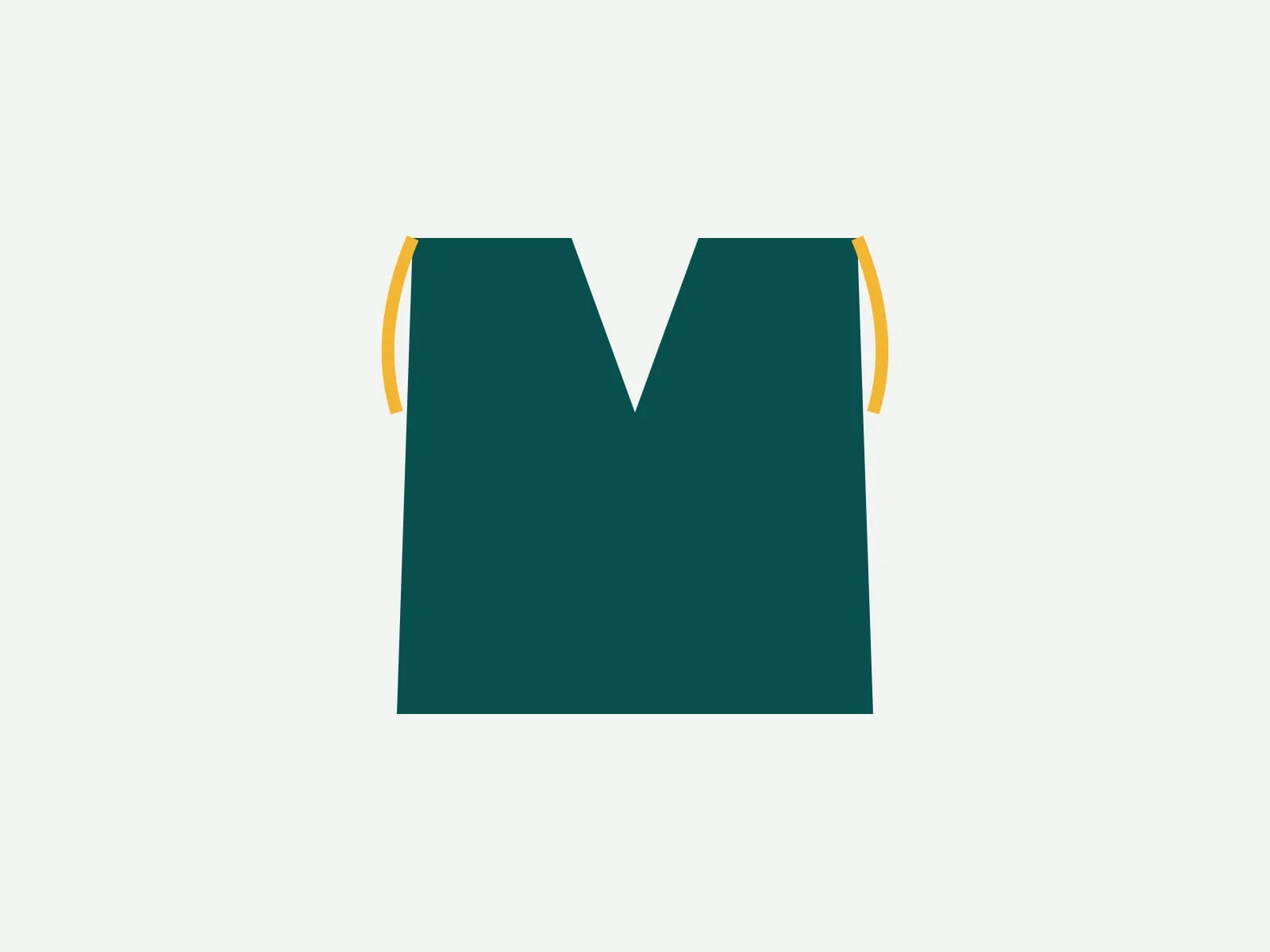
A fitted front panel narrows at the armholes and opens at the neck, ending with two shoulder straps. This calculator works out the stitches to leave unworked and to decrease at each armhole, the neck shaping for a V, scoop or square neck, and the stitches left for each shoulder.
How to use the calculator
- Enter the panel width at the chest, the width across the shoulders (armhole to armhole), the neck opening, the armhole depth and the neckline depth.
- Choose the neckline: V, scoop or square.
- Enter your stitch and row gauge.
- Follow the shaping lines from the start of the armhole.
How the calculator works
Each armhole removes half the difference between the panel and the shoulder width:
Stitches removed at each armhole = (panel width − shoulder width) ÷ 2 × stitch gauge
Following common drafting proportions, about half of those are left unworked at the start of the armhole and the rest are decreased one at a time over the first third of the armhole depth.
Each shoulder = (shoulder width − neck width) ÷ 2 × stitch gauge
The neck starts the neckline depth below the top of the armhole:
- V-neck: the panel is divided in half, and each side decreases to the shoulder count over the neckline depth.
- Scoop: about half the neck stitches are left unworked in the centre, and the rest are decreased early on each side, then the shoulders are worked straight.
- Square: all the neck stitches are left unworked, and the shoulders go straight up.
Reading your results
- Removed at each armhole: with how many are left unworked and how many decreased.
- Neck stitches: and how many are decreased each side.
- Each shoulder: in stitches and width.
- Shaping: the armhole, neck and shoulder instructions, with the stitch count after each step.
Worked example
A 20 in front panel at 4 stitches and 4 rows per inch (80 stitches), narrowing to 15 in across the shoulders, with an 8 in neck, an 8 in armhole and a 5 in V-neck:
- Each armhole: (20 − 15) ÷ 2 × 4 = 10 stitches: 5 left unworked, then 5 decreased over the first third of the armhole. 60 stitches remain.
- Each shoulder: (15 − 8) ÷ 2 × 4 = 14 stitches, so the neck is 60 − 28 = 32 stitches.
- V-neck: 12 rows above the start of the armhole, divide into two halves of 30 stitches. Each side decreases 16 stitches at the neck edge over 20 rows: every row 12 times and every 2nd row 4 times, ending with 14 stitches per shoulder.
Accuracy and limits
- The counts are exact and covered by our automated tests. The proportions (half the armhole stitches left unworked, the rest over a third of the depth) are standard drafting choices, not rules; check them against your pattern and body.
- Armhole and neck shaping often happen on the same rows: shape both edges together without double-counting.
- If the neck is very shallow, the neck edge may need more than one decrease on some rows; the calculator says so.
- Drop-shoulder garments skip armhole shaping: the armhole goes straight up.
Common mistakes
- Shaping the back like the front. The back usually has a much shallower neck; enter it separately.
- Measuring the shoulders over your clothes' seams. Measure from shoulder point to shoulder point, where the armhole seam should sit.
- Forgetting the turning chain at the shaped edge. Decrease one stitch in from the edge so the seam edge stays neat.
Tips for more accurate results
- Get the panel width from the garment ease calculator.
- Use the sleeve taper calculator for the sleeve that fits this armhole.
- Pin the panel to a garment you like before working the neck, to check the depth.
Frequently asked questions
How many stitches do I bind off for a set-in armhole?
About half of the stitches removed at each armhole, left unworked or slip-stitched across at the start; the rest are decreased gradually. The calculator gives both numbers.
How deep should a V-neck be?
It depends on the style: a shallow V might be 3 to 4 in, a deep one 8 in or more. Enter the depth you want and the calculator spreads the decreases.
What is the difference between a scoop and a square neck?
A square neck leaves all the neck stitches unworked at once, giving straight edges. A scoop leaves about half in the centre and decreases the rest gradually, giving a curve.
Do I shape the armhole and neck at the same time?
Often, yes, when the neck starts before the armhole shaping ends. Work both edges on the same rows, following each instruction.
Do drop-shoulder sweaters need armhole shaping?
No. In a drop-shoulder garment the armhole goes straight up and the sleeve is sewn to the straight edge.
More garments and accessories calculators
All calculatorsCrochet garment ease calculator
Turn a body measurement and ease into a finished chest and panel stitch counts for pullovers and cardigans, including button band overlap.Open the calculatorCrochet hat size calculator
Size a top-down crochet hat from a head measurement: finished size, crown diameter, stitches, and every round including a partial last increase round.Open the calculatorCrochet pattern grading calculator
Grade a garment panel across nine sizes from XS to 5XL, fitted to the stitch repeat, with pattern-ready bracket notation.Open the calculator


Questions about this calculator
No comments yet
Sign in or create a free account to comment under your profile and keep track of your replies.
Your email address is never published. Comments are moderated under our Community Guidelines; see our Privacy Policy for how we use your details.